 |
 |
|
|
|
||
|
BigHook2001
September 5-7, 2001 Woods Hole, Massachusetts |
BigHook
Home | 2001 Collage | Context
| Scribegallery
Wed Midday-a | Wed-Midday-b | Wed Eve Thu Morn-a | Thu Morn-b | Thu Midday | Thu Eve | Fri Morn |
The
Boundaries
|
|
|
||
Session 1a: What boundaries? What network?
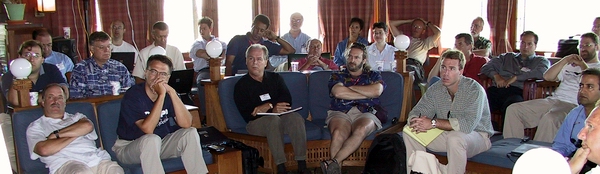
Getting started . . .
Wednesday, September 5, 2001
David Isenberg:
Our task over the next three days is going to be to make the ideas rise
to the level of the weather, the music, the food, the architecture, and
the accomplishments of the people in the room. 
Let us look around and see who we are with. I think we are a bunch of
extraordinary people. I would like to welcome you to my hometown, Woods
Hole. I grew up here. It is an extraordinary place with a greater density
of Noble Prize winners than probably any place on earth including Cambridge,
Massachusetts.
Man: Stockholm
Isenberg: Stockholm has a very large concentration of Woods Holers
about once a year.
Now why are we here? Well, we have been talking about the intelligence
moving to the edge of the network for about at least 4 years. Decades
longer, if you're David Reed. Last year we spent an awful lot of time
talking about the middle of the network, about stuff that goes on in the
core of the network, core routers, fiber miles, whether the traffic in
the core is increasing, and so on. Dewayne Hendricks and a few others
of us thought that we didn’t spend enough time talking about the
edge of the network. Since the middle of the network is in fact becoming
stupid, becoming commoditized, becoming boring transport, the real action
is at the edge of the network. The real action is in the access network,
the metro area network, the computers, the terminals that terminate the
Internet protocol and host the applications and store the data -- and
the people that use these terminals.
My interest really is how the people at the edge of the network interact
with the network, how their lives are changed by it, in good and not necessarily
good ways.
It occurred to me that edge is probably not the right metaphor. Edge implies
a sharp boundary, a discontinuity and kind of a passive process. You are
either on one side of an edge or the other.
The question ramifies the more you think about it. There are the characteristics
of the edge that users interact with and then there are the characteristics
of the edge that application service providers interact with. Then there
are edges within edges within edges. The metaphor is that of a cell membrane
where the membrane actually defines the cell as much as the nucleus or
the mitochondria or the cytoplasm. 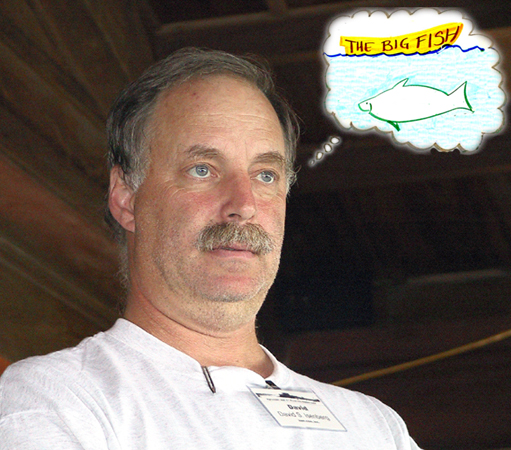
Tom Freeburg:
There are two sets of interactions that we should consider. One is the
interaction of the users with the network and the other is the interaction
of the users with the information on the other side of the network. As
far as the information is concerned the job of the network to be totally
transparent. The network is there to connect the user with the information,
period full stop. Isenberg: I’m in complete agreement. But let us
take a microscopic view of the edge. I’m with you that the edge should
be transparent to information and that the middle should be really stupid.
But if you zoom in on that edge you will see that there is all kinds of
machinery in there that allow that transparency to work. You have a computer
with an operating system. The operating system has active processes. Around
that you have a business and a business has active processes. When you
look at edge processes under a microscope there is a lot of interesting
stuff going which I would like to examine over the next 3 days.
Adina Levin: Does it help to say we are looking at the network
as a collection of nodes and it doesn’t matter whether they are popular
nodes or less popular nodes?
Freeburg: But there is fabric in between the nodes too that one
needs to be concerned about. The forest isn't just the trees.
Isenberg: Let me do a little bit more process here before we jump
into substance and I’m not really a process guy so forgive me. One
thing that I forgot to talk about is this wireless network that we have
here. Andy Maffei is another Woods Hole guy, but also a genuine part of
the networking community. Andy could you please introduce yourself and
spend about 3 minutes talking about what you’ve put together and
how it works.
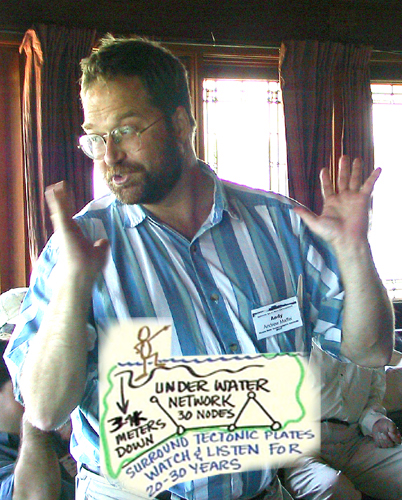 Maffei:
. . . and how it is torturing certain members of the audience. (laughter)
I’m Andy Maffei and I work with the Woods Hole Oceanographic Institution.
I built the network here. Tom Freeburg provided the Motorola equipment
running a point to point wireless link from a bedroom upstairs to one
of the Woods Hole Oceanographic buildings.
Maffei:
. . . and how it is torturing certain members of the audience. (laughter)
I’m Andy Maffei and I work with the Woods Hole Oceanographic Institution.
I built the network here. Tom Freeburg provided the Motorola equipment
running a point to point wireless link from a bedroom upstairs to one
of the Woods Hole Oceanographic buildings.
Isenberg: About a third of a mile away, with 99-point-something
percent accuracy.
Man: Is that how we are getting bandwidth?
Andy: You are getting
bandwidth from [the WHOI] campus network. We have 5 or 6 T-1s. From the
window we run a wire down to this wireless access node here. Yesterday
we brought it in and my PC ran fine, Dave’s came up and ran fine.
There is information up on the board on how to set up your PC, and I would
be glad to sit down with you and try to help. We have had some problems
with the Linksys cards but I think the infrastructure itself is working
fine. It is a matter of getting the PCs to talk to the cards.
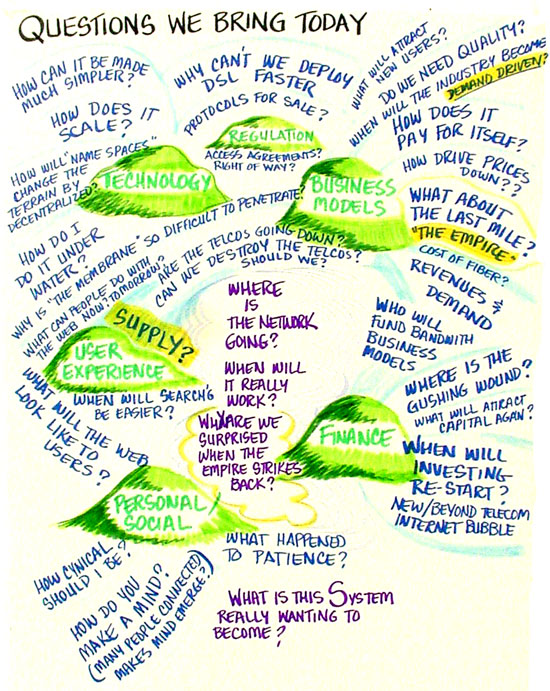
Introductions -- and Big Questions
Isenberg:
Let's go around the room and do a brief introduction, but also to tell
us the one question that has been bugging them about this business.
 Scott Bradner, Harvard University, IETF, Miscellaneous geek. Question:
Can we make this stuff pay for itself.
Scott Bradner, Harvard University, IETF, Miscellaneous geek. Question:
Can we make this stuff pay for itself.
David Reed,
no affiliation other than reed.com, or maybe lots of affiliations, the
question for me is always, does it scale? Lately, does wireless scale?
Bob Berger, UltraDevices -- we make wireless equipment. My concern
right now is that we are in the Empire Strikes Back phase and I’m
really concerned that the bad guys -- the incumbents -- have grabbed the
last mile and they're using it as a choke point to make everything else
not happen.
I’m Bob Lucky.
I’m with Telecordia. (Man: Part of the Empire.) My one question:
I really don’t understand what limits the rate that
we can put out DSL? Why can’t we do it faster?
I'm Raj Sandhu, a private investor. I used to work at Soros Financial
Management. My question is the same as Scott’s so I’ll ask another
related question: when will we see demand and revenue get reinvigorated?
I’m Porter Stansberry, I’m a newsletter writer and my
question is financial: how will the market pay for the trillions that
have been lost and when will people begin investing again?
I’m Tim Denton. I’m a lawyer. I work on domain name issues
for Tucows which is a big domain name wholesaler. I’m going to save
my question for later.
I’m Steve Mattioli. I’m with YottaYotta and my question
is how are we going to drive the price of network utilization down so
that it can be used?
I am Anders
Comstedt. I run a dark fiber operation in Stockholm for all the Nobel
Prize winners. I have been doing this now for 6 years and during all those
years people have asked questions about how we are going to transform
the last mile and the question is still valid, I think.
I’m Frank Robles. I’m with Oakstone Ventures. My question
is about fighting back against the dark forces as in The Jedi Strikes
Back. I don’t think that the last mile [bottleneck] has been broken,
so I’m still going to try to solve that question, how to create the
last mile?
Richard Prytula from Technocap. Last year we did massive scalability
stuff, this year who cares? My question is, where is the gushing neck
wound again?
Dewayne Hendricks of the Dandin Group, in the San Francisco Bay
Area. I’ve got too many questions and no answers. That is my problem.
I will just put one out. We had a train ride and I don’t think that
it is over yet. I don’t really know where we are going anymore.
 Tim
Horan, I’m a Communications Services Analyst at CIBC in New York.
My question is related to last year's topic: Is the network really getting
done? What is really getting commoditized?
Tim
Horan, I’m a Communications Services Analyst at CIBC in New York.
My question is related to last year's topic: Is the network really getting
done? What is really getting commoditized?
Do we really need quality of service? Is quality improving or not? There
are a lot of companies seeking to control the Internet in certain ways
to benefit themselves -- how is that related to this topic?
My name is
Victor Blake. I’m better known as Victor Parente, the former
manger of network architecture at America On Line. I’ve been trained
as a computer engineer and became a teacher after that. Right now I’m
learning how to build bridges, studying for my Master’s in Civil
Engineering. My question is, whatever happened to patience?
I’m Andy Maffei with the Woods Hole Oceanographic Institution.
I have a lot of questions but the one that is most on my mind is how do
I do this all under water?
I’m Steve Kamman. I’m cover Telecom equipment at CIBC.
I used to work with Tim, he got rid of me which was a good thing. Serious
question: How cynical should I be? There were high hopes for radio, there
were high hopes for television, and how they were going to change the
world. How cynical should you be about what [the Internet] actually ends
up being? Radio basically creates pop music for kids and not a lot else.
That is not what they first thought it was going to do. There is a part
of me that worries that 20 years from now we are going to have a great
mode of delivery for pornography and not a lot else.
My name is Dave Curry. I’m with Worldwide Packets. In a former
life, a chapter closed last summer when I sold my OSS business to Nortel.
I now am running Worldwide Packets. My question is, it is pretty clear
the service providers that we have come to love and hate are not going
to rebuild the last mile. WWP is counting on somebody else to build it.
In this country we are counting on municipalities and utilities to build
out the last mile. I would like to understand better from this group how
we can accelerate that? And whether we can rely on our government friends
or just exactly how are we going to make it happen? Somebody has to build
it. This can’t be as good as it gets, DSL not withstanding.
Napier Collyns. I spent most of my life at Royal Dutch Shell. When
I retired I decided to help start a network with people of Global Business
Network and my main question is, when is this network actually going to
work?
My name is Peter Cochrane. Until recently I was Chief Technologist
for the British Telecom. I was part of an Evil Empire. The reason I left
was they wouldn’t listen. The kind of questions I have been asking
is, can we destroy the Telcos? And would it be a good idea? What would
we replace them with because we don’t have any technology right now
that will replace them. There is no technology that can do everything
on a single pipe. There is technology that can reduce costs. My question
is, how the heck do we get enough brain cells and enough human beings
on this planet pointing in the right direction to invoke change?
My name is David Hoffstatter. I founded a company about 3 years
ago, that is either a CLEC or a dot.com. The good news is that we are
still in business. I tend to be an optimist. I have a great curiosity
as to the timing in which the patient will start to recover from an investment
and a capital markets perspective. I think we do need to have patience
with respect to the last mile. My business is very agnostic to whether
we have broadband in the last mile. It is customer funded, and change
is funded by revenue. If you have a business that isn’t as dependent
on some of the promises of the telecom Internet bubble and is revenue
funded maybe we will see a new type of solution emerging.
I’m David Weinberger. I’m a regular guy and I’m
interested in what the web, the net, is going to look like to users over
the course of the next generation and where we are in the process of figuring
that out?
I’m Malcolm Laws, based in London for Advanstar, a U.S. media
company, running their telecoms media worldwide. I am particularly interested
in the question: are we seeing the telcos carriage industry disintegrating?
And what will happen after that if that is the case? The other question
is am I going to catch my first fish?
Clay: Clay Shirky, no affiliation other than shirky.com or lots
of affiliations. I think a lot about peer to peer and the thing that has
interested me most is seeing the way that the Napster and ICQ have decentralized
name space creation in the same way that PC’s decentralized computation
away from the main frames 20 years ago. What I wonder is, what can we
learn from the fact that these new name spaces, which violate everything
engineers know about name spaces (they are non hierarchical, they are
flat, they are not well characterized) have incredibly superior growth
characteristics to DNS. It is somewhat analogous to the explosion of the
.alt hierarchy in usenet (among other examples of loss or control leading
to better growth). How do we characterize the difference between these
decentralized name spaces and systems like DNS?
I’m Matt Oristano. I built a high-speed wireless ISP called
SpeedChoice and sold it to Sprint. My question is, why is it that the
membrane seems to feel more and more like it is made of barbed wire?
I am Marc Balevi.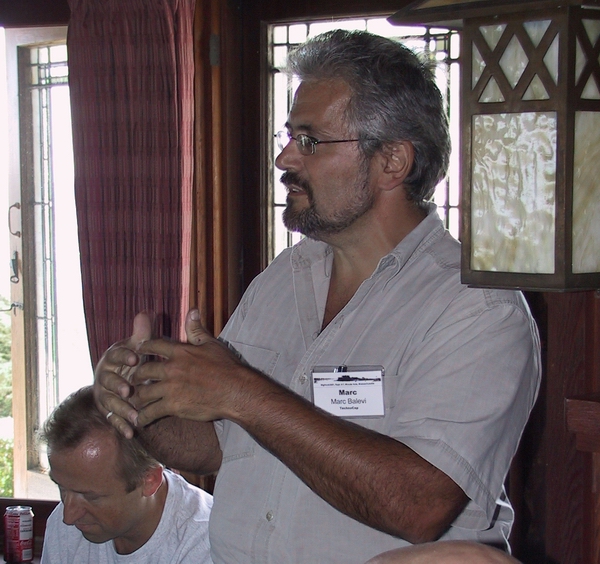 I’m a partner of Technocap, the venture fund. I represent the user
of the network that you are all creating. My
question is, when will you create something that makes an hour transparent?
'Cause it is clearly not in my point of view.
I’m a partner of Technocap, the venture fund. I represent the user
of the network that you are all creating. My
question is, when will you create something that makes an hour transparent?
'Cause it is clearly not in my point of view.
I’m Jerry Michalski, I [am a] newsletter writer. I used to write
Esther Dyson's 'Release 1.0. I'm traveling now. In the Spring/Summer of
next year, I’ll be a published author. And my question right this
instant is why doesn’t this shit work? And my real question is, how
much of this can be done for free or cheap? How much of this can be done
by volunteers on toaster-nets, in ways that are practical and actually
get the job done, and become an integral part of the infrastructure that
we take for granted, like the air and the water and all that good stuff?
My name is Peter Ekelund, an investor from Stockholm in Sweden.
I have been a serial entrepreneur most of my life. I recently founded
a fiber-to-the-home operator in Sweden called B2, which already passed
50,000 customers. My big observation of this industry the 2 years that
I’ve worked in it is when will this industry become demand driven
rather than supply driven?
John Roese with Enterasys Networks. It came to me, when will we
figure out how to make one user identity available in a global heterogeneous
network?
Man: Do we want to?
Roese: Yes.
Man: Is the next step an Intelligent Network?
Jonathan Thatcher, I’m with Dave [Curry] and work at Worldwide
Packets. I am also chair of the 10-gig Ethernet committee, which I think
is why I’m here. My question is when will the web be useful again?
When I started using it a long, long time ago the whole idea of the HTML
and how it was basically a construct that was organized and you could
actually go find things. I can’t find things anymore. When I want
to go look and search for things the best that I get are advertisements
back. If I’m lucky an advertisement may take me to a site that has
something that is actually useful. To a large degree the web is pretty
useless to me other than doing email.
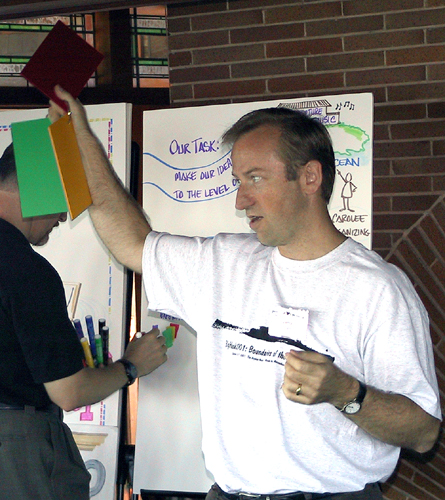
Isenberg: Jon, you have got 3 red cards and 1 green card up. Does
somebody with a red card want to say why?
 Man:
I use Goggle and it is amazing, absolutely amazing!
Man:
I use Goggle and it is amazing, absolutely amazing!
Thatcher: But you have to admit it has become more difficult.
Isenberg: And easier.
Man: I notice I don’t read a lot with hyperlinks in the text
anymore. Remember when the text was all suppose to be hyperlinked and
you were supposed to be bouncing around, there was supposed to be one
continuous seamless document? I’m realizing that I’m reading
a lot of newspaper articles and there's no hyperlinks left.
Man: If you get half way through a sentence and are gone, and half
way through a sentence and are gone, you never complete anything. At the
web shops that I ran, we used to design sites with embedded hyperlinks
all the time [but] we moved to off-loading links to improve usability.
Man: It is a really interesting thing because there is a span of
lack of control. You are describing a paradigm where you as the writer
want to control your reader cause you don’t like them going off the
line. It is a very interesting paradigm cause that is what I think is
driving this, want to control the eyeballs.
Isenberg: One minute let’s keep going around. Let us come
back to it.
My name is Mark Petrovic. I work at Earthlink, an ISP. I have found
myself wondering recently whether an assumption that I have made all along
these past number of years about network protocols holds true. I’m
wondering whether the natural state of protocols that are now open would
be proprietary. I am a little concerned about some of the things that
we hold dear and count on to be there.
My name is Larry Lessig. I am a law professor at Stanford. My question
is why are we surprised when the Empire Strikes Back?
I’m Tom Freeburg, Motorola paid my salary but I don’t
feel like I work at all. I actually hold two titles in Motorola now. I
have been chief futurist for a while now, a very fun job. I’m also
Director of a new business operation now -- we set up a thing called Broadband
Wireless Technology Center. I have a strong motivation behind all of this.
It has been my goal for the last 20 years to get rid of all the wires.
The thing I am focusing on now is trying to break the idea of a single
pipe from a single carrier to bring all of the information to your home,
office, etc. I think that the natural situation is going to be 3, or 4,
or 10 different ways that you can get information. They all should be
there. And by the way, there will be 3 or 4 or 10 or 100 different business
models behind those different ways. I’m focusing on finding these
business models right now with this new business and this new product
line at Motorola. I'm trying to figure out who is going to be willing
to put an adequate amount of capital in and enough attention and energy
into the business in an entirely new way, and what their end business
will be.
I’m Eric Best from Morgan Stanley. I do corporate strategy
development and I’m here partly because, actually entirely because
David and I go back some distance into the network. I’m very interested
in the questions related to resurgence of the market, restructuring and
what is the strange attractor that brings capital back. I would like to
hear a discussion about what are the users doing that attracts capital
to do something that users want done?
My name is Catharine Trebnick. I’m an independent consultant.
Formerly I was with Lucent Technologies where I worked with softswitches,
which is a very disruptive technology in the network. We have so many
new technologies and we have been marketing them to the next-gen carriers.
Really my question is with the downturn in the economy, when is the come-back,
who are going to be the purchasers, and what is going to drive the demand
from the end users?
Bradner: Why did you say that the soft switch is a disruptive technology
when it really is an imitation of a 5E?
Trebnick: Well, I would disagree with you whole-heartedly. It is
basically built off of entirely software.
Bradner: I know that but it is meant to be operated by a carrier.
Trebnick: It was disruptive in the sense that a lot of carriers
did not even want to entertain putting in something that didn’t have
a structure of a 5E. You had to sell to the Level 3’s.
Man: So it is at that level that it is disruptive. But at the level
of business model it is actually a mirror image.
Trebnick: It was disruptive in a corporation where the cash cow
was the 5E, and a little 10 million dollar project really sunk the 5E
for a long time.
Isenberg: When you make a telephone call, the 5ESS is the first
switch that a classical circuit switched call hits.
I’m Tim Flynn, I founded a company called Lodgenet. For a
question, I am going to echo the words of those people who want to know
when demand is going to start driving our industry?
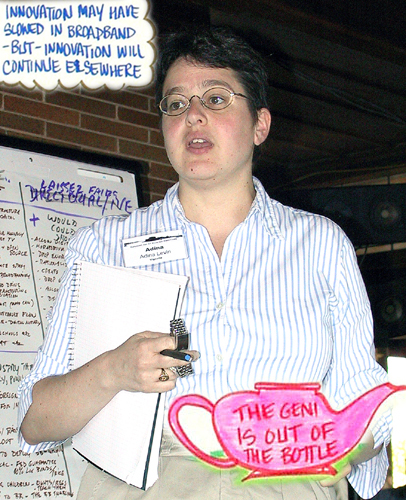
My name is Adina Levin, I work in product strategy at The Vignette
Corporation, which makes web content management software and Internet
application software for large companies. The question I have is, there
is already a network out there, it is not about how we get that, or how
we get pipe fatter? Using the network that we have with emerging standards
for web services, what are the applications for web services going to
be when you have data, information, and people at the edge of the network?
What are the new interesting things that people can do in interacting
with each other in new ways in web service construction?
My name is Peter Kaminski. I’m currently unaffiliated but
most recently I was with Yipes. Those of you who were here last year heard
about Yipes.
Isenberg: Peter and Frank co-founded Yipes, and if anybody tells
you different they are smoking something, and they are making too much
money.
Kaminski: My question comes from a discussion around dinner last
year. I believe that groups of people when they work together create a
brain or a mind and even in a small group like this or larger groups like
a corporation or a stock market or an entire society. Networks facilitate
or speed up that connectivity between people and so my question is how
do you make a mind?
My name is Gigi Wang and I’m with Asia Qwest. I was supposed
to be representing a company called Qalacare and you will hear more about
that later. I have to tell you, I met David at a conference in Singapore
maybe 5 years ago. My question is from the user side. Right now all these
service providers are going out of business. I keep talking to users who
are so upset for losing their service, especially Northpoint customers.
They would be more than happy to pay twice what they were paying to keep
their service. So why can’t we raise the prices and keep those businesses
in business?
Isenberg: Red, green, which one of you wants to go first?
Man: I noticed that half the time AT&T and the other broadband
providers say nobody wants their service but they seem to be able to raise
the price to recover their costs so somebody really wants it a lot. When
the prices go up that means people want it not that they don’t want
it.
Isenberg: Here is an interesting fact. Peter help me out with this.
I learned that in Sweden, if you go into an apartment building that already
has DSL and you offer 10 megabit symmetrical service for about the same
price that 70% switch right away. So anyone who tells you, "Oh DSL
is enough, that everybody is going to be happy with it," they are
wrong.
Man: I’ve had two separate DSL companies go bankrupt out from
under me. Then Northpoint called and said, Oh we are going to move you
to Covad and everything is going to be OK." That is the day that
Covad announced that they were filing Chapter 11. Just raising the user
prices on small volume wouldn’t have been enough. There were bottlenecks
in the system such that, if we had all paid as much as we felt we were
willing to pay, it still wouldn’t have been enough because they couldn’t
roll the service out to make the margins on volume. It is an infrastructure
problem.
Man: That goes to Bob’s question on why they can’t deploy
it faster?
Evil Empire &
Jedi Knights
Man: It seems like everyone’s question goes around in 3 main
issues:
is it supply (is it the Evil Empire)?
is it the demand, killer applications?
is it finance, capital market, [the fact that companies can't find] profitability.
Peter asked a question about, when are we going to create the applications.
In Sweden if you offer the bandwidth, people seem to be buying it. So
that is why I was pretty curious about your question
Man: It is very simple. There are two parts of the equation. I
think it is dead simple. The first one is you have to build the new network.
It is not only playing around with all different types of technology because
there are all different ways to do it. You have to do it in a very productive
way. We have come into another environment and now it is kind of different.
Isenberg: Frank has an answer, not just a question.
Robles: I have a theorem. I think there is a cultural problem.
People don’t want to work each other’s businesses. I was in
the middle of all of this stuff. Maybe the guy in charge of sales won’t
get comped or his sales force won’t get comped. Maybe the person
in charge of the customer support group doesn’t want to take on the
burden of teaching all the new people. There are huge political issues
inside some of these companies. That is why some of them are falling by
the wayside.
Freeburg: Why in the world do we think that there is one answer
to any of these questions? I think that the web has already proven that
there are many, many, many answers. OK not all of them are going to be
workable and win but a lot of them are going to work and win. There is
not one auto manufacturer, there is not one transportation network left,
for heaven sake there isn’t even a single currency scheme.
Kamman: There is defiantly a lot of cultural resistance but more
fundamental is economics. I have a taxi, I have no incentive to ever replace
that cab, I just run the thing into the ground. The point is that if I
buy a new cab nobody is going to hale my cab verses the next cab. So the
reason I put in DSL, the reason I spent $500 to $1000 CapEx on DSL rather
than spending 3-$5000 CapEx on brand new fibers alone. I don’t want
to replace that cooper asset because it doesn’t actually deliver
that much more revenue, it just keeps me in business. The fundamental
question is in some ways is, how do we tip these guys over the edge?
Now another other thought on Sweden: some like 70% of the Swedes live
in apartment buildings. This is not true in the US. Maybe our infrastructure
[is not conducive]. Maybe we got shamed into it when the Koreans and the
Germans and the Swedes and the Canadians got broadband., The point is
no one wants to replace that 30 year asset out there because no one is
paying for it.
Trebnick: Back to the original question, why are the DSL companies
going out of business? And one of the big reasons is this. Catherine Hapka,
who was CEO of Rhythms, who left when they went bankrupt and I have had
many discussions on this. She had such a hard time negotiating carrier
agreements and doing the provisioning and clipping. I want to bring in
the regulatory aspects that they have and the hold they have on any next
gen telco.
Isenberg: Back to the Evil Empire theme again.
Man: There is definitely a cultural issue but I think you are over
rating it a bit. It is really funny how all the old people from AT&T
went out and ran entrepreneurial companies and suddenly became entrepreneurs.
Lucky: But you know, the question I’ve asked a number of friends
in the telecos and stuff is, do you really, really want to do DSL? I’ve
asked Joe (???) who ran the program for Verizon. I said you loose money
on every DSL line, right? His answer was two words: "Big time! We
loose money -- big time -- on every DSL line."
Isenberg: And why do they want to do it?
Lucky: I’ll tell you why. A couple of people from other companies
told me the one reason we really want to roll out DSL is because the analysts
are counting the number of lines that we have. That is the motivation
to do it.
Isenberg: Isn't the second reason that it is worth taking the loss
to keep from having to do fiber? Because once they do fiber there is so
much abundance out there that I could be a telco.
Man: I think the bottom line really is that it is an economic story.
They are driven by different economics and you look at their economics
and they have their solution to it.
David Reed: I don’t normally show my paranoid side but here
is my deep paranoid side just to bring in one slightly different aspect
of economics. There is a form of economics called regulatory economics,
which is the books you show to the government. They are used in a lot
of interesting ways. You cannot trust what companies say in a very fundamental
way in big parts of the telecom industry. They are incented for not telling
the truth. So here is my example: If you drive Route 128 outside Boston
in this place where it is not economic to put new fiber, you will find
trenches all over the place and wads of fiber this thick around going
in. Now interesting question: there is nobody around here that will lay
claim to doing it. In fact they do it with trucks that are unmarked. So
this is my paranoid thought: people do recognize there is an economic
question, and their incentive is not to tell people what they are doing
until they can win the whole game. This plays out in Telecom all the time.
You go for the whole game and until then you don’t let on what you
are doing.
Peter Ekelund: I’ve only done about 10 projects in 10 cities
calculating the costs and performance, all across Europe and I've actually
done 2 projects here in America as well. [inaudible] We may announce this
in one particular big city in middle Europe, about 400,000 people and
the average price for the fiber for the building, about 25 apartments,
is about $400 for getting a 100 Mbps connection for fiber to the home.
Here it is about $700. The difference in the United States compared to
Canada and compared to Europe and compared to Asia is the cost to right
of way. You want to remember what is the cost. Let’s say you could
put in 10 megabits with ADSL, or VDSL, but the cost of doing that is =
10 times higher than with fiber. People need to realize that they are
investing money in what is long-term productive.
Isenberg: Scott has more data.
Bradner: Fortune magazine last year reported that the average cost
of installing ADSL to a new installation with existing cooper, not new
cooper was $1,400. The average cost of installing new fiber was $1,5000.
That is in the US.
Curry: Just an observation. We are in this business. We have communities
like Peter has in Europe. We have communities up and running delivering
voice, data and video over fiber access networks in the United States
now. We have 2 communities of 40,000 inhabitants who will be announcing
within the next 60 days of complete conversion and complete fiber overbuild
over the existing incumbents networks, voice and video networks. This
works. The economics of it works. We are delivering those services over
those networks. The ironic thing is that despite the incumbent’s
complaints (and I know George (???) from trying to sell him OSS systems)
despite their complaints about how extensive it is and how they’d
rather not be in the business, Verizon, for example, spends hundreds of
millions of dollars trying to prevent communities who have an appetite
to do this, trying to prevent them from doing it, simply by lobbying (???)
disturbances, in parts of this country. They absolutely refuse to allow
the communities to finance it themselves. They will not ever, ever deliver
services to those communities.
Isenberg:
We have now 3 questions, at least 3 questions, can we save the questions
fast just to see if they are the same question or not.
Laws: This is, I believe more about power than it is about economics,
not that they are not connected. It is about incumbents wanting to keep
in place. If you put fiber in as an incumbent it is a lot easier to open
that up to third parties to use bandwidth than it is with cooper.
Man: Tom’s point was we can have lots of different things
coming into the house. The question is, if you have fiber coming into
the house, what else would you need? You don’t have a lot of electricity
wires coming into the house.
Man: Watch this space over the next 10 years.
Isenberg: You have a question, though?
Freeburg: Why are we focusing on incumbents? I believe the future
of communications to the home is in the direction of all sorts of new
folks getting in there. We have to find ways. Second and I want to introduce
you guys to what I call Freeburg’s Law, OK? I submit for roughly
the same general network topology the electronics to make a connection
cost the same whatever the medium is. [It can be] fiber, in place wire,
(by the way, the in place wire can cause you a hell of a lot more grief,
a lot more grief then putting in a new wire), new wire, or by the way,
wireless. I just came across using the web, I submit a interesting fact
-- in Germany today there are more Internet users than there are telephones.
Isenberg: Even fixed and mobile, both?
Freeburg: Yeah!
Isenberg: OK, Wow! Clay has been patiently waiting, Clay do your
thing.
Shirky: I just wanted to quickly inject a note of historical pessimism
into the incumbent conversation. I’m reading Janet Abbate's wonderful,
"Inventing the Internet." In 1963 the Prime Minister of England
suggested that it was imperative that the UK not fall behind the US in
computer networking. It agreed to fund a notion for packets switched networking
based on Baran and Davies' work. It was crushed by British Telecom. So
this is not recent . . .
Man: Nonetheless the railroads and streetcars industry tried like
hell to crush the nation's automotive industry in this country.
Shirky: When you look at the automotive industry they found a way
to sell a product directly to end user that they can use without having
to be part of another network.
Man: And they were in Federal Circuit Court buying local rail companies
just to shut them down.
Man: Who framed Roger Rabbit?
Blake: And you can make analogies about the telecom industry doing
the same thing. While I have the floor, I just wanted to say the right
of way thing is a big problem. It was granted [to AT&T, but] they
never actually paid for that asset. I am a property owner. I have a 2600
foot easement across my property by Verizon. I know that 3 owners ago
under the name of Pacific Telephone Co., they gladly paid that off for
a dollar, which means that it was granted by right of eminent domain.
Those issues need to be worked out to be able to allow a new infrastructure.
Who does that really belong to? Verizon? Or does it belong to the public
cause it was granted to the public?
Isenberg: Eric has a question.
Best: This is from something that I heard last week at another
meeting from Russell Eakoff(?) talking about systems. Systems can't be
understood by analyzing [their] component parts. If we were talking about
this as a system, what is the system mostly about? Does it have any sort
of biologic properties of wanting to evolve or survive? What is it’s
desire, this system? What is it trying to become? What is it doing? I
find myself collapsing into these little black holes of cooper versus
fiber in the last mile.
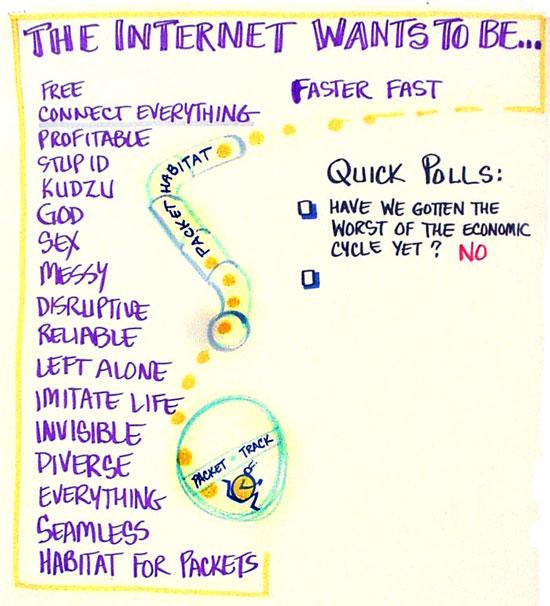
The Internet wants to be . . .
Isenberg: That
is great! I want people to fill in with one word the following sentence,
the Internet wants to be . . .
 |
|
Isenberg: I’m trying to get your question, what does this
system, what is driving the system to be what it is or to be something
different than what it is?
Man: The Evil Empire is [trying to make] something different than
the innovators [intended].
Man: In the US we are all citizens, individuals. The corporations
also have rights that appear to be those of individuals. We wear two different
hats. [We want a lot of bandwidth at home, and we want to make money from
providing bandwidth.]
The Internet wants to be diverse.
It wants to be everything in its opposite.
Reed: Organisms create their own environment. I think that the
Internet wants to be a habitat for packets.
Man: With little packet running wheels . . . and packet trails
. . .
Man: It is our worst hopes and our best fears. Remember, last year
we said, "We want the Internet to be free," and then somebody
said too you want your kids to look up pornography.
Man: I don’t want it to be that free!
Man: Normally the Evil Empire is trying to give us want we want
which is a safe environment.
Levin: By describing what the Internet wants to be I think we are
missing a piece of the metaphor. If we are using an evolutionary metaphor
you have evolution and competition and different actors so we are looking
at the Internet as this competent actor. Then we are saying that there
are corporations with lots of money and lots of political access and ability
to buy the government. And that is a set of actors. Then there are entrepreneurs
and they are another set of actors. So if we want to look at evolution,
we need to look at who are the relevant actors, what are the motives of
the different relevant actors and then what is mostly like to happen if
you tell the story that way.
Ekelund: It wants to be faster (??). I don’t know, probably
all of you have been in negotiations trying to get peering agreements
and realized the policy of many incumbents and how quickly they really
want to get those access points and how they want to accept those rules,
which is just another way for them to control their local access. I think
that the fastest operator should be the one defining the Internet rather
than the other way around. That is a very, very effective way which they
hold out. Let me give
you an example. If I come and offer 10 megabits, people say, "Why
do you need 10 megabit? You only need a maximum of 500K, because that
is how we define the capacity. So ADSL is absolutely max and you don’t
need anything else."
Bradner: That is why IEEE just started a Ethernet in the last mile
[group].
Man: The last mile?
Reed: The first mile.
Man: [Let's get back to] what the Internet wants to be. It seems
to me that it wants to connect everyone to everyone else, and to all the
organizations. It wants to interconnect all people and all organizations.
Man: Sounds like the telephone network!
Man: Yeah, it does, that is what I was thinking. I was wondering
how is it different?
Man: My kids want to talk to their friends. And we want to send
email back and forth to each other. And I want to go to websites and look
what this company or this person at this meeting do. I want to be connected
to all that.
Lessig: So I think that this is really unhelpful way talking because
it makes us think that there is this vibrant, lively thing that is going
to defend itself. There are a lot of real people and companies out there
that really do have wants and they are the people that effect what the
Internet is. This goes back to the Empire Strikes Back. We let the Empire
get so much power and I’m not talking about the obvious Empires.
We really thought that this thing was going take care of itself, that
all censorship would be routed around, and all that bullshit. In fact,
what we are realizing is that the architecture that we had, that was the
brilliance that you guys built, has got to be defended, not by talking
about what it wants but by what *we* want.
Supply, Demand, Finance
Isenberg:
Good! That brings us back to reality. We are going to have a break pretty
soon but Raj had a great idea and Tim Horan put some instantiation around
that idea. Raj wanted me to do a little bit of straw polling to get a
sense of the room about what are the critical issues. And Tim said that
there were 3 themes here. One was supply and demand.
Horan: Supply problem, demand problem, a world finance problem.
Isenberg: OK but there was also an Empire problem, right?
Horan: Well the supply side is that the Evil Empire eliminates
supply.
Man: The demand side is the killer applications that people really
want.
Horan: The finance problem is very complicated. Is the problem
that the capital market have abandoned the Internet? Or is the problem
that the return on invested capital just wasn’t there, and people
have been forward pricing too much. Those are the questions, unless I
left one out.
Isenberg: This is a little bit bogus, but how many people think
that the supply problem is the critical near term stumbling block?
Man: What do you mean by the supply problem?
Man: [He means] the Evil Empire limiting the supply and keeping
pricing too high.
Man: By saying it is an Evil Empire problem, you're saying it is
a supply problem.
Man: Who is it who said that when the Evil Empire strikes back
why should we expect to be anything but evil? If we are looking to identify
the source of the problems, we have to ask ourselves, is this the most
productive way to understand how this moves forward. If you identify the
problem as being behavior of a self-interested corporation preserving
its incumbent position in the market you end up winding yourself around
a whole bunch of protracted solution sense that I don’t think that
we are empowered to really solve.
Horan: There are other issues around the supply side too. Tom has
had a point that new technology is going to solve the problem, which is
also the supply argument that you can make.
Man: There are unique problems in this country. Other countries
“get it”. If this meeting was taking place in Canada, where
I’m from, or in Europe or Asia it might be a completely set of answers
to the questions that you are just asking.
Man: There are parts of Canada that work under Bell Canada.
Man: Oh, I understand! There are two problems. Notwithstanding
that, there is more enlightened legislation, more enlightened Governments
and this country doesn’t seem to understand that.
Horan: But can I answer the question? It seems to me if there was
a compelling killer application out there that people were really willing
to pay dollars for . . .
Man: No, the killer app is connectivity. What was the killer app
for the car? What was the killer app for the telephone? There isn't a
killer app. There wasn’t a killer app for the automobile. It is connectivity
that you get, that is the killer app.
Man: There is no killer app, we already have it.
Shirky: When I think about supply, there is supply of bandwidth
[but then] there is also supply of freedom. You know, what the users can
do with the connectivity they've got is as least as big an issue right
now, having seeing Napster driven down, seeing Packbell drop the alt.binary
groups, and so forth. That is in my mind at least as big an issue: Supply
of freedom at the edge of the network versus supply of high-speed access
to the edge of the network. So I don’t know that supply and demand
in big terms capture [the situation] granularly enough.
Isenberg: Let me try one more straw poll. How many people think
that the economic situation in Telecom tech and networking is going to
get significantly worse before it gets better? How many people think that
were already at the bottom, or turning around and coming back up? The
pessimists win. Among the pessimists, how many people think that the bottom
is 6 months away or less? How many people think that it is a year away?
Man: David, there is another component. This goes back to the infrastructure
question. When were the railroads paid for? They were never paid for.
Will this infrastructure be paid for in the same way they were, in stock
market crashes? We already had the crash. The question is, is the crash
that we had enough?
Isenberg: Is the crash that we had enough yucky medicine?
Man: We have to work through the debt markets yet. You can only
see public equity markets, but in the communication space people don’t
really realize high yield bonds are trading 30 or 40 cents less than a
dollar.
Reed: I have a different way to think about it. We tend to get
sucked into tangibility or what I call 'the hardware fallacy'.
Isenberg: Which is?
Reed: Which is that this business is about the hardware or the
wires or even the spectrum if you think of that as a tangible thing. In
fact the economy of communications, the application level, could be at
its bottom and it may never be the case that a particular round of hardware
recovers. It might move on to a new platform.
Isenberg: Raj, the answer is that these guys will not do a straw
poll. So ladies and gentlemen on that note we are going to take a half
hour break and when you hear the music again come back in.
Page last modified:
November 14, 2001
(return
to top)

|
BigHook
Home | 2001 Collage | Context
| Scribegallery
Wed Midday-a | Wed-Midday-b | Wed Eve Thu Morn-a | Thu Morn-b | Thu Midday | Thu Eve | Fri Morn
|
