|
Session
2: Holy halibut! What happened to the Communications Revolution?
Wednesday evening,
September 5, 2001
David Isenberg:
Roxane, you have five reward-minutes for being right last year. 
Roxane Googin:
Last year I was very politically incorrect in my fairishness. I learned
a lot from this meeting last year. I run a strategy advisory service
for portfolio managers. I've listened with great interest because people
were talking about the core of the Internet. I spoke earlier about the
hourglass [model] and how the best network is one that is totally generic
so that you can't tell one bit from the next. That is the beauty of how
this network works. You can project on to it what you need to do. Also
the network is infinitely extensible, [because] we have DWDM. I walked
out of this conference [in 2000] and told all of my clients to sell every
stock that they owned as fast as they could.
Isenberg: How
come you didn't tell me?
[laughter]
Googin: And
raise cash. The reason for that is . . . a system that behaves like that
is an economic horror show. It is going to repel capital because any
system that is totally generic has no barrier to competitive entry. You
can't differentiate yourself. One that is infinitively extensible means
that you are going to be stuck in a Malthusian swamp, where your cost
of selling will be one inch above the marginal cost of production.
Both of those scenarios
are going to repel capital. I knew that, so the goodness of it on one
hand was a nightmare economically on the other. It is a paradox. And
just like oil, society is going to benefit the most if bandwidth is the
cheapest because then we can project all of this stuff on to it. But
if bandwidth is the cheapest, no one is going to be there to build the
bandwidth. So what I saw happening is that the cat had been let out of
the bag, the genie was out of the bottle, and people were building these
networks and we were headed for this huge train wreck whereby capital
would start pulling away from this industry once they realized that this
was going to happen.
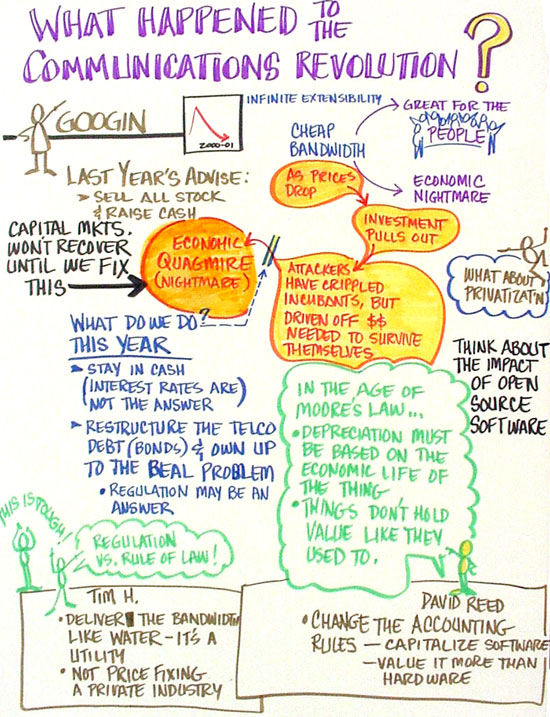 So
the attackers with the new technology were going to starve to death because
they weren't suppose to be cash-flow positive yet, cause they've gotta
build this huge network. As prices come down your network has to be bigger
before you are profitable so it was working against them. So
the attackers with the new technology were going to starve to death because
they weren't suppose to be cash-flow positive yet, cause they've gotta
build this huge network. As prices come down your network has to be bigger
before you are profitable so it was working against them.
And then on the other
side, the incumbents (and I'm going to be a little general here and you
can disagree with me but this is how I see it) are slowing going bankrupt
on their own, some quicker than others, and I'm talking not only the BTs
and the DTs and the FTs and the NTTs and the ATTs and the Worldcoms and
the Global Crossings but the RBOCs too because their SONET-based networks
have a cost of provisioning up here [high].
But even though the
attackers are starving, they are forcing the marginal bandwidth prices
below the RBOCs' cost of provisioning -- not only replacement but provisioning.
So the RBOCs are going to get squeezed because they have this complex
labor intensive infrastructure that is no longer supported by the economic
base. So you have this kind of nightmare scenario where nobody wins and
it is just a big mess because the attackers are going under but they have
crippled the incumbents.
What we are witnessing
is the perfectly predictable outcome which is no equipment sales, and
no more progress. No one planned this, but it is too late to turn back.
The other problem
is the phone companies don't own their gear -- it is leveraged. That is,
they bought it forward in time. These guys have 20/30 years bonds outstanding
against their SONET gear, because this was never suppose to happen.
We are looking at
the worlds largest single businesses, I think. (I don't know if they
oil business or car businesses is bigger, but it is one of the three.)
The business has been rendered economically dead because of a real important
piece of progress that has come out that acted differently than anyone
planned.
Those 30 year bonds
that were funded on the continued operation of this SONET gear will never
be paid back. Those insurance companies, those orphans owning those bonds,
the asset that they were buying against will not be economically viable
in 20 years much less two.
So not only is their
capital base being rendered useless, but now they are supposed to reinvest
in a bunch of new gear. They are obviously not doing it because they
can't.
This is what I envisioned
when I walked out of here last year. I got kind of freaked out. But
it is manifesting. If you listen to what is going on in Europe, DT just
fell below its offering price in 1996 for the first time. NT&T continues
to slide, France Telecom, British Telecom, they're at multi year lows.
And it continues to get worse.
We live in interesting
times. I don't want to call it a problem but it is certainly is something
that is . . .
[laughter]
Man: Do you
have any bad news?
Isenberg: What
happens next?
 Googin:
Well and that is really interesting cause I would like everyone to join
in on that one. One thing that I do for my clients is I predict trends.
I never predict the future, OK? There is a difference. And I'm just trying
to think if I had a big idea that slipped out here. Googin:
Well and that is really interesting cause I would like everyone to join
in on that one. One thing that I do for my clients is I predict trends.
I never predict the future, OK? There is a difference. And I'm just trying
to think if I had a big idea that slipped out here.
Man: You mean
parts of the twelve you have already given us?
Googin: So
what do we need to do, we need to restructure the entire industry but
how.
Man: We socialize
the risk.
Googin: I agree
because . . .[somebody boos] . . . but I've got to finish.
Man: That is
a sure way to loose.
Googin: Yeah,
well they did pretty good with the interstate system and . . .
Man: They subsidized
all of the truckers at the expense of the railroads. Why was that good?
Roxane: That
was a good point.
Man: Why in
the world would you subsidize the risk? I don't want the damn risk.
I didn't buy the bonds.
Man: . . .
in your IRA . . .
Man: No I don't.
Man: Yes you
do.
Isenberg: Roxane,
finish.
Googin: The
last paradox is that we want it dirt-cheap. We can talk about what we
are going to do. It sounds like you have some good ideas so I want to
hear.
We want it dirt cheap
because then it can be as good as it can be for all the other economic
things that it is suppose to do. But it can't be so cheap that it repels
capital. OK people keep asking me well what do I do with my stocks? My
answer is stay in cash, until . . . but when will things get better?
They will get better when we fix the problem, OK?
Everyone is watching
Greenspan cut rates. If interest rates have been 22% and he took them
down to 3, then you could say interest rates caused this. But interest
rates have nothing to do with this. This is technology problem, so interest
rates aren't going to fix it or impact it one way or another.
You can go to Japan
and see 11 years of decline with 0-percent interest rates. So we have
to fix the problem. This means restructuring the debt and owning up to
what the real issues are. This owning-up hasn't been done yet.
Then we have to reallocate
the assets to the right parties. Unfortunately some markets don't behave
in a traditional market way. This is something to think about. Typically
common good markets, like transportation systems, tend to be regulated
markets, because the capital outlay upfront is associated with an unknown
return in the future. This regulation is rather contentious, whether it
is the old telecom, the airlines, or even trucking. There are just some
markets that don't behave well, and I'm afraid that this is one of them.
So we have a lot to think about.
Man: I would
infer that you're saying there has to be a re-regulatory impulse.
Googin: We
should debate that here. That is out of my area of expertise.
Man: I'm just
asking you whether or not the inference that I'm drawing is correct that
there has to be a re-regulatory impulse because the private market is
not going to get there fast enough.
Googin: I don't
know if the market will ever get there. I think . . . regulation -- my
limited imagination could come up with that.
David Reed:
I have a suggestion for 2 reasons. One is, I wrote an article four years
ago called, "Accounting in the Age of Moore's Law," which said,
until we fix this we are building something that is equivalent of the
savings and loan crisis.
I came out with a
different answer about what is going to turn it around. The point was
that in the age of Moore's law, if you just think in terms of depreciation,
that is the right way to think about it, what is the depreciation life
time of something where technology is doubling every 3 years, 1 year,
or whatever it is, in capability? The depreciation should be based not
on how long the equipment lasts but on how long the equipment is competitive.
Googin: The
economic life.
Reed: The economic
life. It is clear that we now have history in the communications industry
that the economic life is very short. So you cannot issue a bond that
is any longer than 3 years. And that doesn't make economic sense.
Man: Not true.
Man: Well hold
on. You have to recognize that you are arbitraging long and short, if
you are going to do that.
Man: Or you
are betting that you can change the rules, what 'legal' means?
Reed: Two things
have happened. One, for a long time the telecom industry has lived in
a regulatory environment that has forced it to use long depreciation lifetimes
and assume that it is will get pay back on equipment. It can't live in
that environment anymore; there are too many ways to solve the same problem.
Googin: And
thank heaven equipment is cheaper.
Reed: And second,
we expense software, except software's economic life time is much longer.
So my argument was that, for a long time, this was OK because software
and hardware bundled and it sort of came out right. We were depreciating
the wrong thing and not depreciating the right thing but they were in
the same place. So nothing really mattered.
Then we unbundled
the two. We had protocols and applications, and we had connectivity.
That destroyed the world. The only way out is to stop assuming the value
is in the hardware and start capitalizing the software, the infrastructure,
the applications, the way that they should be as a lifetime asset.
Tim Denton:
When you speak of regulation you engage a zone . . .
Reed: I was
not saying regulation; by the way, I was proposing accounting rule changes
that are consensual agreements analysts have with companies, right?
Denton: I would
like to speak of regulation and the difference between regulation and
the rule of law. This is a general discussion point about these things.
When you play hockey
there is competition between the players within a bounded rink on a certain
ice with blue lines that are drawn. And the net is a certain size. That
is the rule of law. There's also regulation, which is enforced by the
referees, to determine whether high sticking or elbowing is going on.
One of the things
that makes markets work, and what an obsession with markets fails to understand,
is that they work in a context of a rule of law, whereby you simply just
can't take out the head of the grocer because you disagree with his pricing
decisions. So we all live in a zone which is determined by a rule of
law.
When you speak of
re-regulation, you may very frequently be thinking about something, which
is actually a rule of law issue rather than a regulation issue. When
I think of a regulation, I think of a bureaucrat or functionary of the
state setting a price, determining output, or something like that.
Now here we have a
situation where the problem is that there ain't no money in it so but
it is manifestly good that [e.g.] we get clean water. So we have taken
clean water and we have put it in to the domain of something that is delivered.
We have taken a function, we have made it so simple and so cheap that
everybody gets it. So perhaps what may happen is that when we get bandwidth,
which is, there is just no money in bandwidth and yet it is so manifestedly
good for everybody to have tons of it, that we may socialize the risk.
We may just turn it
into water delivery. So in a true Internet fashion the transport is just
taken care of, like the interstate highway system, [while] the applications
continue to be totally competitive.
So I've changed my
topic in a sense, but what I wanted to say is before we talk about regulation,
let us just be clear that we are not talking necessarily about someone's
setting a price, we are talking about somebody creating a legal framework
in which investment can take place in a rational and orderly way. And
my panic meter goes into the red when I hear re-regulation if we assume
that what we are really doing is taking a private sector of monopolies
and setting prices and outputs in the old fashioned way.
Man: We did
a great job re-regulating Amtrack in the United States˜
Man: California
did a great job of reregulating electric power.
Man: So maybe
some issues are settled by a framework of a rule of law as which competition
proceeds rather than that a bureaucrat determines prices and output.
Reed: There
is border crossing. Somebody explained to me that Louis Brandeis, when
he was serving on the Supreme Court, wrote a decision about regulation
that basically said, in considering economic questions you are not allowed
to consider economic extranalities. That was the way it was explained
to me. So network externalities, like scaling laws or whatever, could
explicitly not be considered in the context of either set of rules.
Denton: David,
I didn't understand a word that you said. Your point would be?
Reed: My point
would be that driving these fine distinctions about what's regulation
and what is not is not really so simple. Because judges are perfectly
happy to rule on meta-points as well as what kinds of rules are allowed
to be made.
Denton: I'm
just saying that society might set up laws that might permit the solution
of this problem that would not involve constant price adjustment by bureaucrats,
lawyers . . .
Man: In time
the industry will work its way through to earn return on invested capital.
It is just a matter of time. Michael Porter's five forces generally determined
profitability of an industry. It is not so much what a regulator is going
to do about the industry -- how many competitors do you have in an industry?
And over time this industry will consolidate its way down eventually it
has to because it will not get any more increases in capital until it
starves itself
Man: Which
is the other option. There are only 2 options, either you reregulate the
industry or you completely deregulate the industry. We are kind of in
the mid-way point, no one really knows, we kind of want to deregulate,
but we don't really.
Man: Tim when
you say "reregulate" would you please unpack what you mean by
that term.
Isenberg: In
which dimensions?
Man: [I think
he means] socialize and build out fibers to everybody's homes. Everybody
shares the fiber plant.
Man: Private
companies can do it. Public companies can do it. The point is that there
is a framework of law in which a bulk commodity is delivered very cheaply
for a lot people.
 Victor
Blake: First of all, communications is [governed by] interstate law.
I'll remind you that a very small fraction of the global population of
the world actually gets municipal water, including me. I get private
water. Victor
Blake: First of all, communications is [governed by] interstate law.
I'll remind you that a very small fraction of the global population of
the world actually gets municipal water, including me. I get private
water.
Isenberg: And
you are going for a civil engineering degree . . .
Blake: Civil
engineering degree, right. Communications law, particularly in the United
States, would make a very interesting. comparative study with other countries.
A lot of the problems that we have are probably related to that. There
are functions that appear to be legislative law -- by the people, for
the people. But most of the law is actually administrative law with a
very poor history of case law. If you understand how case law works,
particularly with administrative law, the best analogy for telecommunications
regulation in the United States is actually immigration law. It is horrible
because of the way that you establish a single incident by a decision
of a judge. This does not involve public oversight or public decision
making. It is essentially private decision making. That is in fact how
telecommunications law has been proceeding over the United States over
the last 70 years.
Adina Levin:
I just wanted to say if Roxane had any more suggestions I wanted to hear
them.
Googin: I would
like to hear what every one else thinks. I think it is urgent. Our network
economy is not going to manifest until we figure this out.
Isenberg: That
is why we are here.
Googin: Time
is of the essence. The reason that sales are down, blah, blah, blah,
is because this is just draining the vitality of the entire economy.
On the margin this is where our growth [has been] coming from, and it
has stopped. It would be helpful if someone in Washington knew the problem,
and could actually say it rationally. Then I think the more ideas the
better. I can identify the problem, but I don't think I'm qualified to
solve it.
Peter Ekelund:
I want to say I wholeheartedly agree with your conclusions. I think all
of us here might be academically right. [But] we have created a completely
impossible business to invest in. Unless we are figuring out a way that
makes economic sense, unless we want to re-introduce socialism, we better
figure out a way to make economic sense of investing in this business.
I think that that
should be our strong focus, not how to create these wonderful ideas.
But a very, very stringent laser focus on how to make money on what we
have created. Otherwise people will all die. I'm very optimistic about
doing that but frankly, to listen to people around here, it has not sunk
in yet how serious it is.
Jonathan Thatcher:
Yeah, I certainly underscore all of the above. When I hear about legalities
and regulation law and communism and all these other things being thrown
in˜.
Man: No one
has said communism.
Thatcher: I
would like to go back and use water as an example. In my own mind that
makes a really lousy metaphor for one simple reason, and that is the delivery
of water over the last 2000 years has not technologically improved dramatically
at all. Decisions on what is good for society [regarding] something that
does not move and is not inherently chaotic in its advancement, is a simple
process that has significantly low risk.
But [we are discussing]
something that we don't really know and understand, and we don't know
where it is going to go, or what we can we predict in 20 to 30 years.
To say that any group of people can get together and can noodle out the
right way to create the environment that is the optimal solution for the
technology -- this just doesn't make sense to me.
The only thing I know
of in the history of the world that has been successful at making any
sense out of chaos, unfortunately, is capitalism. And capitalism given
enough time will in one way or another refine the chaos into something
that may not be ideal but at least has order and has benefit.
Man: I want
to go back the idea of repelling capital because of the price of provisioning
is so close to the price of resale. It seems to me that there are businesses
that have high capital investment cost but are nevertheless sold on very
narrow margins, like the cooper business. Take any commodity market.
Googin: DRAMs.
Man: DRAMs,
red winter wheat, light sweet crude oil -- the kind of market where when
the price goes up competitors come in, and when the price goes down, competitors
exit without causing these cataclysms we are seeing. Can we get from here
to there or are there aspects of this market that keeps this from being
a commodity market, a spot market for bandwidth?
Googin: We
could do that, but I think that the infinite extensibility that we apparently
have with DWDM . . . it takes you a little while to dig up the coal and
you do have different people's cost of recovery . . . I have a whole other
theory but this isn't the right time about the post-Newtonian economy
. . .
Man: You keep
saying that there is something unique about bandwidth, that theoretic
demand for is infinite.
Googin: No.
Man: How is
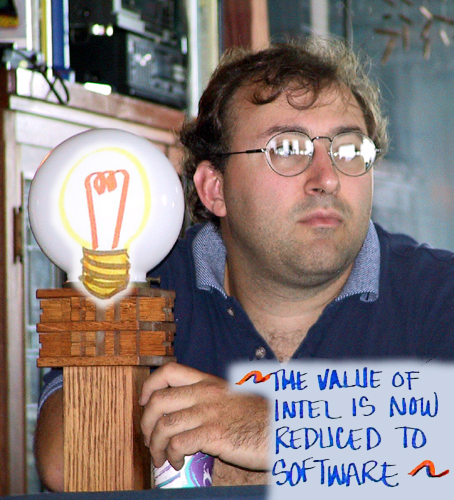
that any different than the business of making Pentium processors? The
supply of computer processing power is infinite, and increases at roughly
the same pace, and it is incredibly capitally intensive, yet Intel has
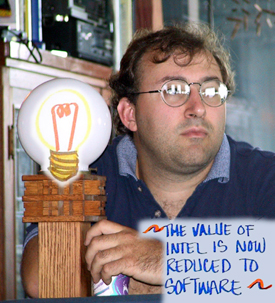
made more net profits than any other company in the world since 1971.
Man: They had
70% market share.
Man: Yeah,
but they don't have any government involvement or any socialization .
. .
Man: We won't
have 11 networks in the United States from 5 years from now, one way or
another, we will be down to 3.
Man: I would
like to point out that your characterization for the bandwidth market
is not at all unique. There is no difference between that commodity and
any other commodity.
Steve Kamman:
Adam Smith, the father of capitalism, said the government exists for 2
reasons -- national defense and the regulation of natural monopolies.
If you are going to look me in the eye and tell me that this is the fixed
line network, not the wireless network which is another natural monopoly
cause there is only so much spectrum.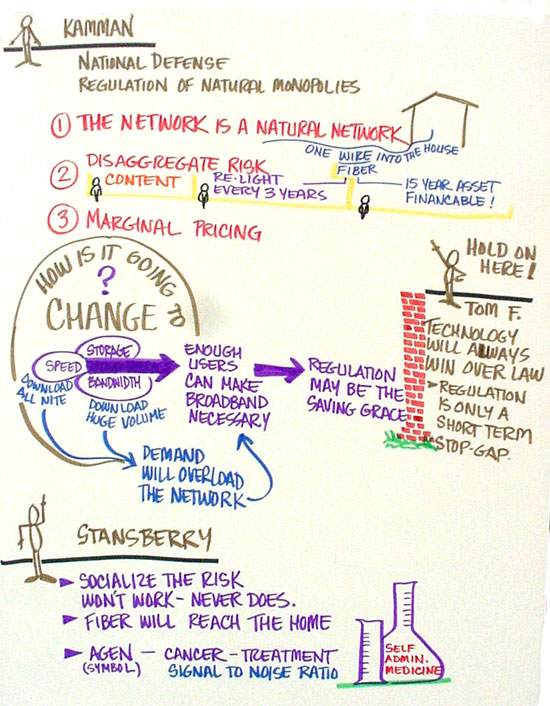
Isenberg: Steve's
5 minutes have now started.
Kamman: I'm
an ex-telecom guy who switched to being an equipment guy. I was at MCI
and I am older than I look. I start with sort of 3 base line points.
First, it is a natural monopoly.
Man: What is?
Kamman: The
network. At the absolute last mile, when you get down to it, it makes
more sense to have 1 wire to have 2 wires. Now we can talk about wireless.
We can also talk about how we get access. We can also say from a societal
point of view, I would prefer a society to invest in one wire. Now the
nice thing about it is that if I just have that one wire it is a 30 year
asset. Maybe it is only a 15 year asset, maybe it is only a 10 year asset,
but it is an asset I can finance with debt with some certainty. Talk
to the Worldwide Packets guys.
Man: Only if
you block other initiatives.
Kamman: Before
you say no, keep the mind open for a little longer . . . The fiber is
a 15-year asset. What you light it with, how you light it, what you send
down that pipe, who owns it, is not a 15 year asset. What you have here
is a fundamental shift where in the good old days the network and the
application were tied to each other. It was a network and it carried voice.
Today the physical asset is still something that you did a trench for
and you shove it in the ground and it sits there.
Man: You have
been reading me.
Kamman: If
I put a fiber in there, I can stick whatever I want on it. I can finance
that fiber with, say, 15 year debt, say, 10 year debt. I can go out and
legitimately say I can deliver X dollars a month by selling a fiber to
somebody else. They take on 2 additional risks: [First,] technology risk.
What am I going to light it with? That is going to change every 3 years.
I've got to take on a risk -- I need to relight the network every 3 years
in order to stay competitive. Then the other risk, which everybody wants
to bundle in to that same network, is the content. Well, I don't want
to take the content risk if I am taking on the lighting risk. Somebody
else has to figure out what is going down that pipe.
So we disaggregate
the industry. And somebody owns the boring 10 year asset that they finance
with boring old debt. Somebody else owns the middle part -- maybe that
is just the plain customer. If I'm going to light my fiber into my home
with something really old and slow because I don't want to upgrade, that
is my problem. Nobody comes in and tells me that I have to upgrade my
bloody refrigerator. Whenever I want to buy a new frig . . .
Then, the last item,
somebody else takes the risk of what am I going to put in the frig. Well
that is my problem. Number 3 is marginal pricing. The reason marginal
pricing is so bad is that the traditional network cycle (and this is where
it is different from cooper) when I first build a network, it has a potential
capacity of, say, 100. But I only sell 10% of it. And then over time
I sell more. The marginal cost of the next bit is almost zero, so that
is how I make my money. Somewhere in the middle I cross over and suddenly
every additional bit is pure gravy. The big problem is right at the end,
when the marginal cost per bit goes through the roof because the fundamental
architecture of my network wasn't designed for that many bits. So I'm
throwing a lot of capital to get that next marginal bit out.
Man: ADSL
Kamman: That
is ADSL, that is SONET. OC-48 was suppose to be a core backbone product,
and we are selling it on the edge. The problem is that if I build an
asset with a 10 year life and, I price it on a 10 year life, and it turns
out to be a 5 year asset. I'm screwed! So the problem is that you are
dealing with these screaming marginal costs curves. We as a society would
argue that there is a societal interest.
You have to walk up
to that guy who is saying, "I don't want to sell you more bits because
it costs me too much money, I loose money on every bit that I sell."
And you've got to kick them off the cliff.
So the debt holders
finance the network, and then the equity holders get the returns at the
end. [The solution is that] right at the end you have to kick the equity
holders back off and put it right back to the debt guys who get the next
10 years worth of spending.
When I am e.g., driving
my fully depreciated taxi cab, the last thing that I want to do is to
buy a new cab. In New York, every 5 years you have to buy a new cab.
I don't really care whether the old cab is working or not working. Every
5 years, new cab, finished. You can do that or you can go to Washington
D.C. and the cabs never˜.
How is this going
to change? And I'm just convinced of this: we are so bandwidth centric
in this world. Remember there is bandwidth, there is processing, and
there is storage and they are effectively substitutes for each other.
If I have all the bandwidth in the world, I don't need processing, and
I don't need storage. All the storage in the world and da, da, da . .
. If I had all the processing in the world, I could compress the Internet
into one 8 kilobit thing. Send [???] like zen.
Remember this, because
right now what we have is a bandwidth bottleneck. That is not going away,
because there is no way to finance it. Now you'll have some stuff on
the edge, and have some stuff on the margins. But people will take advantage
of the fact that processing and storage are still hammering forward according
to Moore's law. Particularly the storage out there is going to get so
bloody cheap that I'm going to replace storage for bandwidth.
How do I do that?
I will just tell them it is a critical mass of residential broadband.
If you get enough users out there . . .
Man: What is
the cheapest way to do it?
Kamman: Storage
right now, without a doubt. The point is, I am going to need a lot of
megabits to do streaming, or I need a lot of hours to pull that thing
down, dump it in the thing and then pull it out of local cache. To an
end user it is the same problem, same result, same solution. I'll take
the cheapest solution -- water finds the lowest level [e.g.] big Tivo
boxes. Even better, a friend of mine just downloaded his whole CD collection
on to a hard disk simply because it allowed him to play random play.
The day that I get broadband and the day that he has broadband is the
day that I ask him to email it to me.
[laughter]
Man: This is
your answer to Napster.
Kamman: Absolutely
but here is where it goes back to the network. So you start see to see
groundswells. If you get enough people using ADSL, they'll use it in
ways that they never thought. That's how they do Napster. You come in
at 11 o'clock at night, you tic, tic, tic, I want all these songs and
then it downloads all night long. That is how people do Napster. Eighteed
hours a day, while you are asleep or at work, that your little DSL modem
is going to be sucking stuff out of the network.
The network is not
built for everybody's DSL modem turning on when everybody is away at work
trying to suck down vast quantities of content. It blows up the networks.
How do we know that? It is exactly what Napster did to the campus LAN.
It is going to happen all over again. What happens then?
Then the consumer
comes into the equation. Why can I shut off all the Northpoint? Because
it is a bunch of geeks. Hey Northpoint, click you are gone, you guys
don't vote, I don't care. I know, it is 150,000 geeks but the senate
doesn't care. When AOL went to flat-rate pricing the whole network browned
out. Suddenly AOL had 2 choices, number 1 tell its users to go pound
sand -- over time, we will get to it -- typical Telco response. Number
2, you nearly go bankrupt throwing capital at the network and then run
away from it as fast as possible and outsource it to everybody else.
Why did they choose option 2? Because, remember it was on the cover of
Time magazine. The FTC was about to fine it. It had senate holding hearings.
Cause you had enough people who were started to depend on the Internet
. . .
I'm not saying this
is good for the telecom industry. I'm saying that broadband is going
to get dragged kicking and screaming out of the national economy one way
or another because if you get enough people out there that want it, then
the demand is going to increase, then it is going to become irrational,
then the best hope is regulation. It is the only way we will get a decent
return on that asset.
Isenberg: Hang
on here. We have two more panelists. Thank you.
[applause]
Tom Freeburg:
I used to work with a guy who pointed out that every problem, no matter
how complex, there is a solution that's appealing, simple, easy to understand,
which is not exactly the same way as simple, elegant, and wrong.
That suggests that
too many of us are falling into the simple thing.
By the way, there
is a stock market in bandwidth, as a lot of us here probably know and
a few of us that have even played in. We keep thinking about bandwidth
as a natural monopoly just like the railroad barrens thought about transportation
as a natural monopoly. Hey guess what guys? Technology has outstripped
that. It is too blooming late. You can't make that stick much longer.
I have a 2-hour speech I like to give on economic models and how that
it affects telecommunications.
Man: Please
give it now!
Freeburg: It
is when the world changes the people that owned the world before, go nuts
and they try everything that they can to change it, FUD, uncertainty and
doubt, legislation, all sorts of things like that. We are in the FUD
arena of telecommunications moving from a natural monopoly into something
where entirely different laws apply. By laws I mean natural laws, not
written-down laws. And as we all know, as the whole Napster thing clearly
illustrates, the world is changing and the legal system can't possibly
keep up with it.
History tells us you
can't pit law against technology and expect law to win. At best law can
sweep the tide back for a very short period. That is all that is gone
on right now. It can't possibly come out any other way. Technology is
going to win. There are just too many ways to deliver bandwidth. And
people are using bandwidth in too many new ways. By the way they are
going to use it in ways that we haven't even thought of yet. It is all
over, it really is.
I spent a lot of effort
explaining to my bosses that broadband cable was going to win over DSL
because broadband cable allows a number of different companies, different
entities, to use the same cable to transport [???] without having it look
exactly the same and without having to thread through even the same business
organization. It allows entrepreneurship but DSL doesn't.
Isenberg: Let
me point out that the very definition of natural monopoly has technology
in it. So if the technology changes then than the natural monopoly changes.
Larry quick comment?
Larry Lessig:
Just a quick disagreement with this. In the long run it doesn't matter,
but nobody wins in the long run. In the long run we are all dead. You
could have said the technology of radio would not have admitted of this
-- commercial control of radio was produced by the FCC when the FCC was
captured by radio in the 1930's and 40's and 50's. You could have said
that technology would not allow that and eventually radio will be liberated.
Well maybe if Dewane gets his way in 20 years, that will happen. But
still we had a 100 years of the technology being distorted by the legal
process being captured by special interests that had an interest in stopping
the progress of technology. So this is a happy story about how technology
wins in the end. But where we are right now is in a world where strong
interests are trying to stop the progress of technology in a way which
is hampering [???].
Isenberg: Now,
let's get back into the panel. Porter Stansberry is a free marketeer
to beat all free marketeers -- take it away!
Porter Stansberry:
I'm going to try to be very succinct. I write a newsletter and you can
all find my newsletters. I publish 4 different newsletters, one of which
I write . . .
Isenberg: No
commercials!
Stansberry:
pirateinvestor.com,
Isenberg: No
commercials!
Stansberry:
I've got 5 minutes to say whatever I want.
Isenberg: Free
marketeer, bullshit!
[laughter]
Stansberry:
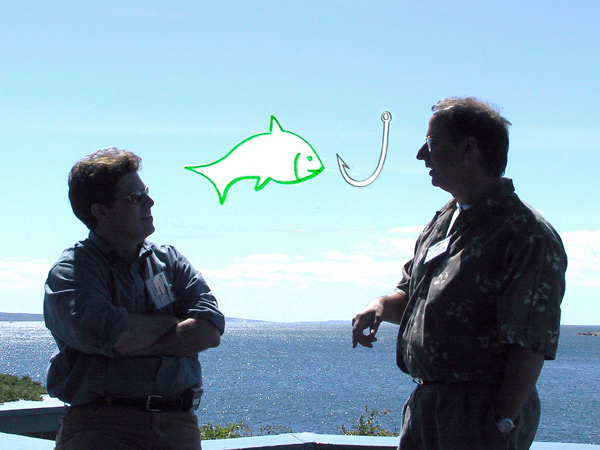
Anyway the password that you will need is Big Hook.
Isenberg: Hey,
no commercials!
Stansberry:
Well, the user id is BigHook and the password is 2001, so go priinvestor.com
and enter Big Hook, 2001. And in one minute I am going to summarize what
happens to all the networks in the world. The bottom line is that it
was very, very bad business. Between 1998 and 1999 capital expenditures
for telecom companies doubled, but revenues didn't come close to doubling.
That was a sure sign of that we were in the midst . . . [Tape turns over]
. . . The other thing
that people should have noticed was in 1994 AT&T's revenues peaked.
So you have the leader of the industry suffering declining revenues 6
years into it, it is a sign that piling on is not necessarily the best
idea. The real problem is the narrow pipes to the user, because what
you are building was not supply but capacity, and there is a difference.
So there is an over-capacity problem. There is no such thing in economics
as a problem of over supply. Supply drives demand, price change. So
in the future what is going to happen is optics will come into the local
loop, and finally supply will come on line. Over capacity will solved.
All that won't happen if you socialize the risks. They socialized the
risks of Japan's banking system in 1990 and it didn't get us anywhere.
If you go back all through history, socializing the risk in any industry
freezes it in time, and nothing ever changes. Going back to the railroad
analogy, the first private railroad in the United States was James Hills
Northern Railroad. It was wildly profitable and it didn't receive any
government subsidies in an arrow when, supposedly, the costs of running
a railroad were below the price of [???]. So these problems have all happened
before and the answers were never social. The answers were always entrepreneurial.
Man: Rent control
in New York City.
Stansberry:
Another great example. And there is no such thing as a natural monopoly,
that is just total crap. If there would be, government would regulate
real estate, they don't, so forget about it.
Isenberg: Except
for rent control in New York City . . .
Stansberry:
Right -- it doesn't work. I have something more interesting to talk about
with my remaining 2 ½ minutes. It is much more valuable re: the signal
to noise problem, and that is the treatment of cancer. I have been spending
a lot more time on that this year because there is no money to be made
in telecom. Anyway, briefly, there is a great company that you guys should
all take a look called Antigenics, out of New York. The symbol is AGEN
and it trades for $16.50. The market cap is 500 million dollars. They
have an extremely successful, well proven vaccine, a therapeutic vaccine
for cancer. The technology is called heatshock protein and the signal-to-noise
problem is that in cancer your body has a tumor that grows that is made
out of your own cells, so it does not trigger your immune system. Your
immune system does not detect cancer is being a foreign invader so it
does not react. Antigenics takes a sample of your cancer tumor, you specifically,
extracts something called the heatshock protein, which is a signal of
your immune system and then delivers that signal directly to your immune
system over a 2-day process using Federal Express.
Man: Oh, that
is hot.
Stansberry:
This is first commercialized program of individualized medicine. When
people say we wasted all this money on the Human Genome Project, it is
an example of people not understanding the difference between a technology
and a killer application. I made a point earlier about the combustion
engine beating the technology carving the application. In this case,
genomics is the technology, but the application will be individualized
medicine. It is going to happen in a lot of forms. The first one will
be treatments for cancer because cancer is unique to the individual.
So a phase 3 trial
is going right now for kidney cancer, should be finished in 2003, approval
in 2004. It will be a $20,000 treatment and it replaces chemotherapy
and radiation. As soon as it is approved for one cancer, it can be used
off label for any cancer. The technology is not cancer specific but patient
specific.
The second trial they
have going on right now is in pancreatic cancer. They get 40% success
rates. Kidney and pancreatic cancer are both 99% fatal, pancreatic cancer
within 12 months. So the testing process can be very quick, the burn
rate right now for the company is between 6 and 10 million dollars a year.
They have 80 million dollars in cash. Garo Armen, CEO, took Imunex public
and had a 12 year career at Goldman Sachs. When he discovered the technology
in 1994, he resigned his job, became CEO. The first doctor that they employed
to run the first clinical trail left his practice and became Chief Medical
Officer. I have about 10% of my net worth in this stock.
Woman: And
what was this company name again?
Stansberry:
Antigenics, AGEN.
Man: What entrepreneur
funded all the basic research that went to that genetic information?
[laughter, applause]
Stansberry:
The government spent 3.5 million dollars on the human genome project over
a 10-year period and another company named Celera, in 6 months beat all
that with less than a 300 million dollar investment. And now nobody is
using the public database because it is no good.
Isenberg: You
know, there is summer tradition in Woods Hole called the Friday Night
Lecture at MBL. They invite the people who are gonna win the Nobel Prize
in the decade to come and talk. Or in rare instances they are late and
they have Nobel Prize winners. Craig Venter spoke 2 weeks ago and he
was awesome. I went because of [Porter Stansberry]. What do you say
about the average employee at Celera? There are 24 year old math Ph.D's
from the top of their class who ride skateboards down the hall and . .
.
Stansberry:
I was doing a comparion between Amazon.com's average employee and Celera's
-- at the time they were roughly valued the same.
Isenberg: Anyway,
so somebody whispered in my ear this is the first time I've seen a corporate
logo at one of these Friday night lectures -- because, in general, they
are all academics. Venter was awesome. Thank you very much for that.
Stansberry:
Sure. I bought my stock for $11 in January.
Man: Why are
you telling us this?
Stansberry:
I'm telling you because I thought it was a much more profitable example
of the signal-to-noise problem.
Man: If he's
right, he gets twice as much time next year.
Isenberg: Now,
that is the real commodity.
Stansberry:
And I think that the problems of the network are pretty well understood
and I think that they will be solved, hopefully in market ways over the
next 5 years.
Victor Blake:
Can I ask a question? One thing that nobody has really discussed yet is
privatization of networks. We've talked about network operators and service
providers with the vision that that is how networks should be built.
It you were to take a look at transportation as an example, one can conclude
that cars are simply the privatization of transportation -- as opposed
to railroads.
One point of information:
you probably don't know that AOL runs a huge number of private networks
that are not on public carrier networks that carry approximately 75% of
AOL's gross traffic volume between data centers. They are on 3 year depreciation
schedules for capital equipment and 10 years for the fiber. It is very
agressive --these are privately owned and privately capitalized by AOL.
Kamman[?]:
Regarding transportation there is another way to look at it if you think
about marginal costs. For example, in L.A. they stopped building new
freeways because the next freeway doesn't really change traffic patterns.
The problem is that the individual still wants to own his car, but looking
at the collective cost, in 200 years we will have to do something. I
don't know what that is. But at some point you have to scrap the system
and either build different cars, or force everyone to buy motorcycles,
or force everybody into trains, or do something different, because otherwise
L.A. starves.
Blake: In D.C.
we call it the toll road. It is a private enterprise investment and it
is actually profitable, as I understand it.
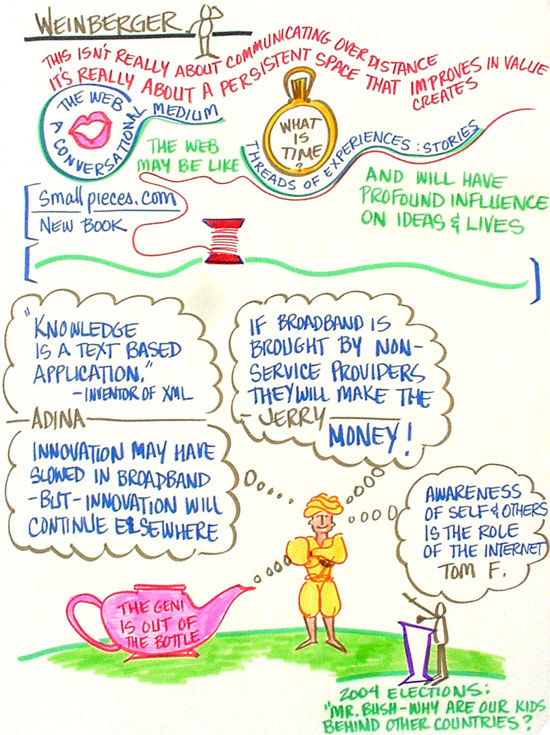 David
Weinberger: I don't really understand any of this. But since I am
standing I will continue. Did you just see a blinding light of fear washing
over me? I was going to talk about the telecommunications revolution
and why it hasn't done what we have expected it to do. David
Weinberger: I don't really understand any of this. But since I am
standing I will continue. Did you just see a blinding light of fear washing
over me? I was going to talk about the telecommunications revolution
and why it hasn't done what we have expected it to do.
The first thing is
that I don't look at this as a telecommunications revolution at all because
it is just not my area of interest. What I care about is not so much
the questions of provisioning bandwidth, which I understand is a crucial
question. I don't look at this as telecommunications at all. Telecommunications
is communicating over a distance and I don't think that the Internet or
the Web is really about communicating over distances.
What's remarkable
about it is that it is a persistent space. It is a space that accretes
value over time. Every page that is put up and every discussion that
gets added to adds to the value of the web. That is really different
than what the telecommunications infrastructure was built for -- telephone
calls -- it has nothing to do with that.
So I think of the
Internet as a persistent space that accretes value over time. I, like
Jerry, just turned in a book draft a week ago, so I'm in this nervous
state of waiting to hear what my editor says about whether it is done
or not. So I would like to talk about this by talking about a book that
I was co-author a couple of years ago, and then tell you what the theme
of the new book is. Is that a plug? Oh well, too late!
Man: David,
just tell us what you have to say. Stop apologizing.
Weinberger:
I will apologize as long as I want. Back off! [laughter].
Well the first point
was persistent space accretes value. The second point is that what The
Cluetrain Manifesto said to me is still basically right. It came out
during the height of the positive hysteria about dot.coms. The reason
why the Internet jangled our cultural nerves is not that it is a big opportunity
for some 25 year olds to make a lot of money (but that's nice too). What
we think is exciting about it is that it is a conversation medium that
enables people to have conversations in the literal sense, and then in
the extended sense.
Conversation, in this
case, is people who are talking voluntarily, because they are interested
in the same thing. They are speaking in their own voice with some passion,
about something they care about. That is the characteristic of the web
that has made it such an object of interest and passion. It is not really
that we move some business functions online, although that too is important.
But if that is all it was who would give a shit about the web? Something
else was going on, and Cluetrain suggested that conversation is a metaphor
[???].
The book I just maybe
finished is called, Small Pieces Loosely Joined. I wrote it on the web.
I posted drafts. You can read it, in its unfinished entirety at smallpieces.com.
I haven't talked about this in public before.
What it tries to say
is that what's important about the Web, the biggest effect that the Web
will have will be on ideas, in fact, better ideas of our culture, things
as basic as space and time and matter over reality and knowledge and public
and groups and self and morality. In fact, those are all chapters in
the book.
As I was writing I
realized the chapters are getting repetitive so I decided that that must
be a theme. The theme seems to be . . . let me give you an example of
how I think this works. So we have a theory of time that says -- I'm not
saying that this is a well worked out theory -- but if you ask most people
what time is, if you really push them on it, like in a Philosophy 101
class, they tell you about moments of time and the march of a string across
the knife edge of the now, little tiny quantum, moments of time.
We know that the more
you think of that the less sense it makes; the more paradoxes, the more
contradictions. The most important thing is that it has nothing to do
with how we experience time in our own lives in the real world. We don't
live a series of moments. Our lived experience of time is not of discreet
moments, it is of events. It is 5 minute stretches of our turn to talk.
Or our College years. We have a complex of stories that we view time
in -- threads if you want.
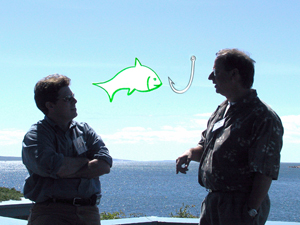 That
is not in accord with our every day philosophy about time, which is of
discreet moments, so we live with some alienation. Now you go to the
Web or the Internet, there are explicitly called threads. The Internet
has this threaded nature. It feels like a set of complex rivers that are
going by, like Heraclitus' Rivers, which were always changing, but there
is a river there, you can step into it. That
is not in accord with our every day philosophy about time, which is of
discreet moments, so we live with some alienation. Now you go to the
Web or the Internet, there are explicitly called threads. The Internet
has this threaded nature. It feels like a set of complex rivers that are
going by, like Heraclitus' Rivers, which were always changing, but there
is a river there, you can step into it.
So there are email
threads, there are discussion threads. My 16 year old daughter has 6
IM sessions opened at the same time. Each of those is threaded within
itself and there maybe some weaving of threads. Even on Ebay, when you
are bidding on an auction that is a story, that is a thread -- you can
go back to it, it has an end that you can reread later on, if you are
really bored.
So web time turns
out to be a lot like our normal everyday experience of time, which is
very different from our abstract explanation of time. That may be one
reason why our experience of the web feels both alien and new, but also
very familiar and very comfortable. [It explains] why hundreds of millions
of people can step into this radical new technology that is disruptive
and it doesn't feel disruptive at all. They feel completely at home.
It is because the experience of time and space and other things on the
web is, in fact, so much like our everyday experience and so unlike what
we have been telling ourselves that experience is about.
So if it is true that
the big effect of the web is on ideas, that the web should be viewed not
just as a technology, not just as an infrastructure, not just as an economic
vehicle but as an idea, the way that democracy is an idea, it arose as
an idea, it had its effect as an idea. If the most important thing about
the web is in terms of an idea, of course the revolution hasn't happened
yet. It takes a long time for ideas to work their way into our lives
and to have practical affects on our lives.
[applause]
David Reed:
David, I would like to offer you an alternative title, which is that there
is many stories in the naked Internet.
[laughter]
Isenberg: Well,
do you want to keep going for another half hour?
Jerry Michalski:
David, it sounds really wonderful. Thank you. That was a great first
talk. It was really excellent.
I want to tie what
you said back to where Roxane's started ask an open question. There is
implicit assumption about capitalism that I've been making for a long
time that I'm beginning to question: that there is no business without
barriers to entry. [Roxane] said that nobody will invest in a business
that doesn't have barriers to entry, because it gets competed down to
nothing, and who wants to make nothing on nothing.
Basically, capital
will flee a market where there is no clear lock, where you don't have
a lock on a patent or a barrier to somebody getting into your business,
where commodity isn't profitable. Maybe it is worse than that -- that
the commodity will never get built if something is instantaneously commoditized.
Also let me tie it
to what Tom was saying earlier -- if Motorola suddenly started building
Metricom-style devices that everybody could buy and install in their home,
that wirelessly connected to one another and created a high speed Internet,
no carrier would own the Internet. No carrier would have the last mile.
We would just provide it for one another and it would heal itself if the
software were good enough. It would be essentially free. Whether bandwidth
or storage or processing was the cheapest, it wouldn't matter, because
those things would chase each other over time. Motorola would make a
bunch of dough from that, just no carrier.
Anders Fernstedt,
who I met through David, made me realize that what 3G means to carriers
is a return to the advanced intelligent network. They plan on corralling
location information about me and selling that to advertisers. They plan
on having control over a lot of info about me that I have no desire for
them to have. And it is not just 3G, it is a whole bunch of old business
models about scarcity and barriers are [still operative].
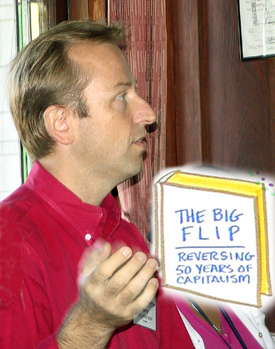 I've
been hunting on the web and everywhere else, for post-scarcity economics.
What happens when there is abundance? What happens when things are inexpensive
and available and there are few barriers. And what happens when companies
build loyalty because they've done good work and they are just closer
to you and they get what you do better. You don't want to leave them.
It is not because they made it really hard to export your data from Yahoo
groups, or some other strange reason. They are perfectly happy for you
to go someplace else but they are doing stuff better for you than anything
else is. I've
been hunting on the web and everywhere else, for post-scarcity economics.
What happens when there is abundance? What happens when things are inexpensive
and available and there are few barriers. And what happens when companies
build loyalty because they've done good work and they are just closer
to you and they get what you do better. You don't want to leave them.
It is not because they made it really hard to export your data from Yahoo
groups, or some other strange reason. They are perfectly happy for you
to go someplace else but they are doing stuff better for you than anything
else is.
Forget branding.
I'm not talking about branding at all, because branding is indirect, expensive
marketing.
Levin: A lot
of the discussion in this room has been about how do we pay for bandwidth
when telecom companies are trying to depreciate 30-year equipment. Right
now, capital markets have stop funding bandwidth. This is a big problem
because this has stopped innovation. If we're in the bandwidth business,
it is a tragedy.
But if we are talking
about the changes caused by the industry, email is already a killer application.
Tim Gray, one of the guys who invented XML has a great quote on his website
saying that knowledge is a text based application. So we are talking
about the killer applications and people that are providing bandwidth
wanted it to be true that radio is the killer application. But a lot
of what is interesting doesn't necessarily require high bandwidth. If
you have a network and it connects large numbers of people who can talk
to each other, that is already a heck of a lot. I think that this is
going to be an unpopular opinion in this crowd, but I think that there
is an amazing amount of innovation you can do on narrowband. That is
point one.
Point two is that
when we talk about having a space that is based around conversation, that
is based around archiving conversation and sharing thought based on editing
conversation, it was done once before, it is called the Talmud. And the
rabbis whose accounted what we now know of Judaism had conversations over
long periods of time and took them down and edited them into these fundamentals
documents. This record is very different from the linear organized way
of thinking that we get from the Greeks. I think we are going back to
a paradigm that people did without technology that now could be easier.
Isenberg: Good.
Freeburg: Just
a few real simple points. I will submit that the killer application for
the Internet is awareness. What people really want is expanding their
sphere of personal awareness, expanding it geographically, expanding it
in terms of social content, expanding it in terms of knowledge. All such
applications are increasing in their demands for bandwidth. The telegraph
took a lot less bandwidth than the telephone, and the things that we are
using today take a lot more.
Second is that all
attempts by governments or quasi-governmental organizations to control
the spread of new technology have in the end failed.
I like your argument
that in the end it may not matter because we are living in the now, except
that remember, the Internet didn't exist as a public phenomenon 10 years
ago. I'm sorry. We have to live out the eventuality. It is happening
too fast in comparison to previously technological changes for it to make
any difference. The automobile, by the way once it took off, absolutely
changed the life inside of a single generation. This is going to be that
much faster.
I have a couple more
pretty simple points. We are having a discussion that leads me to think
about the differences in the way that the French and the Germans approach
the evolution of language. For those of you who don't know it, the French
have a state committee for the preservation of the French language that
is very careful. Whenever a foreign word they don't like gets into the
language they invent a French phrase using existing French words to substitute,
and make it the legally required [language]. The Germans, on the other
hand, have a committee for the extension of the German language that adopts
new words very happily.
We have to be careful
about the difference between teaching the old paradigm and being sure
that for heaven sakes we don't break out of the box, and being aware that
we have unleashed the genie, he is really out of the bottle all together,
but the genie we've unleashed doesn't come in terms of bandwidth or in
terms of fiber, it comes in terms of humans communicating with humans.
By the way, not in real time necessarily.
Remember this sphere
of awareness includes not only other people, it also includes events in
near real time and a tremendous amount of human knowledge, and unfortunately,
a lot that pretends to be knowledge and really isn't. One of the speeches
that I have given in the past in my role as Chief Futurist, I talk about
how we are going to have to develop critical thinking, which is something
that they used to teach in school, so that we are very careful to not
allow our real belief system to be mislead by something just because we
read it on the Internet or in a newspaper. By the way, this exact phenomenon
happen back when the publication of newspaper was first invented. All
of the same stuff that we are talking about happened then.
Eric Best:
I will give you my coupon. To this point about old economy, old economics,
scarcity and barriers, were the models based on abundance? Just briefly,
in 1981-2 I was writing editorials in California and I got really obsessed
with the idea that the centrally-planned economies were doomed in the
face of information technology. What would become of them? They would
just collapse around an internal contradiction.
A couple of years
[later], stimulated by Reagonomics, I thought there must be a internal
contradiction in capitalism if we could only figure out what it was.
Then I had a fellowship year and I spent time going through the Harvard
Library trying to find anything between socialism and capitalism. So
I was looking for something called communal capitalism, but it wasn't
in the card catalogues in the Kennedy School or the Harvard Library, or
the Business School.
Actually you really
didn't hear about it until Clinton started using the phrase, which was
kind of interesting -- what was he talking about? I've been on this journey
for a while in the company of Napier [Collyns]. We were in a meeting
in London at one point in '92, '93,'94, talking about the restructuring
of Europe and what was going to be happening with the technology. I found
myself thinking, 'Oh I'm still in this same kind of quest to understand
is there a contradiction in the capitalist model.'. Now I think, 'Yes
there is', and I think I know what it is.
It's how do you protect
proprietary models in an open information architecture in the knowledge
economy, where you are moving from scarcity of physical objects to the
infinitude of ideas. If you have a knowledge economy where ideas are
essentially unlimited, and they are stimulated by the fact that everybody
has access . . . In fact if you believe that the economy is driven by
supply, is in your interest that more and more people get connected in
order to have more and more ideas, so that those ideas and those derivatives
will produce economic stuff. Therefore, it is in the public interest
that access ubiquity matters. Connectivity matters. So do you think
that connectivity and awareness will be extended fast enough to enough
people to produce this abundance if there is no intervention in the free
market? I think, and I would like to be seen as somebody speaking personally
not as a Morgan Stanley representative . . .
Best: We know
that the free market doesn't do a really good job allocating education
to everyone who needs it, or healthcare to everybody who needs it. So
if everybody needs connectivity the way they decided that everybody needs
a toilet, I suggest we should consider that some intervention might be
needed, if you think the knowledge economy requires connectivity and that
the free market is not actually providing it fast enough because the margins
aren't there, or for whatever reason.
Kamman: As
much as I was passionate before, I am going to get cynical again here.
I remember what Adina said, we were taught a lot more about whether or
not we needed some government action last year. And I would say the mood
in the room when you mention government was much more negative then it
is this year.
What has been interesting
for me to watch, now that I'm an equipment analyst, is that Motorola can
make a lot of money by selling that device, which by the way Robert Berger
is actually building. The equipment guy can make a lot of money by selling
that device. The guy who sells the services on it may not. If you want
to talk cynically, my guys, the equipment stocks, probably won't come
back until broadband comes back. When broadband is something that the
telecoms resist, those guys start to say, "Hmmm our customers and
us are headed down different paths."
Man: Where
is the broadband coming from if the demand isn't there> And how does
the demand get there if the last mile isn't there?
Kamman: Talk
to B2. The point is that you have to make the last mile happen. At some
point in time B2 will . . . the Koreans have 60% DSL penetration. It
does come, but what is the social force that will come in and speak for
it. Intel's stock doesn't come back up until broadband kicks off. So
how does Intel make more money? They start lobbying, because Intel worked
it out. Microsoft is going to work out that the only way they make money
is in broadband.
Man: By the
way, Intel said that gigabit Ethernet is their highest priority.
Kamman: That
is another way to look at it. You get another force in society that starts
going out there and starts throwing money at a party.
Man: How does
that play to your assertion that bandwidth and processing power are interchangeable?
Kamman: I think
what happens is the consumer is going to find a way to suck down stuff.
When enough consumers start sucking down enough stuff, I think it just
breaks the network, period. The beauty of a broken network is that consumers
get angry. The lesson of AOL's problems a couple of years ago is that
15 to 20 million angry consumers get listened to. 10 million angry consumers,
7 million angry consumers don't get listened to. But if I get another
angry consumers out there, then I tip the balance. Then we will solve
this problem.
Ekelund: Can
I give you an argument why I think the U.S. will start deploying fiber
very quickly? It is probably the only argument that actually will beat
the shit out of all of you. You are the biggest country and the most
powerful country that controls the world. Let's assume now I said to you
that Stockholm has 100,000 users using 10 to 100 megabits all the time
sending videos to everyone all the time. And we decide to say here is
Atlanta, Bell South, a shit network. Let's try it out, let's send 10,000
Pearl Harbor movies to them and see what happens. Do you know what is
going to happen? It is dead. If you were the Security Advisor of the United
States . . . are you going to be an isolated world power?
I think this is the
simplest arguement for you to start -- that you are not a world power
if you don't have the biggest broadband network in the world.
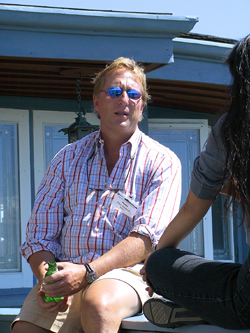 Man:
I am the Democrat running against George Bush 4 years from now and it
is the debate. Man:
I am the Democrat running against George Bush 4 years from now and it
is the debate.
Isenberg: I
hope so!
Man [putting on
southern accent]: Mr. Bush, why is it that an American child doesn't
have the same access to DSL as a Korean, as a German, as Swede? Why is
our nation behind? Is it because of you?
[laughter, applause]
Man: Why are
you from the South?
[laughter]
Jonathan Thatcher:
I just want to let everybody know that I think that there is a glimmer
of silver lining in this cloud. This is going to sound really bizarre,
especially to the investors in the world. As I look out at the last couple
of years that we have spent working with customers what I have seen is
hundreds of potential customers. They are not all real customers. There
are hundreds of potential customers with hundreds of different business
plans. They run the entire gamut of pure capitalism to pure communism
including Red China. I've seen every combination and permutation that
I can imagine of ways to bolt together a business proposition to go forward
and be successful for a community, for a business, for a -- you pick the
entity.
Somewhere in that
morass there are going to be a couple of successful models. I don't know
which ones that they are. As we architect our systems and we go sell,
we don't try to pick which they are. We try to pick the ones that seem
the most reasonable. But there will be a number of them. And we can
speculate what they are going to be, and we probably should. It would
be helpful if we had an idea. But I'm confident, I'm incredibly bullish
on the idea that the inherent competitive environment that we have created
on a worldwide basis [???] the midst of this chaos to find out that winning
set of propositions that are going to be successful. Maybe it just takes
patience. I believe that if we wait three to five years, we are going
to see those things bubbling to the top.
Man: Can you
just answer a question, maybe with a pie chart. What percentage of the
business plans you have seen are financed by long term junk bonds? What
percentage is financed by equipment-vendor financing? And what percentage
is financed by equity?
Isenberg: A
generic answer will suffice; a pie chart is not necessary.
Man: I think
that it is different from country to country.
Thatcher: I
would say that on a global basis, the ones that are going to step forward
and put the money on the line are communities and municipalities who are
tired of waiting for broadband connectivity.
Man: It is
really government bonds?
Thatcher: It is happening
outside of Tier 1 cities, it is happening on the other side of the digital
divide and that is the momentum is coming from in this country.
Man: Technically,
municipalities are corporations. [???] telecom municipal bonds.
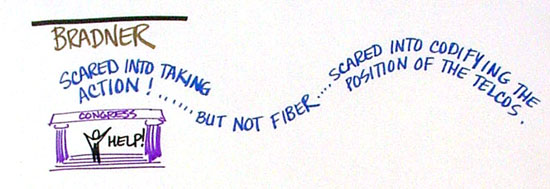 Scott
Bradner: I would like to tie together a couple of the last conversations.
We were told that we needed to be scared into doing the right thing, and
that would be the only way that it would work. Well it happens that we
are being scared right now˜ Scott
Bradner: I would like to tie together a couple of the last conversations.
We were told that we needed to be scared into doing the right thing, and
that would be the only way that it would work. Well it happens that we
are being scared right now˜
Isenberg: I'm
scared!
Bradner: In
Congress this week the regional telephone companies are scaring Congress.
They are scaring Congress by saying that broadband will not be deployed
(and their definition of broadband, of course, is a straw not a fire hose).
It will not be deployed unless they are ridded of the onerous task of
opening up their networks. Congress is not unlikely to pass this, so
what we are being scared into is not fiber, it is not municipal deployment
of fiber, it is codifying the monopolies of the regional telephone company.
The regional telephone companies have spent hundreds of millions of dollars
fighting against municipal fiber deployment and municipal networks. They
have been successful in most cases, so we are being scared, but we are
being scared into a rabbit hole, not out into the great outdoors. It
is not a particularly pleasant view, but that is what is happening now.
I don't think that scaring is the right thing. And of course talking
about Congress and talking about logic is an interesting paradigm.
Isenberg: Paradox!
Bradner: There
are a fixed number of clues in the world and the population going up,
the density goes down. No clue ever visits Washington or any other capital.
This is a perfect example of it. What we are seeing now going on there
is this, Bush what did you do to make the kids bandwidth? And the answer
is, we asked the telephone companies to help.
Man: Nicely!
Bradner: No,
we begged the telephone companies
Isenberg: Right
up the road there is a boat yard called, Quissett Boat Yard, and they
have T-shirts that say, "We are all here because we are not all there."
I think that applies to Congress. I would like to give Roxane the last
word once again because she has been so insightful in the past but first
Frank caught 2 stripers and a bluefish tonight, a big blue fish 10 pounds.
Did anybody else catch any?
Man: Seaweed
-- a couple of stripers and some seaweed.
Isenberg: Somebody
caught salad. A striper. I think that everybody threw them back, right?
Did anybody catch any over 28 inches? No. Oh, the bluefish, yeah but
you threw it back. Fresh bluefish is good! Anyway, so there are more
fish to be caught at first light tomorrow morning. Anyway, Roxane, then
music, and then we will see you in the morning. Roxane, hit it!
Googin: Well
I hope everyone sleeps on this. I hope it doesn't take 3 to 5 year to
fix, cause we are all going to be living on our cash balances in the meantime.
I, for one, am convinced
that our capital markets aren't going to recover until we figure out what
to do. And optimistically enough, I think as soon as we do figure out
what to do, they will jump up a lot, because they are a discounting mechanism.
But their immunity to these tax cuts tells me, on the down side, that
this is something that everyone might benefit from putting their heads
together to figure out.
I do think that our
esteemed government is going to have a very hard time, and I think that
they will get involved, and I am afraid that they might side with the
wrong people. It is up to all of us to try to think about how we can
pull together to make some sub-optimal solution come out of this, since
there is no optimal solution. 
I would just make
the observation that this move toward unlimited supply is moving beyond
bandwidth. Think about the symbiotic relationship between open source
software and the Internet, and how they work together, and how the Internet
helps foster the open source movement, and what economics this [synergy]
starts to impact. The software business is a very large business, and
it could be very negatively impacted by open source software. I'm not
passing a judgment on open source software. I happen to like some of
it. But it is a fact that it will be impacting our markets. Not as big
as the telecom issue because the business is smaller, it is not leveraged,
but it will redefine economics well beyond the bandwidth sector. So maybe
we can all sleep on it and pick this up tomorrow.
Man: And feel
better in the morning.
Isenberg: Well
thank you very much.
(return
to top)
page last modified: June 1, 2002
|