 |
||||
| Painting by Doug Rugh | ||||
BigHook2007: Infrastructure Economics 28Aug08
|
Introduction to BigHook2007 A t-shirt at a BigHook past showed the seven-layer OSI networking stack with two additional layers. Layer 8 was economics. Layer 9 was politics. This year we'll focus on economics. (No predictions about next year.) I'm going to try to herd the feline BigHook discussion towards basic economic concepts like rivalness, excludability and kinds of goods -- public goods, private goods, club goods, etc. There's a reasonable introduction to much of this at the Wikipedia article on Public Goods. To economists, "rival" means that if I have an apple, you don't have that apple. Rival goods are easily excludable; once I eat the apple, you're excluded from eating it. It's different for non-rival goods, e.g., a movie. If you watch it, that doesn't make any less of it for me to watch. If a business wants to make money from movies, there must be special exclusion mechanisms, e.g., a movie theater with admission charges for entering the theater, excluding all those who do not pay. There's a large cost to such exclusion mechanisms -- often exclusion costs more than the the non-rival good itself. This year we'll focus not only on economics, but also on infrastructure. We all know the Internet is infrastructure, but what, exactly, does that mean? To find out, we will inquire into other infrastructures, along with the Internet, to see what is common among them and what is different. Perhaps we'll discover different categories of infrastructure and deepen our thinking about it. BigHook2007 participant Brett Frischmann defines infrastructure as follows: Frischmann suggests that transportation systems, communications networks, and electric grids are infrastructures, and so are resources like bodies of water, the global climate system and ideas, and, in more ways than I might have otherwise thought, the Internet. Chad Jones, another BigHook2007 participant, points out [.pdf, .html] that ideas are perfectly nonrival. I'm an amateur, but I'd say that ideas are anti-rival because if I tell you my idea it not only gets more popular, but might even improve. Jones says it differently, that ideas are subject to increasing returns. In other words, by Frischman's definition, ideas are infrastructure in its most ideal form. Then Jones observes: "Any time new ideas are invented, there is a fixed cost to produce the new set of instructions." Jones cites familiar problems with patents, copyrights and other ideas about how to handle intellectual property, and observes, ". . . that we have not yet discovered the best mechanisms for providing the right incentives for innovation. Such 'meta-ideas' may be among the most valuable discoveries we can make." Frischmann says that for nonrival resources of infinite capacity, the costs of allowing an additional person access to the resource are zero. For partially (non)rival resources of finite capacity (a lake in a drought, throughput on a channel nearing capacity), the cost–benefit analysis is more complicated because of the possibility of congestion. [I have a couple of naive, amateur, and (dare I say) stupid observations about all this. (1) The degree of rivalry seems to be subject to change. It seems to grow suddenly as capacity is reached. Is rivalry really the important parameter? (2) There are rival goods that are infrastructure-like, in that they are inputs to a wide range of goods and services and demand for them is driven by downstream production. Oil is an example. So is infrastructure a continuum? Or a set of categories? -- I'm really looking forward to this discussion!] As the range of downstream benefits from infrastructure grows, the cost-benefit ratio becomes more difficult to evaluate. Larry Lessig [.doc, .html] boils down one of Frischmann's key points to the balance between wide-ranging benefit and excludability. Remember, exclusion mechanisms for non-rival goods have a cost. Said another way, when we don't know all the ways people might benefit from an infrastructure, exclusion from that infrastructure might deny its benefits to unknown parties in unknown ways. Lessig concludes we're paying too much attention to the cost of free riders and too little to the benefits that might accrue when excludability is relaxed. The observations of David P. Reed, another BigHook2007 participant, on "option value," are directly relevant [citation needed]. Reed says that as uncertainty grows, options become more valuable. Chad Jones' work [.pdf, .html] (with many others, most notably Paul Romer) shows that economic growth comes directly from new ideas. He says that an idea lets us combine the same stuff in new, more valuable ways. A delicious cake might have exactly the same ingredients as a merely edible cake; the difference is in the recipe, the ideas behind its creation. Susan Crawford, another BigHook2007 participant, observes [.doc, .html] that the Internet is special precisely due to its ability to spawn and disseminate ideas. So if we're to be serious about Internet policy, she says, a focus on making it universally available will spur economic growth. Meanwhile, we should not forget that BigHook2007 participant Andrew Odlyzko pointed out in 2001 in Privacy, Economics and Price Discrimination on the Internet [.pdf, .html] that companies with their eye on the bottom line are driven -- sometimes unconsciously driven -- to differentially exclude people from their goods in the name of economic efficiency. I observe that they do this even when their goods are consumed nonrivalrously. [By the way, Odlyzko's 2001 paper fulfills the definition of a true classic; it gains importance over time, and it gets better every time I read it.] Before arriving at BigHook2007, please check into the work of Frischmann, Jones, Lessig, Romer, Odlyzko and Crawford cited above. They've layed some important groundwork for our discussion this year. There'll be lots to talk about! I'll archive email and other material directly relevant to Infrastructure Economics on a discussion page -- to contribute to the discussion, send your input to the mailing list or to isen@isen.com -- (anybody have a better idea how to do this?) Agenda [stable-ish, subject to change]
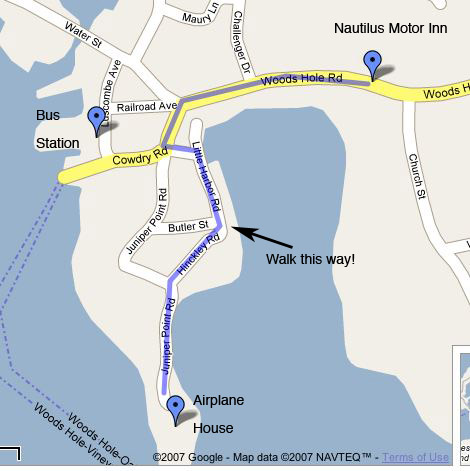
Information about Airports, Busses, Lodging, for BigHook is here. (It's pretty much the same as previous years.) Providence (PVD) is recommended because the airport is small and traffic is better than Boston. New: Robin Chase, a BigHook2007 participant, has founded GoLoco, a ride sharing social network that's another option for getting to/from BigHook. (Please don't use the name BigHook when you sign up . . . thanks!) This is new too -- click pic for "live" G-Map:
Darol Anger & Mike Marshall, who have played together as "The Duo" for almost 30 years, will be BigHook2007's Musicians in Residence this year. BigHook and isen.com, LLC owes a giant debt of gratitude Josh Auerbach of Time Warner's Strategic Planning Group and Mark Peshoff of Cisco's Executive Thought Leadership Program for their generous and far-sighted sponsorship of BigHook2007. We also gratefully acknowledge the support of Google via the good offices of Rick Whitt. |
BigHook Home
on this page: on nearby pages: |