|
 |
|
|
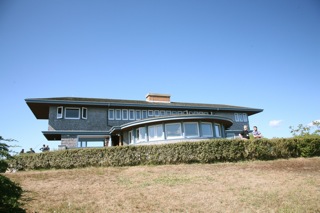
Photo by Scott Bradner |
|
|
|
|
|
|
|
Introduction31Aug08 [still under construction]
"Our Internet, Our Planet" is about stewardship.
At BigHook, the enduring theme is how to leave the best network to our grandchildren. Many of us harbor a hope that this Internet we've created is so immediate (in the end-to-end sense, i.e., no mediators) that it could provide a way to span distance and other factors that separate us so we can begin to realize our common humanity, face our common problems, and think of ourselves as one species living in a common, shared habitat. Central to this hope is the belief that we can use the Internet to consider our options and coordinate our actions to enable us to act wisely and cooperatively, end greed, war and racism, and optimize the benefits of life on Earth for all.
Of course, there are other much less cyber-utopian outcomes. There's strong evidence that our grandchildren face huge dangers. Global climate disruption, nuclear war and other dangers could, under a set of eminently plausible scenarios, render Earth uninhabitable. Not just less pleasant. Not just more dangerous. Uninhabitable. Such crises could occur so suddenly that humanity won't have a viable escape and there won't be time to implement Plan B. The Internet-as-effective-remedy scenario might be trivially weak, or even moot.
So should we reach for what might be effective and start to do it?
|
Impact Benign |
Impact Severe |
| Don't Act |
Business as Usual |
Planet Fails to Support Life |
| Act |
Costs of Acting |
Benefits of Mitigation |
I stole the table above from this guy, below, who points out that we can't know whether the impact will be severe or benign, but we can choose to act or not.
If you're still skeptical (and why shoudn't you be?), watch this one too.
You could decide that the threat isn't real and the costs of acting are too high. And that the Internet is simply another corporate profit-extraction tool like agri-business or bulk chemical production. But you didn't. You're a BigHook participant.
So the question is how do we, Internet experts all in one way or another, and stewards of our grandchildren's network, and our grandchildren's planet, using the tools and methods we created and are skilled at using, act? For example:
- How do we make the Internet itself a greener place? The information technology sector is responsible for an estimated two percent of greenhouse gas emissions, about the same as air travel. Can we reduce this?
- Are there ways to use the Internet to ameliorate climate change, to prepare for its consequences, to address the threat of nuclear war, and to counteract other dangers?
- Are there entrepreneurial opportunities for innovators, engineers and investors in addressing these crises?
- How do we tell this story on the other side of the Isthmus of Juniper?
Along the way, what other ideas do we discover?
A few suggested readings:
Can the Internet Save the Planet? (InfoWeek, Jan08)
The Internet's role in today's energy crises (Andrew Odlyzko)
The Internet and ICT: Cutting CO2 Emissions (Bill St. Arnaud)
The Greening of Academic Internet R&D (Bill St. Arnaud)
Data centers: Green because you have to (Scott Bradner, Network World)
Trading Communications Networks for Generating Capacity (Billy Ray, Glasgow KY Electric Power Board)
Broadband communication enables sustainable energy services (Dennis & Jones, Telecom J of Australia)
Broadband Services: Economic & Environmental Benefits (Fuhr & Pociask, American Consumer Institute) [Incredibly naïve! -- David I]
[Still under construction, to be continued . . . ]
|
|
|
|
Agenda [times are roughly stable, what happens at those times still subject to change]
|
Wednesday, 9/3
Noon to 1:30 PM: Check in, lunch, swimming, meet fellow participants
1:30 to 3:30 PM: Session 1a: Introductions
3:30 to 4:00 PM: break
4:00 to 5:30 PM, Session 1b: Intros, cont'd, then
Does our Planet Need to be Saved? From What?
also, Does the Internet have a Legitimate Role here?
5:30 to 8:00 PM: Dinner, fishing
8:00 to 9:00 PM, Session 2: The Three Legs: Science, Economics, Civil Society
9:00 to whenever -- Five-minute talks on whatever people want to talk about . . .
Thursday, 9/4
7:00 to 8:30 AM: Breakfast, fishing
8:30 to 10:00 AM, Session 3a: Cleaning up our own back yard, making IT greener (Bill St. Arnaud, discussion starter)
10:00 to 10:30: break
10:30 AM to Noon, Session 3b: What can the Internet do in the real world? (Andrew Odlyzko, discussion starter)
Noon to 2:00 PM: Lunch, swimming
2:00 to 3:30 PM, Session 4a: Opportunities while Saving the World (Pip Coburn, discussion starter)
3:30 to 4:00 PM: break
4:00 to 5:30, Session 4b: (We'll think of something for this slot)
5:30 to 8:00 PM: Dinner, fishing
8:00 to 9:30 PM, Session 5: Spectacular Musical Event
plus A Completely Different Angle on Stewardship, with John Abrams [link, link]
9:30PM to whenever: BOF Sessions
Friday, 9/5
7:00 to 8:30 AM: Breakfast, fishing
8:30 to 10:00 AM, Session 6a: Telling the Story
10:00 to 10:30 AM: break
10:30 AM to Noon, Session 6b:
Noon to 2:00 PM: Lunch, swimming
2:00 PM: Adjourn
|
Logistics
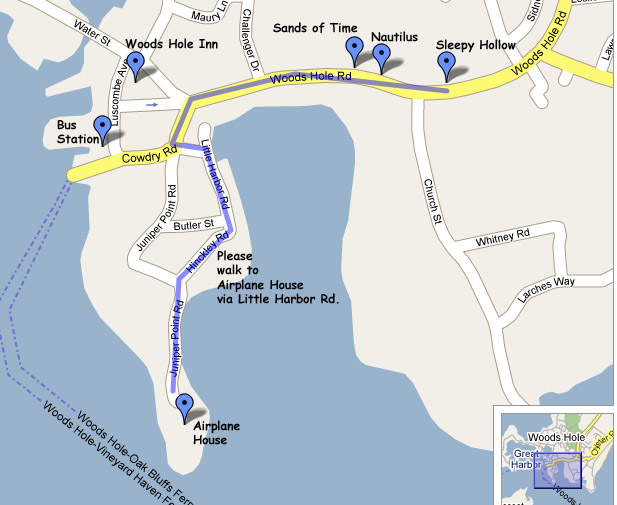
Information about Airports, Busses, Lodging, for BigHook is here. (It's pretty much the same as previous years.) Providence (PVD) is recommended because the airport is small and traffic is better than Boston.
Robin Chase, a BigHook2008 participant, has founded GoLoco, a ride sharing social network that's another option for getting to/from BigHook. (Please don't use the name BigHook when you sign up . . . thanks!)
Click the pic for "live" G-Map of Airplane House, etc:
Musicians in Residence
Mike Marshall and Hamilton de Holanda will be BigHook2008's Musicians in Residence.
Sponsors
The BigHook community and isen.com, LLC owe a great debt of gratitude to Mark Peshoff of Cisco's Executive Thought Leadership Program for Cisco's consistent and far-sighted sponsorship of BigHook2008. We also gratefully acknowledge the support of Time Warner Cable, thanks to CTO Mike Lajoie, and Google via the good offices of Rick Whitt and Vint Cerf. Thanks also to BT for its support.
Fine Print:
All of the above is on a best effort basis. I might fail to deliver on any of the above, so none of it is a promise, and no guarantees or warranties are implied. Here's my promise: I'll do my best, and if things screw up or stuff happens that causes plans to change, I'll do my best to give as much notice as I practically can. In other words, if you don't expect the impossible, I'll do my best to deliver it. -- David I
|
BigHook Home
on this page:
Intro
Suggested Reading
Schedule
Logistics & Travel
Music
Sponsors
on nearby pages:
2008 Participants
Backchannel chat
 Photos from BigHook2008! Photos from BigHook2008!
elsewhere:
Green-Broadband Blog
Connected Urban Development
Dot.Earth
ITU & Climate Change
:
|