MainChat — Wednesday, September 4
| Sep 4 | 1:20 PM |
| David S I. |
Hello world
|
| Sep 4 | 1:25 PM |
| SOB |
hello small world
|
| Sep 4 | 1:30 PM |
| Ben G. |
Bonjour
|
| Brewster K. |
I like the urgent call: we need to save the Internet
|
| Sep 4 | 1:35 PM |
| Rick W. |
In past years we focused mostly on the
corporations trying to harm the Net in some ways. Now it's The
Government who seems to be The Enemy.
|
| Sep 4 | 1:40 PM |
| Christopher M. |
Rick: Indeed, hard to tell fed gov apart from corporations in some of these threats
|
| Rick W. |
Agreed
|
| Rick W. |
But I would submit that governments have many more tools (direct/indirect) to screw with your life.
|
| Christopher M. |
Intuitively, I agree that fed/national govs have
more tools for maximal disruption (taking life, property, etc). But my
life seems plenty screwed with by big corporations, including my ability
to control my government.
|
| Sep 4 | 1:45 PM |
| Barbara C. |
Corporations and governments coevolve... and since
the Citizens United case the political/economic interrelationships are
even more complex and often opaque.
|
| Sep 4 | 1:50 PM |
| Elliot N. |
it's alive!
|
| Carlien R. |
yes David, I did
|
| Brough |
yes!
|
| Christopher M. |
Dewayne brought us this wireless - THANKS!
|
| Sep 4 | 1:55 PM |
| Christopher M. |
Dewayne and I did 3 podcast interviews -
http://muninetworks.org/content/community-broadband-bits-18-dewayne-hendricks http://muninetworks.org/content/community-broadband-bits-25-dewayne-hendricks-returns http://muninetworks.org/content/dewayne-hendricks-explains-forgotton-national-information-infrastructure-community-broadband |
| Eleanor S. |
You fight a different game - a structural one, an economic one.
|
| Elliot N. |
"what do you do when rule of law is gone". sadly, See: Egypt
|
| Sep 4 | 2:00 PM |
| Eleanor S. |
This is the same thing we face with NSA.
|
| Fumi Y. | |
| Steve S. |
Dewayne talks about "Person of Interest" as being relevant to what we're discussing
|
| Christopher M. |
Not just that the show is relevant, but it gives
us a shared vocab and a sense of what people who aren't in this room
know - that show gives them information to make sense of the world.
|
| Elliot N. |
the show itself is kind of meh, but the point is quite germane
|
| Ben G. |
Person of Interest may be a reality... see Future Attribute Screening Technology https://en.wikipedia.org/wiki/Future_Attribute_...
|
| Sep 4 | 2:05 PM |
| Elliot N. |
the people at the top want to know about the future now!
|
| Christopher M. |
fewer self-identified technologists in the room than I would have expected...
|
| Sep 4 | 2:10 PM |
| SOB |
david started by saying that we needed to save the
Internet - to me that is a sub problem - what we are seeing is that we
are under observation in everything - not just the Internet - the phone
net, the road & highway system, waling down the street etc
|
| Steve S. |
++ scott
|
| Ben G. |
+1
|
| Rick W. |
Although the network (Net/IP) is the basis for much of that surveillance.
|
| SOB |
s/waling/walking/
|
| SOB |
rick - the Internet is a mechanism of transport for the info but not always the mechanism for collection
|
| Steve S. |
/agree sob
|
| Rick W. |
yup
|
| SOB |
"/agree" means "end of agreement"?
|
| Steve S. |
sorry, gaming term, means I agree with ou
|
| Steve S. |
... you
|
| Steve S. |
to elaborate, we have a number of sensor grids out there.
|
| Christopher M. |
SOB - the problem does seem limited to technology
though... is it not the new technology that allows this level of data
collection? And that seems tied to the Internet often.
|
| Sep 4 | 2:15 PM |
| Steve S. |
cameras, power meters, other utility grids, stores
(brick and mortar), town records, public records, all of which observe
and collect various pieces of information about us. THen, plus
there's what we self-publish on the interent. The sum of all these
things, fed into ever-more-powerful inference engines, can tell a
frightening amount about us.
|
| SOB |
technology makes the process of observation
inexpensive - e.g. it would have been impossible to even think of the
postal service taking a picture of every piece of postal mail before
digital photography - but too much of this seems to be 'if I can to
this, then I may do it'
|
| Steve S. |
(dang, campfire cut off the first part of my longish comment :(
|
| Christopher M. |
Right, the idea of 1984 existing in a time when
the technology itself wasn't practical, so we were somewhat insulated
from the abuses we now find regularly occurring.
|
| SOB |
dog ate my homework? :-)
|
| Steve S. |
yup :)
|
| Christopher M. |
The tendency of those in power to abuse it is
timeless, but the technology does change. And when it changes, sometimes
it seems like toothpaste out of the tube. Hard to put back in.
|
| Sep 4 | 2:20 PM |
| Elliot N. |
I think there is good news in all this
|
| Elliot N. |
there is SO much more transparency
|
| SOB |
not voluntary transparency however
|
| Elliot N. |
I believe that corruption (broadly defined) is
slightly on the decline (yet still terrible) but transparency is growing
exponentially
|
| Elliot N. |
I mean the ability to expose and disseminate wrongdoing
|
| Ben G. |
transparency for who?
|
| Ben G. |
kk
|
| Christopher M. |
Elliot - disagree. I think transparency is on the
wan. Fewer reporters and far fewer that actually do real reporting. I
think we are heading to golden age of corruption.
|
| Elliot N. |
think of what we know about PRISM
|
| Elliot N. |
and about snowden's flight
|
| SOB |
know or guess?
|
| Elliot N. |
and about ATTs role in with the DEA
|
| Elliot N. |
all of this would have been completely private a generation ago
|
| Christopher M. |
For me, it is a reminder of how terrible 99% of reporters are doing at informing us.
it is not 99%, but probably 75% |
| SOB |
and what don;t we know because someone in the know has not yet told us
|
| Elliot N. |
and it used to be 90%
|
| Christopher M. |
I wish I thought these leaks are a sign of more to come.
|
| Elliot N. |
SOB: LOTS
|
| Elliot N. |
but way less than we used to
|
| Elliot N. |
we need to put it in context
|
| SOB |
way less = N% less, but is the % significant
|
| Elliot N. |
we are all in deep agreement about how terrible it all is
|
| Elliot N. |
but the context is so important
|
| Sep 4 | 2:25 PM |
| Elliot N. |
SOB: do you mean that the absolute amount is greater in your opinion?
|
| Eleanor S. |
Transparency is complicated. The same
transparency that can help us fight corruption is what makes
surveillance so effective, and the power law value of accumulated data
puts us at the wrong end of things.
|
| Elliot N. |
because remember we are barely more than a generation away from hoover and mccarthy (that is j edgar, not herbert)
|
| SOB |
I worry that we do not know more than we know
about the scope and depth of government and commercial knowledge of our
smallest actions and thoughts
|
| Christopher M. |
I recall that conversation differently - I thought most of us took it seriously but didn't know what we could do.
|
| Elliot N. | |
| Elliot N. |
but there is a public face http://www.reddit.com/r/planbshow/
|
| Robin C. |
Brad: you are such a pollyanna!
|
| Elliot N. | |
| James V. | |
| Sep 4 | 2:30 PM |
| Elliot N. |
James V: has higher security clearance than me ;-)
|
| James V. |
It's all inverted. I have lower clearance, which lets me tunnel deeper.
|
| Ben G. |
Global view on Internet censorship and monitoring http://www.amazon.com/Access-Controlled-Cybersp...
|
| Josh L. |
Dubai/ITU was *also* about whether and how the global south can exert influence on global internet governance
|
| Josh L. |
the divisions were not as clear as Pepper is making them out to be...
|
| Elliot N. |
I would suggest there is NO country in the world that is in favour of an Open Internet
|
| James V. |
Speaking of the reddit darknet plans. They have
been much mocked as cjdns fetishists, but I can't really find any
research on cjdns virtues and tradeoffs. If anybody here has insight or
resources on that, I'd appreciate a pointer or a chat.
|
| Elliot N. |
not one
|
| Elliot N. |
not canada or sweden
|
| Josh L. |
+1 Elliot
|
| SOB |
there were multiple fights in Dubai - one of which
is the one Josh mentions but there was just as strong a fight over what
the control would produce
|
| Ken Z. |
Echo Elliot: NO country wants and open Internet
|
| Eleanor S. |
there are countries that find pushing for an
internet that is somewhat more open than what their adversaries want to
be temporarily convenient.
|
| Elliot N. |
the US and China are partners in working against an Open Internet
|
| Christopher M. |
I'm a big partisan for open Internet - an extreme
position on our planet... for instance, Germany has laws limiting
speech. How can we welcome a conversation about it while being unwilling
to compromise on openness? ... I sure don't want to compromise it.
|
| James V. |
A lot of countries want an open internet everywhere but at home.
|
| Elliot N. |
luckily it is people who are in favour
|
| Elliot N. |
James V: dewayne may have a view on cjdns
|
| Sep 4 | 2:35 PM |
| James V. |
Thanks. I plan to chat him about a couple things. I'll add that to the list.
|
| Christopher M. |
Elliot - Canada also has laws limit hate speech, are such laws not popular?
|
| Elliot N. |
friends = humans, enemies = nation states, LEA, IP, telcos
|
| Elliot N. |
Christopher Mitchell: not sure you can draw that line
|
| Elliot N. |
there are laws against hate speech but I can say whatever I want to you
|
| Elliot N. |
so we can debate what it means to publish
|
| Eleanor S. |
This presumes that a) giving up your privacy is psychologically survivable (it's not, for most people)
|
| Aleecia M. |
+1
|
| Christopher M. |
Elliot: I think my point is that it is more complicated than you suggest in saying people prefer openness.
|
| SOB |
all gods children will have no clothing?
|
| Eleanor S. |
and b) that there's some kind of equality between a $5B company and a single individual if they're both naked.
|
| Eleanor S. |
Neither of these are true.
|
| Carlien R. |
+1 Roxanne: trust is the new currency, and in other to be able to trust each other maximum transparancy is needed.
|
| Sep 4 | 2:40 PM |
| Josh L. |
what does "open" mean?
|
| Eleanor S. |
Carlien: Not really. That's not how trust has worked for the rest of human existence.
|
| Josh L. |
if Google and Facebook are the definition of "open," we're going to have some disagreements :)
|
| Eleanor S. |
Carlien: It might mean that for companies, but it doesn't mean that humans.
|
| Eleanor S. |
Forcing all data to be open only helps the largest
entities that are able operate at a global scale. It doesn't help
humans at all, except the "help" of being persistently exploited.
|
| SOB |
such a Pollyannisn view of the world :-)
|
| Rick W. |
I think "open" is the Net platform itself, upon
which a wide swath of business models (from open to closed) have a
chance to compete.
|
| Christopher M. |
Josh, I think of open as all things are out there, filtering is done by end user
|
| Carlien R. |
Eleanor: I partly agree. This link made me think about it: http://money.cnn.com/2013/08/26/technology/soci...
|
| Josh L. |
Chris, so if a company can be "open" by exposing
data in a way that encourages interoperability, but is in favor of
deregulating the telecoms (hyopthetical), are they really in favor of
"openness"?
|
| Carlien R. |
@eleanor: the ultimate question however is not if I
have friends with a bad credit score but which bank has clients with
bad credit scores
|
| Eleanor S. |
Carlien: That trust only goes one direction. Yes,
it lets the bank predict my behavior more closely, but I can't trust the
bank any more because of this.
|
| Elliot N. |
ICANN now = the nexus for governments and law enforcement to try and exert control over the Internet
|
| Sep 4 | 2:45 PM |
| Elliot N. |
they are making progress
|
| Eleanor S. |
Carlien: In this case, them predicting my behavior
more correctly is just a matter of them being able to more finely
exploit me economically.
|
| Christopher M. |
Josh: open depends on context. I'm thinking of
ways national governments want to limit content in the context of the
above discussion. Open means other things when talking about access to
information via an ISP.
|
| Christopher M. |
Struggling with Eleanor's comment... giving up x%
of privacy seems to do little damage psychically. But 2x or 3x may do
damage depending on person.
|
| Carlien R. |
Eleanor: your premise is that companies will
always be the dominant entities, I think that the internet will enable
us to do more and more ourselves. Like Chris Rufer says, people are the
ultimate reality and the only operative elements. An Organisations is
but an idea, a concept.
|
| Elliot N. |
Carlien Roodink: +1 re: dominant entities
|
| Sep 4 | 2:50 PM |
| Aleecia M. |
Basically the trouble with Brin
|
| Wendy S. |
right, Brin glosses over power imbalances
|
| Elliot N. |
the Internet is bigger than any company
|
| Sascha M. |
*has been hit by three separate reporters today
talking about moving jurisdiction over Internet communications from the
FCC to the FTC... looks like the telcos are rapidly gearing up for what
to do assuming the FCC loses its court battle (in order to prevent
reclassification under Title 2).*
|
| Dan G. |
Big data brokers are also a big problem: Axciom
wants us to help it create even more invasive dossiers on us. No,
thanks. owl.li/oz4aE
|
| Eleanor S. |
It's a question of centralization, not of the company form.
|
| Elliot N. |
Eleanor Saitta: not much today is more "powerful" than anonymous. no media is more powerful than reddit
|
| Eleanor S. |
And centralization of agency, not of ownership.
|
| Elliot N. |
and agree re: centralization
|
| Josh L. |
Sascha Meinrath:
|
| Christopher M. |
Elliot: Fox News sets the agenda of the powerful
to a far greater extent than Reddit. Reddit may have long term impacts,
but in the now, I don't see it has particularly powerful.
|
| Eleanor S. |
Elliot: while I agree in some ways, but tell me
with a straight face that Reddit matters more than CNN for swinging a US
presidential election.
|
| Robin C. |
I've been conceptualizing these new organizational
structures as Peers Incorporated. Right now, the peers haven't
organized. We are too early in this new paradigm to have seen the need.
But starting right now, this need is becoming more apparent. The Peers
need to be able to organize in order to mainain the power balance. And
this is happening new. New NGO: peers.org trying to help them.
|
| Sep 4 | 2:55 PM |
| Steve S. |
Elliot, I'm not much using reddit, maybe you could give me a short primer sometime the next few days?
|
| Brewster K. |
David Reed: internet is the freedom to assemble more that freedom of speech
|
| Josh L. |
What does it mean in theory if the FTC takes the FCC's place and we let telecoms regulate themselves? (loaded question obv)
|
| James V. |
We've also provided unions with a bunch of legal
privileges, so maybe it makes sense that we have rules for what we call a
union.
|
| Robin C. |
I think the big platforms that are now engaging
with peer will be required to give the peers more power and rights if
they want long-term viability
|
| Dan G. |
Freedom of assembly has devolved into what
governments call "free speech zones" -- where they corral protestors out
of sight and hearing of the people they're trying to reach.
|
| James V. |
Dan G.: online, we call those free speech zones "Reddit". They're similarly safely out of common sight.
|
| Steve S. |
I highly recommend Elliots registrar -- hover.com
|
| Christopher M. |
Indeed - switched all my domains to hover and I love it.
|
| Eleanor S. |
The pop-up union efforts in the UK are pretty
interesting. Create something that creates the power structure of a
union but that doesn't last long enough to be
corrupted/captured/suborned in the same way.
|
| Christopher M. |
Also switched to Ting - very happy with it.
|
| Sep 4 | 3:00 PM |
| Christopher M. |
It bears repeating: Elliot is Canadian
|
| Dan G. |
Another happy Ting customer...but worry that Elliott is putting too many eggs in one (Sprint) basket...
|
| Eleanor S. |
hehehe
|
| Eleanor S. |
I wish I agreed with David here.
|
| Sascha M. |
Dan: Agreed!
|
| Eleanor S. |
I don't think it's desperation at all.
|
| Steve S. |
Can't use Ting, I travel to widely in New England
and Sprint doesn't have coverage. I wish I could though. I think
Sprint is the only major mobile carrier that widely supports MVNOs.
|
| SOB |
transparency when it comes to the powerful orgs
(like government & companies) is good - transparency when it comes
to people is not quite the same thing
|
| Aleecia M. |
Seems to be over more people than has ever been possible before
|
| Christopher M. |
People who snear at mainstream media miss that it sets the agenda for today.
|
| Eleanor S. |
I think it's a very simple, straightforward plan being executed.
|
| Sascha M. |
Elliot: [only somewhat facetiously] So mandatory full-body probing = win for privacy rights?
|
| Eleanor S. |
DoD said a decade ago that it needed to own the Internet, so it went out and took it.
|
| Sep 4 | 3:05 PM |
| Elliot N. |
Sascha Meinrath: no, foreplay
|
| Robin C. |
some people in government might get it (and those
are important ones), and then there is a whole bunch (most) who are
clueless about the whole thing
|
| Elliot N. |
moto X will get me to ditch my iphone 5
|
| Elliot N. |
and (I told rick) our shipment was just delayed 2-3 weeks
|
| Sascha M. |
Completely put together in USA... by robots created in China. ;)
|
| Eleanor S. |
...if only it had a keyboard.
|
| Elliot N. |
YAY!!
|
| Eleanor S. |
<3 my Samsung Relay; it's far from perfect, but I can type on it for real.
|
| Christopher M. |
Is it assembled in the US or in Texas? I'm confused.
|
| Elliot N. |
sign Ting up
|
| Elliot N. |
Rick W: can go home with a customer
|
| Brewster K. | |
| Wendy S. |
"unlike software"? unfortunately, that's garbled by patent claims too
|
| Sep 4 | 3:10 PM |
| Sascha M. |
Rick: I want 5 of those... plus the Voltron module.
|
| Eleanor S. |
[yay New Zealand!]
|
| Dan G. |
Seems to me that the most important feature of the
Moto X is Google -- the way it's more than any previous phone an
extension of the mother ship.
|
| Steve S. |
I'm going to get a moto x. Re: our topic though,
note the low power chip that does speech processing any time the device
is powered on. Compromised (or vendor or regime-inserted) code could
enable 24x7 audio scanning of any place the phone goes. .... global
sensor grid ...
|
| Eleanor S. |
for precarity
|
| Eleanor S. |
woah
|
| James V. |
A phone optimized for google services is exactly the kind of thing that's defeating privacy.
|
| Eleanor S. |
does the moto X have a removable battery?
|
| Sascha M. |
Alas, Android still hasn't put ad-hoc mode back
into its operating system and still ties users far more closely to the
telco motherships than they need to be.
|
| Elliot N. |
@dan it is. you just have to choose which mother ship
|
| Sep 4 | 3:15 PM |
| James V. |
The new Moto X comes pre-0wned...
|
| Eleanor S. |
because if not, I don't want that phone near me.
|
| Elliot N. |
James V: LOL
|
| Steve S. |
exactly Eleanor
|
| James V. |
Elliot: that joke courtesy of my recent browsing of Ting refurb phones
|
| Carlien R. |
Robin: I am not sure I understood what you said
about AirBnB and hosts. AirBnB has the possibility to create groups. It
started last week.
|
| Christopher M. |
Jim and I started a podcast series on muni network history - First episode here: http://www.muninetworks.org/content/jim-baller-... - others to be published soon.
|
| Robin C. |
Carlien! ha. excellent. I'm been pitching that it
was needed. Right in time with their growth cycle. Airbnb is good enough
that it was time to introduce it, and they have. Good for them.
|
| Robin C. |
airbnb is BIG enough...
|
| Sep 4 | 3:20 PM |
| Ben G. |
Robin Chase: does Amazon's mechanical turks provide a view into the new model?
|
| Christopher M. |
gigabit effectively means not having to wait for network stuff to happen.
|
| Christopher M. |
(in this context)
|
| SOB |
seems to me that gigabit tail circuits mean that you DO have to wait for network stuff (elsewhere) to happen
|
| Christopher M. |
Seeing more interest than we have in my 6 years in
the field. Not expecting *most* cities to build competitive networks.
There are major benefits to a relative minority of communities making
smart investments.
|
| Sep 4 | 3:25 PM |
| Christopher M. |
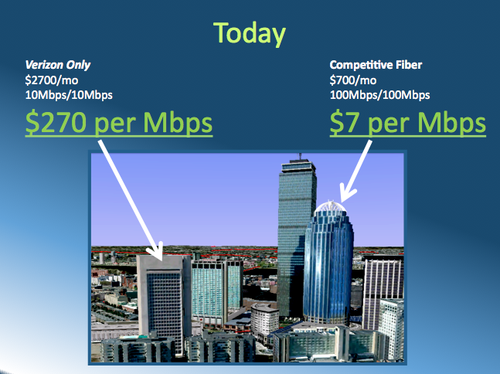
Brough created this slide, which many of us have loved to share: http://www.fiberevolution.com/images/6a00d83452...
|
| Josh L. |
wow
|
| Brewster K. | |
| Elliot N. |
damn sales. it makes business such a bitch
|
| Elliot N. |
growth hacking!!
|
| Sep 4 | 3:30 PM |
| Robin C. |
Ben g: it is one version. The lowest common
denominator of what peers can do. Interesting for me to think at that
level. It does deliver the benefits of peer diversity (resilience,
redundancy and innovation -- I'm thinking of the sheep drawing project).
compare that use of peers with TopCoder, different ends of the
spectrum.
|
| Aleecia M. |
Robin - at some point I'd love to talk with you about some research I'm working on
|
| Sep 4 | 4:05 PM |
| Eleanor S. |
changed the room’s topic to
Who's Watching
|
| Sep 4 | 4:10 PM |
| Brewster K. |
testing testing
|
| David R. |
fail fail
|
| Sep 4 | 4:20 PM |
| Christopher M. |
Will all the "bad guys" please self-identify?
|
| Wendy S. |
talk about perverse incentives
|
| Elliot N. |
sim city!
|
| Dan G. |
definte "bad"
|
| Dan G. |
that's define
|
| Christopher M. |
Thank you for self-identifying, Dan. =)
|
| Christopher M. |
If all this spying is working, why did the NFL
come up with new, more restrictive requirements limiting ability to take
purses into games this year?
|
| Eleanor S. |
This is the existential problem at the heart of the black state.
|
| Brough |
What is a pound of intelligence worth?
|
| Sascha M. |
Brough: less than a gram of wisdom.
|
| Eleanor S. |
"there is no bar too high where we can't justify more intelligence, because if we don't we might all die"
|
| Wendy S. |
and would the non-survival of some of the marketers be so bad?
|
| Sep 4 | 4:25 PM |
| Christopher M. |
We are manufacturing more enemies with every drone hit. Don't worry about running out.
|
| Dan G. |
Terrorism, a franchise business. Soon: Terror University.
|
| Eleanor S. |
The enemy is us. Is anyone who might threaten the hegemony of Empire.
|
| Christopher M. |
Eleanor: I think Clapper would be surprised to
hear that we think we are the enemy. I think he and his type believe
they are protecting us from Hobbes' world.
|
| Robin C. |
Al Quaeda is a franchiise. I have been thinking
about this a bit. It is a form of Peers Inc. If Al Quaeda creates a
compelling platform for participation, we could imagine the high growth,
scaleable, resilient, redundant organization they could make. Imagine
the possibilities
|
| Eleanor S. |
Christopher: Us as humans, or us as Americans?
|
| Christopher M. |
Americans, emphatically.
|
| Elliot N. |
seems dan's mercury stuff is not indexed :-(
|
| Eleanor S. |
Right. I don't care two whits for passports.
|
| Christopher M. |
Why bring Rick into this? ;-)
|
| Brewster K. |
I saw this test work in a room like this: who is
the primary threat, corporation or government, gives an idea of
democrat vs republican. I find myself thinking the big-corps and gov
are becoming symbiotic.
|
| Elliot N. |
this has nothing to do with motorola
|
| Elliot N. |
;-)
|
| David R. |
In the banking crisis, the following phrase was in
play in the banking senior executives (especially trading side): "If
you don't know who your counterparts is, the counterparty is you".
Replace counterparty with "enemy" or "antagonist" - it applies.
|
| David R. |
damn spelling corrector (counterparts meant counterparty)
|
| Sep 4 | 4:30 PM |
| Eleanor S. |
There's a giant human opportunity. I think if you make it into a business, you make it into a target.
|
| Rick W. |
thanks elliot
|
| Eleanor S. |
This follows the standard pattern of a new piece
of surveillance law being introduced to ratify current practice
happening via extralegal means.
|
| Eleanor S. |
Yup, that's about the shape of it.
|
| Elliot N. |
I think we would all be better off if we just agreed we have lost it
|
| Christopher M. |
As Dewayne reminded me last night, much of America
has already lost basic democracy. However, middle and upper class folks
are just starting to notice.
|
| Eleanor S. |
What about traffic analysis?
|
| Elliot N. |
it = democracy
|
| Eleanor S. |
Elliot: Yup. Because then we can start fighting to bring it back without our illusions.
|
| Dan G. |
Here's what I wrote about Scott Bradner's BH talk 11 years ago:
|
| Elliot N. |
Eleanor Saitta: I think we need to fight for the next thing
|
| Elliot N. |
democracy is what is always was
|
| Elliot N. |
which is better than monarchies and empires
|
| David R. |
big data == traffic analysis with very high reliability/accuracy
|
| Dan G. |
|
| Eleanor S. |
Elliot: Of course; sorry, took that as read.
|
| Brough |
SOB - In response to Snowden etc. IETF has dropped anything that uses other than end-to-end encryption.
|
| Sep 4 | 4:35 PM |
| Christopher M. |
Elliot: Democracy is not what we have imagined it to be (where we = middle class and above)
|
| Elliot N. |
and then the USG eventually funded sascha!
|
| Elliot N. |
schizophrenic
|
| David R. |
democracy is what allows the suppression of inconvient dissent
|
| Elliot N. |
Christopher Mitchell: @eleanor yes! onwards :-)
|
| Christopher M. |
Elliot: Government is a handy term for a specific collection of competing interests
|
| Eleanor S. |
Christopher: I don't know about that. I think it's
still exactly what the people who bought it ordered, re: class. It's
not what the middle class thought it was, sure, but a middle class who
understand their position in the world are a threat to the state. :-)
|
| Christopher M. |
Indymedia gained prominence in the 99 WTO protests
in Seattle. It was among the first online news sites to allow anyone to
publish to a live newswire.
|
| Christopher M. |
Eleanor, if I understand, you meant "not a threat..."
|
| Sep 4 | 4:40 PM |
| Eleanor S. |
Christopher: Not at all. It's not in the state's interest that the middle class understand how the state works.
|
| Sep 4 | 4:40 PM |
| Christopher M. |
I think our republic has worked better and worse
over the years regarding its ability to aim toward a common good for a
large segment of the population.
|
| Christopher M. |
Eleanor, OK
|
| Christopher M. |
Not sure I agree, but I understand the point.
|
| Elliot N. |
repression was the same. transparency was greater. my core hypothesis
|
| Christopher M. |
I think a tripling or greater of the prison population suggests repression changes. Not the only factor, but an important one.
|
| David R. |
Ultimately, the population has to think of
government as controllable and valuable. The rhetoric that works (both
for GOP and Democrats) is to describe government as uncontrollable and
useless. This works.
|
| Eleanor S. |
Elliot: to some degree, yes. But more transparency
can also be read as more ability to repress. "We don't need to hide
that you don't have any real rights any more".
|
| Wendy S. |
lots of good comes from "sacrificing some cocktail napkins"
|
| Elliot N. |
Eleanor Saitta: I don't think this society would allow that. I think if the mask was truly ripped off it would be over
|
| Elliot N. |
but of course you may be right
|
| Eleanor S. |
Elliot: Like a bandaid. Inch by inch, piece by piece.
|
| Eleanor S. |
I have plenty of friends who are less legible who aren't that different than Sascha who get plenty of hostility from USG.
|
| Eleanor S. |
(within the US)
|
| Eleanor S. |
It depends whether you look like something they understand or not, and how far you stick out your neck.
|
| Elliot N. |
Eleanor Saitta: oh for sure. we all have friends who are casualities
|
| Elliot N. |
this is war and there will be some
|
| Elliot N. |
I agree TOTALLY with this being war. I feel great about the outcomes, but war is hell for sure
|
| Sep 4 | 4:45 PM |
| Christopher M. |
I think people who have been to shooting wars may
take issue with the use of calling this struggle a war. No one is coming
to kill me. Or even Sascha... not yet anyway.
|
| Eleanor S. |
Christopher: Tell that to Aaron or Len. There are plenty of ways that we see casualties.
|
| Elliot N. |
Christopher Mitchell: point taken
|
| Eleanor S. |
(Point taken at one level, but no, this is very real)
|
| Elliot N. |
Eleanor Saitta: I was going to say that, but I ate it
|
| Christopher M. |
I'm not saying there are no casualties or that we don't face threats. But I don't expect to get PTSD
|
| Dan G. |
CB: Barrett Brown?
|
| Eleanor S. |
Christopher: I have friends who have PTSD from doing field technical support for internet freedom.
|
| SOB |
re The Machine - Mike (from Moon is a Harsh Mistress)
|
| Sascha M. |
Christopher -- they only shot tear gas and rubber bullets at me... the absolute worst were the Canadians.
|
| Christopher M. |
I think there is a difference in scale from "there
are some that have paid a major price" to hundreds of thousands of
people dead or injured for life. I don't want to harp on it, I just
think we need to be aware of the words we use.
|
| SOB |
sounds like Poindexter
|
| James V. |
Observe everything. Understand it. Remember it forever.
|
| Christopher M. |
Interesting that our brains are powerful precisely because of what we can forget.
|
| Wendy S. |
and then the sub-working-groups
|
| Steve S. |
"Observe everything, understand it, remember it forever"
|
| SOB |
understand it enough
|
| Eleanor S. |
Christopher: it's a small war right now,
definitely. The flip-side is that when we understand this as a war, it
changes how we heal and recover from it.
|
| Sep 4 | 4:50 PM |
| Carlien R. |
when we talk about government, do we mean Civil Servants AND politicians?
|
| Aleecia M. |
"conflict" seems to do nicely as a replacement for the word "war"
|
| David R. |
And Robin
|
| David R. |
Robin, Roxanne, Barbara - organizational restructuring is radical
|
| Eleanor S. |
Very much a +1 to the phase transition.
|
| SOB |
many more civil servants who "just do their jobs"
& those that define what those jobs are than politicians (who define
other people's jobs)
|
| Christopher M. |
Elliot appears skeptical. Also excited to talk about Canadia.
|
| Sep 4 | 4:55 PM |
| Elliot N. |
I think barbara is right about the path dependence and the broken US system
|
| Elliot N. |
BUT I think canada is a bad example
|
| Elliot N. |
what she is saying right now is RIGHT
|
| Christopher M. |
Re: Elliot on the networks in Canada, I regularly
hear from people who say their options are worse - high prices, few
choices, slow speeds, low data caps, etc.
|
| David R. |
Canada's path dependence might be different
|
| Elliot N. |
but canada is the only country in the world that is worse in terms of outcomes
|
| Eleanor S. |
The US bubble is really thick. The world looks so different from the outside.
|
| Wendy S. |
Bring back common carriage!
|
| Elliot N. |
another part of the historical problem and the path barbara speaks of is that theodore vail was actually a great CEO
|
| Elliot N. |
and ATT has not had one since
|
| Christopher M. |
I find Barb compelling, but I can't help but think of the quote, "How many divisions does the Pope command?"
|
| David R. |
We could discuss the value of measuring outcomes
(and what gets measured and not measured), because by choosing the
definition properly, you can twist the statistics into any truth you
want to hear
|
| David R. |
Remember, Genachowski declared that the US is entirely covered by broadband as his legacy
|
| David R. |
And he has the "statistics" to prove it = $tati$tic$
|
| Christopher M. |
David: Yes - those who pushed for broadband
mapping did not expect how terribly the USG would do it. It has
reinforced their message.
|
| Sep 4 | 5:00 PM |
| Sascha M. |
US vs. Canadian broadband speeds (spanning tens of millions of tests over 4+ year period): http://bit.ly/17vqo4V
|
| Sascha M. |
take-home message -- Elliot is correct,
historically, Canada has been slower than US... but watch what happens
over time as Canada catches up, then surpasses the US.
|
| Christopher M. |
Wow Sascha - great visualization
|
| David R. |
Nice, but not as pretty as the pictures from the $tink Tank$
|
| David R. | |
| David R. |
That's my slide about "data" (as a signal processing guy)
|
| Robin C. |
this is what the NSA is saying. This isn't information yet, it is just data so it doesn't count
|
| Elliot N. |
tom said "yours" like he had one too! :-)
|
| Sep 4 | 5:05 PM |
| Aleecia M. |
pink barbie cameras should be illegal right there :-)
|
| David R. |
I have two pink Barbie cameras from my daughters. Can I sell them on eBay?
|
| Eleanor S. |
The daughters?
|
| Elliot N. |
Sascha Meinrath: canada is going backwards. there is NO muni broadband movement
|
| David R. |
Now, now
|
| Aleecia M. |
"If you don't feel guilty, you're doing something wrong" -- awesome
|
| Christopher M. |
Elliot: Agree that there is very little muni
networks, but at the very least, the people in Canada who are taking
speedtests are on faster networks now.
|
| Elliot N. |
Christopher Mitchell: very little = 0
|
| Wendy S. |
IMMI.is
|
| Christopher M. |
Sounds like Iceland wants a US military base on it.
|
| David R. |
Sadly, satisfying people's short term needs is
what central power uses to maintain itself. So Canada's oligopolies use
that strategy.
|
| James V. |
It's not entirely clear Iceland wants to be the free haven we all want it to be.
|
| David R. |
The alternative is to buy government help (which is cheaper in the US) to exclude new entrants
|
| Sep 4 | 5:10 PM |
| Eleanor S. |
Christopher: It used to. They got rid of it.
|
| Sep 4 | 5:10 PM |
| David R. |
Iceland after the Pots and Pans revolution doesn't want the crooks that ruined its economy (at least for now)
|
| Christopher M. |
Susie Cagle on Freedom to Connect: fun illustrations. http://www.thisiswhatconcernsme.com/2012/05/23/...
|
| Sep 4 | 5:15 PM |
| Christopher M. |
The whole "high school dropout" meme is uselessly distracting. Just a mainstream media BS distraction.
|
| Wendy S. |
Squid Friday > Caturday
|
| Elliot N. |
I think that makes 4 people from sascha's world (a strange variation on wayne's world)
|
| Christopher M. |
Barry Lynn keynote from Freedom to Connect: https://www.youtube.com/watch?v=4IRcpdjL_G8 and lots of other good keynotes here: http://freedom-to-connect.net/2012/videos.html
|
| Sep 4 | 5:20 PM |
| Christopher M. |
I think this was the first article about 21st century monopoly capitalism that blew my brain up. http://monthlyreview.org/2011/04/01/monopoly-an...
|
| Sep 4 | 5:30 PM |
| Eleanor S. |
Carlien: Yes! The Dutch government is very effective at harassing all of my political friends in the Netherlands. :-)
|
| Elliot N. | |
| David R. |
Wouldn't it be great if Accenture had such a component of its skill set,,,
|
| Wendy S. |
+1 to the Conspiracy of Open
|
| Elliot N. |
Brewster Kahle: I am in!
|
| Josh L. |
let's do it
|
| Sep 4 | 5:35 PM |
| David R. |
What would "open surveillance" be, if it were to be a good thing? I'm really interested in that.
|
| Carlien R. |
@eleanor: interesting, are they public figures?
|
| Wendy S. |
"interesting and contentious space," says the master of understatement
|
| Eleanor S. |
Carlien: No, activist types.
|
| Sep 4 | 5:40 PM |
| Dan G. |
I love this music. My first instrument was clarinet (still my favorite)...
|
| Sep 4 | 8:50 PM |
| David S I. | |
| David S I. |
Disruptive camou
|
| James V. |
If you search for "dazzle ships" you'll see some pics of those ships
|
| Sep 4 | 8:55 PM |
| Fumi Y. |
My friend in Japan does digital camouflage http://www.youtube.com/watch?v=CflMr6y-UeU
and since we don't have to hide ourselves using camouflage in peaceful
Japan, the application they made was to show the camouflaged background
inside the car so that the driver can see the view of outside the car
directly inside the car. http://www.youtube.com/watch?v=YDioQoSB8mI
|


MainChat
People in this transcript
- Aleecia M McDonald
- Barbara C
- Ben Gaucherin
- Bob L
- Brewster Kahle
- Brough
- Carlien Roodink
- Christopher Mitchell
- Dan Gillmor
- David R
- David S Isenberg
- Dewayne Hendricks
- Eleanor Saitta
- Elliot Noss
- Fumi Yamazaki
- James V
- Josh Levy (Free Press)
- Ken Z
- Monica Webb
- Ram M
- Rick W
- Robert Pepper
- Robin Chase
- Sascha Meinrath
- SOB
- Steve C
- Steve Smith
- Susie Cagle
- Wendy Seltzer
