|
BigHook2013: Who's Watching.
September 4-6, Woods Hole, Massachusetts
The theme for BigHook2013, "Who's Watching,"
could be a question but it isn't.
Back in 1995-6, the Opportunity Discovery Department at AT&T Bell Labs Research, working with Peter Schwartz, Napier Collyns, Stewart Brand, and other Global Business Network folks, put together a set of scenarios for the future of the Internet. One of those was a future in which the Internet had become so surveilled and censored -- and everybody knew it -- that it had become a hostile place for dissident, creative, artistic and other non-main-stream activities. This network was literally degenerate. It had lost its generativity. It was no longer a platform for anything other than the most mundane kinds of innovation and the most mainstream kinds of expression. It was still indispensable for such activities of daily life as banking, shopping, getting the weather forecast and reading the official version of the news, but playfulness had been replaced by fear, and the net's chaotic nature and disruptive potential had given way to regimented politeness with an underlay of vandalism, griefing and petty crime. The Internet wasn't cool anymore. Young people wouldn't go there to play. Innovation stalled. Disruption stopped. Nothing to see here, move along.
On June 23, @dymaxion tweeted "Info disclosure, like humor, is a social weapon. Using it up a power gradient is good, but down one is violent." In humor, it's why telling jokes about political leaders, or the super-rich, or your boss is OK, while telling sexist/racist jokes, jokes about the disabled, etc., is not OK.
For information disclosure, let's state explicitly that "Who's Watching" is potentially symmetrical -- it could mean we're watching them or they're watching us. The Internet allows both. In my opinion, it's good when we know what our government is doing and it's not so good when they know what we're doing. Unfortunately, the balance of power tilts more towards them watching us, whereas when we watch them such watching is framed as law breaking, aiding the enemy, and theft of intellectual property.
Now, of course there's limits. Some of the things that the government does should properly be secret, and some of the things we do the government should know about -- but in both cases, in my opinion, the scope should be rigorously and explicitly specified and tightly circumscribed.
We're also talking about commercial activity when we talk about Who's Watching. Here again watching is, at first examination, symmetrical. The Internet expands what a customer can know about a vendor and its products and also what a vendor can know about its customers. Of course it is to a buyer's advantage to know as much as possible about vendors and products. As Andrew Odlyzko has pointed out (e.g., in Privacy, Economics and Price Discrimination on the Internet [.pdf]) knowing your customer is the key to charging what the market will bear. Do economies of scale and the frictionless nature of the net tilt the customer-vendor symmetry?
Many other watching relationships (parents/children, spouses, teachers/students, business competitors, other ("foreign") governments, etc.) are changed by the Internet -- it might be worthwhile for us to understand the implications of these changes too.
In closing, let me remind returning BigHook participants and explain to new ones that the annual theme is not designed to constrain the conversation! Anything related to the network we want to leave to our grandchildren is fair game. The theme is simply to give the discussion a central tendency. This year, though, Who's Watching gives us much to discuss.
|
|
Agenda
Wednesday, September 4
Noon to 1:30 PM: Check in, lunch, swimming, meet fellow
participants
1:30 to 3:30 PM: Session 1a: Extended Personal Introductions
3:30 to 4:00 PM: Break
4:00 to 5:30 PM, Session 1b: More Intros, Intro to Who's Watching
5:30 to 8:00 PM: Dinner
8:00 to 9:30 PM, Session 2: Spectacular Music, "A completely different take on visibility and security," by Roger Hanlon of the Marine Biological Laboratory
9:30 to Whenever: Whatever
Thursday, September 5
7:00 to 8:30 AM: Breakfast
8:30 to 10:00 AM, Session 3a: Discussion on Who's Watching
10:00 to 10:30: Break
10:30 AM to Noon, Session 3b: More Discussion, discussion starter tbd
Noon to 2:00 PM: Lunch, swimming
2:00 to 3:30 PM, Session 4a: Yet more discussion
3:30 to 4:00 PM: Break
4:00 to 5:30, Session 4b: More discussion
5:30 to 8:00 PM: Dinner
8:00 to 9:30 PM, Session 5: Spectacular Musical Event plus Something Else Awesome tbd
9:30PM to whenever: BOF Sessions
Friday, September 6
7:00 to 8:30 AM: Breakfast
8:30 to 10:00 AM, Session 6a:Wrap-up talks invited here
10:00 to 10:30 AM: Break
10:30 AM to Noon, Session 6b: Summaries, Learnings, Action Items.
Noon to 2:00 PM: Lunch, swimming
2:00 PM-ish: Adjourn
|
Travel & Lodging
Information about Airports, Busses, Lodging, for BigHook is here. Providence
(PVD) is a small airport and traffic is better than Boston, though "The
Big Dig" has made Boston's Logan Airport much more accessible. Also the
bus
service
from Logan to Woods Hole is MUCH better than Providence bus service.
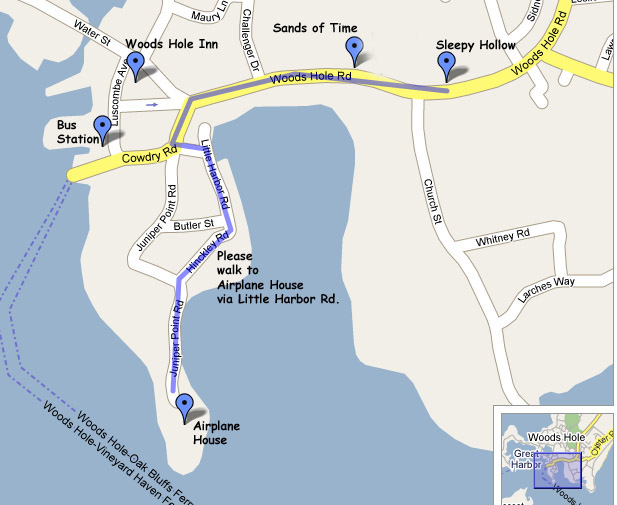
Lodging establishments are depicted below. Click the map for "live" G-Map of Airplane House, etc:
Music
The BigHook2013 musicians in residence are Anat Cohen and Howard Alden.
Sponsors &
Acknowledgements
The BigHook community and isen.com, LLC gratefully acknowledge the generous sponsorship of Afilias, thanks to Ram Mohan and Desiree Miloshevic, and Google via the good offices of Aparna Sridhar and Vint Cerf. Also, thanks to all BigHook2013 participants who dug a bit deeper into their budgets to support BigHook this year.
Thanks also to
- Chef Roland and his fine crew
- Dewayne Hendricks, Hartley Hoskins, Art Gaylord, and the
Woods Hole Oceanographic Institution for Internet connectivity
- Judi Clark for Web work
- Gardner Miller, the Point man
- Paula Blumenthal
Fine Print:
All of the above is on a best effort basis. I
might fail to deliver on any of the above, so none of it is a promise,
and no guarantees or warranties are implied. Here's my actual, real world promise: I'll do
my best, and if things screw up or stuff happens that causes plans to
change, I'll do my best to give as much notice as I practically can. In
other words, if you don't expect the impossible, I'll do my best to
deliver it. -- David I
|
BigHook Home
on this page:
Intro
Agenda
Travel Info
Music
Sponsors
on nearby pages:
2013 Participants
Susie Cagle's Toons
Posters from BH2013
Photos of BH2013
More photos
Chat archives:
Day One,
Two, and
Three
Core Documents (additional suggestions welcome):
The CIA and the Media by Carl Bernstein, 1973
How Much Privacy Do You Expect? The Death of Privacy In America by Jonathan Turley, 2011
How to Decode the True Meaning of What NSA Officials Say by By Jameel Jaffer and Brett Max Kaufman
FISA Court Ruling on NSA Upstream Collection
ACLU: All NSA documents released to the public since June 2013
The Public-Private Surveillance Partnership by Bruce Schneier
Schneier.com -- perhaps the best single source for all this stuff
EFF Deeplinks -- another great resource
Glenn Greenwald on Security and Liberty
Phil Zimmerman interview with Om Malik
New Zealand appears to have used NSA spy network to target Kim Dotcom by Cyrus Farivar
CyberSweep™ Solutions to counter cyber crime and cyber terrorism
Pentagon bracing for public dissent over climate and energy shocks by Nafeez Ahmed
Social Privacy in Networked Publics: Teens’ Attitudes, Practices, and Strategies by danah boyd and Alice E. Marwick
10 steps from democracy to authoritarian state by Juan Cole
Surveillance Teach-in with Jacob Applebaum and WIlliam Binney, [excerpt, whole thing] by Laura Poitras
Interview w/Original NSA Whistleblower Russell Tice
The Authoritarians [.pdf] by Bob Altemeyer
NYT: Drug Agents Use Vast Phone Trove, Eclipsing N.S.A.’s by Scott Shane & Colin Moynihan
NYT: A Data Broker Offers a Peek Behind the Curtain by Natasha Singer
Health app users have new symptom to fear, FT 9/1/13
Megaupload & the future of digital rights [.pdf] by Robert R. Amsterdam and Ira P. Rothken
ACLU: Not Just the NSA: Data Brokers Amass Detailed Profiles on Everyone Online, by Sandra Fulton
How should you protect yourself from cyber surveillance? by Dan Gillmor
AP-NORC Poll: The Public's Take on Civil Liberties & Security [.pdf], September 2013
The Banality of Systemic Evil by Peter Ludlow NYT |