|
BigHook2014: Trust
September 8-10, Woods Hole, Massachusetts
Whereas the overall theme for BigHook, since its inception, has been, "leaving the best network possible to our grandchildren," the annual theme for BigHook2014 is trust.
The concept of trust has at least three clusters of referents:
- Systems trust: trusted systems, trusted connections, trusted networks, etc.
- Social trust: trusted people and organizations
- Financial/Legal trust: trust entities that have business interests or financial/fiduciary duties
Ed Gerck, considering primarily systems trust, wrote in 1998,
[Trust] is recognized by many to be cardinal to information security, security policies, accountability, reliability, corporate management models, business relationships, interpersonal relationships, etc. However ... what is trust? What are the conditions under which trust exists, its truth conditions? What does it denote, what are its truth-values? Still today, there are no satisfactory answers, no consensus and no well-defined models.
Gerck's definition of trust is surprisingly simple:
"trust is that which is essential to a communication channel but cannot be transferred from a source to a destination using that channel"
Is this definition adequate? Does it mean that trust is equivalent to the communications protocol itself?
L. Jean Camp, in an essay (2003) that attempts to comprehend both social and systems trust, writes:
Experts focus on the considerable technological challenges of securing networks, building trust mechanisms, and devising security policies. Although these efforts are essential, that trust and security would be even better served if designs more systematically addressed the (sometimes irrational) people and institutions served by networked information systems. In order to address human concepts of trust, privacy must be a consideration and not an enemy or afterthought of the implementation.
[. . . ]
Design for trust requires examining all assumptions about a system and the user of the system. Sometimes those assumptions are based on class (e.g., the user has a credit card). Sometimes those assumptions are based on the capacities of the human (e.g., the user must select a large number of context-free random passwords). Sometimes the assumptions are necessary to enable a functioning design. Design for trust requires enumerating the social assumptions and examining how those assumptions can function to put some user of the system at risk. In order to understand and design trust systems, acknowledgement of the social and human elements are required.
Bruce Schneier primarily addresses social trust:
" . . . there are many different definitions of trust floating around. The trust I am writing about isn't personal, it's societal. By my definition, when we trust a person, an institution, or a system, we trust they will behave as we expect them to. It's more consistency or predictability than intimacy. And if you think about it, this is exactly the sort of trust our complex society runs on. I trust airline pilots, hotel clerks, ATMs, restaurant kitchens, and the company that built the computer I'm writing these answers on."
Bruce goes on:
Cooperating--or acting in a trustworthy manner--sometimes means putting group interest ahead of individual interest. Defecting means acting in one's self-interest as opposed to the group interest. To put it in concrete terms: we are collectively better off if no one steals, but I am individually better off if I steal other people's stuff. But if everyone did that, society would collapse. So we need societal pressures to induce cooperation--to prevent people from stealing.
There are two basic types of defectors. In this example, the first are people who know stealing is wrong, but steal anyway. The second are people who believe that, in some circumstances, stealing is right. Think of Robin Hood, who stole from the rich and gave to the poor. Or Jean Valjean from Les Miserables, who stole to feed his starving family . . . When society is in the wrong, it's defectors who are in the vanguard for change. So it was defectors who helped escaped slaves in the antebellum American South. It's defectors who are agitating to overthrow repressive regimes in the Middle East. And it's defectors who are fueling the Occupy Wall Street movement. Without defectors, society stagnates.
Ben Gaucherin contributes the below (8Sep14):
L Jean Camp paper on Net Trust
http://papers.ssrn.com/sol3/papers.cfm?abstract_id=707139
There is also an interesting YouTube video of a talk Jean gave at Purdue a few years ago
https://www.youtube.com/watch?v=KjvpdO9kR3A
And on the technical side of things. Ken Thompson's Reflections on Trusting Trust speech. Most of the moral really bothers me, but the underlying point is interesting "You can't trust code that you did not totally create yourself. ":
http://cm.bell-labs.com/who/ken/trust.html
Jon Lebkowsky contributes the below (8Sep14):
Interview with Bruce Schneier, discussing Liars & Outliers:
http://www.well.com/conf/inkwell.vue/topics/452/Bruce-Schneier-Liars-and-Outlier-page01.html
In the interview, he refers to this summary of his book:
http://whatever.scalzi.com/2012/02/16/the-big-idea-bruce-schneier/
[Under construction as of 31 Aug 2014. More soon . . . ]
Reminder: the theme is not designed to constrain the conversation. Anything related to the network we want to leave to our grandchildren is fair game. The theme is simply to give the discussion a central tendency.
|
|
Agenda
Monday, September 8
Noon to 1:30 PM: Check in, lunch, swimming, meet fellow
participants
1:30 to 3:30 PM: Session 1a: Extended Personal Introductions
3:30 to 4:00 PM: Break
4:00 to 5:30 PM, Session 1b: More Intros
5:30 to 8:00 PM: Dinner
8:00 to 10:00 PM (or so), Session 2: Spectacular Musical Event plus advance screening of the mostly-complete movie "A Good American," a documentary about Bill Binney and the NSA.
After that: whatever
Tuesday, September 9
7:00 to 8:30 AM: Breakfast
8:30 to 10:00 AM, Session 3a: Discussion
10:00 to 10:30: Break
10:30 AM to Noon, Session 3b: More Discussion
Noon to 2:00 PM: Lunch, swimming
2:00 to 3:30 PM, Session 4a: Yet more discussion
3:30 to 4:00 PM: Break
4:00 to 5:30, Session 4b: More discussion
5:30 to 8:00 PM: Dinner
8:00 to 9:30 PM, Session 5: Spectacular music and a fascinating talk.
9:30 to Whenever: Whatever
Wednesday, September 10
7:00 to 8:30 AM: Breakfast
8:30 to 10:00 AM, Session 6a:Wrap-up talks invited here (sign up in advance)
10:00 to 10:30 AM: Break
10:30 AM to Noon, Session 6b: Summaries, Learnings, Action Items.
Noon to 2:00 PM: Lunch, swimming
2:00 PM-ish: Adjourn
|
Travel & Lodging
Information about Airports, Busses, Lodging, for BigHook is here. Providence
(PVD) is a small airport and traffic is better than Boston, though "The
Big Dig" has made Boston's Logan Airport much more accessible. Also the
bus
service
from Logan to Woods Hole is MUCH better than Providence bus service.
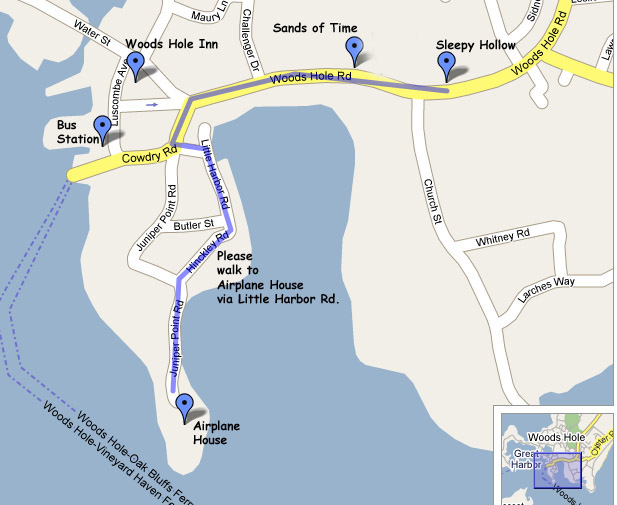
Lodging establishments are depicted below. Click the map for "live" G-Map of Airplane House, etc:
Music
The BigHook2014 musicians in residence are Marcio Marinho, aka Frango do Cavaco, and Henrique Neto.
Sponsors &
Acknowledgements
The BigHook community and isen.com, LLC gratefully acknowledge the generous sponsorship of Google via the good offices of Aparna Sridhar and Vint Cerf, ThoughtWorks (thanks to Matt Simons) and Motorola (thanks to Rick Whitt). Also, thanks to all BigHook2014 participants who dug a bit deeper into their budgets to support BigHook this year.
Thanks also to
- Chef Roland and his fine crew
- Dewayne Hendricks, Hartley Hoskins, Art Gaylord, and the
Woods Hole Oceanographic Institution for Internet connectivity
- Gardner Miller, the Point man
- Paula Blumenthal
Fine Print:
All of the above is on a best effort basis. I
might fail to deliver on any of the above, so none of it is a promise,
and no guarantees or warranties are implied. Here's my actual, real world promise: I'll do
my best, and if things screw up or stuff happens that causes plans to
change, I'll do my best to fix them and/or give as much notice as I practically can. In
other words, if you don't expect the impossible, I'll do my best to
deliver it. -- David I
|
BigHook Home
on this page:
Intro
Agenda
Travel Info
Music
Sponsors
on nearby pages:
2014 Participants
Photos of BigHook2014
More photos
Even more photos
Epad Collab Doc
Monday
Tuesday
Wednesday
Epad Chat
Monday
Tuesday
Wednesday
Core Documents
Design for Trust by L Jean Camp
Witnessing You by Carol Nevejan
Trust in Cyberspace, National Academy of Sciences, 1999
Whose Terms? A Glossary for Social Practice: TRUST by Emily Zimmerman, New Museum
Trust in corporations waning in wake of scandals By Bruce Horovitz, USA TODAY, 7/16/2002
About the Music
Talking about Choro by Henrique Neto |