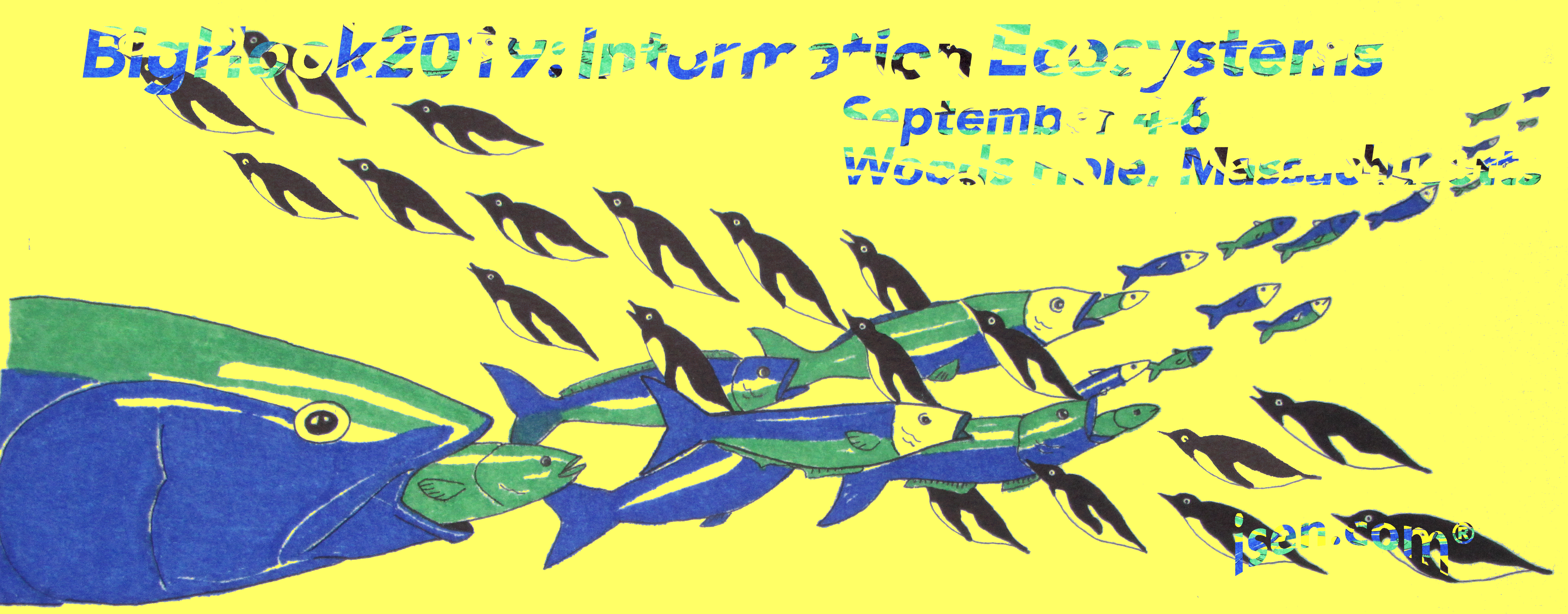
Introduction: The annual theme for BigHook2019 is information ecosystems.
Ecosystem is a term from biology that means all the living and non-living things in an environment and how they affect each other. The German zoologist Ernst Haeckel, coined oekologie in 1866 from the Greek oikos, meaning “home, place to live.” By the time the word translated into English as ecology in 1875 its meaning had broadened to embrace plant habitats as well. The related term ecosystem was proposed by the British botanist Arthur Tansley, 60 years after one of his own professors first translated Haeckel’s oekologie. [Above adapted from Meriam Webster article
on ecosystems] - DI.]
Today ecosystem means everything in a given environment, living and not living, that interacts with other things in that environment, and the interactions themselves, and their consequences, and the consequences of those consequences, dot, dot, dot, dot.
We might deepen our understanding of what an ecosystem is by considering studies of two actual biological ecosystems.
The first study regards the re-introducing wolves to the Yellowstone area. Quoting this NY
Times article
. . . wolves tidied up explosive deer and elk populations, which had eaten valleys barren. That helped bring back trees and shrubs. Birds and beavers, as well as the animals that live in dams, also returned. The wolves ate coyotes, freeing up their prey for others. Bears and raptors came back for carrion. With more trees controlling erosion, the flows of some rivers were less chaotic, forming pools that became new habitats. Reintroducing wolves changed the course of rivers, impacted plant life and changed the niches inhabited by fish, birds and small mammals.
Here's another nicely
done story on the same topic from the Yellowstone National Park Web site, and a good
Wikipedia article.
The second series of studies is about our internal ecosystem - our microbiota or microbiome. The discovery of the microbiome is a huge paradigm shift; almost everything we know about immunology and infectious disease - and much of what we know about genetics - is wrong.
Over the last 20 or 30 years, biologists have begun to see our bodies as ecosystems. For every cell that's "us" - that is, that have DNA from our mother and father - there are at least ten organisms (bacteria, viruses, fungi and archaea) - that live in and on our body that don't have "our" DNA.
Ironically, this discovery, which is still in its early discovery period, was accelerated by DNA sequencing, which indicated the diversity of life within us. The best summary I've read is by the food writer Michael Pollan, entitled "Say
hello to the100-trillion bacteria that make up your microbiome," or "Some of my best friends are germs."
There's a more recent, very readable book by Ed Yong too, entitled I contain multitudes. There's another good book co-authored by former Woods Hole scientist Jack Gilbert, called Dirt
is Good.
Pollan writes: . . .
for every human cell that is intrinsic to our body, there are about 10 resident microbes — including commensals (generally harmless freeloaders) and mutualists (favor traders) and, in only a tiny number of cases, pathogens. To the extent that we are bearers of genetic information, more than 99 percent of it is microbial. And it appears increasingly likely that this “second genome,” as it is sometimes called, exerts an influence on our health as great and possibly even greater than the genes we inherit from our parents.
This leads to some weird findings. For example, oligosaccharides are a major component of human mother's milk, but the human infant lacks the enzymes necessary to digest them. It turns out that these oligosaccharides nourish a particular gut bacterium which, in turn, protects the infant's gut epithelium from inflammation by displacing less beneficial bacteria. So when the mother spends energy producing oligosaccharides, they help the baby thrive even though it can't digest them. Who knew?
Pollan hypothesizes that since our micro-organisms can reproduce in as little as 20 minutes they can evolve adaptations to changing environmental conditions faster than "we" (who only reproduce every 20 years or so) can, so host animals (that is, us) get the benefits of evolution without having to evolve ourselves.
Remember our college biology understanding of immunology, that the immune system recognizes what is "not self" and attempts to eliminate it. If we harbor so many microbes as a matter of course, an immune system bent on eliminating "not self" would be working overtime . . . and failing.
At BigHook we are using "Information ecosystems" as an analogy. As Doc says, all analogies are wrong. The key is to figure out where an analogy applies and where it doesn't, and to decide whether the parallels that the analogy illustrates are useful.
Our human systems of information are indeed complex, with many interdependencies at many levels. Unintended consequences are the rule, not the exception. We might even wonder if intended-unintended is a useful distinction.
There's a plethora of writing on the reintroduction of the Yellowstone wolves and on the microbiome of the human body. I entreat you, the participants in BigHook2019, to think up good questions that will help us understand and discuss our information ecosystem and its most profound perturbation ever, the Internet. Agenda Wednesday, September 4 Noon to 1:30 PM: Check in, lunch, swimming, meet fellow participants
1:30 to 3:30 PM: Session 1a: Extended Personal Introductions
3:30 to 4:00 PM: Break
4:00 to 5:30 PM, Session 1b: More Intros, also What do we know about information ecosystems?
5:30 to 8:00 PM: Dinner
8:00 to 10:00 PM (or so), Session 2: Music, something awesome.
10:00 PM to Whenever: Whatever Thursday, September 5 7:00 to 8:30 AM: Breakfast
8:30 to 10:00 AM, Session 3a: Discussion
10:00 to 10:30: Break
10:30 AM to Noon, Session 3b: More Discussion
Noon to 2:00 PM: Lunch, swimming
2:00 to 3:30 PM, Session 4a: Yet more discussion
3:30 to 4:00 PM: Break
4:00 to 5:30, Session 4b: More discussion
5:30 to 8:00 PM: Dinner
8:00 to 10:00 PM, Session 5: Music, whatever.
10:00 PM to Whenever: Whatever Friday, September 6 7:00 to 8:30 AM: Breakfast
8:30 to 10:00 AM, Session 6a:Perspectives,
Wrap up talks.
10:00 to 10:30 AM: Break
10:30 AM to Noon, Session 6b: Summaries, Learnings, Action Items.
Noon to 2:00 PM: Lunch, swimming
2:00 PM-ish: Adjourn Music Jerron "Blind Boy" Paxton and Dalton
Ridenhour are the BigHook2019 musicians in residence. Sponsors & Acknowledgements The BigHook community and isen.com, LLC gratefully acknowledge the generous support of the John S. and James L. Knight Foundation via Alberto Ibargüen, the generous ongoing support of Comcast via Jason Livingood and Afilias via Ram Mohan & Desiree Miloshevic, and the patient support of Google via Vint Cerf. We also give thanks to all the paying participants who helped make BigHook a continuing, sustainable success. Thanks also to - Chef Roland and his fine crew for the food
- Dewayne Hendricks for Internet and applications support
- James Vasile for the chat application
- Molly Bang and Elisa Meyer Ferreira for this year's graphic
- Comcast & Jason Livingood for Internet connectivity
- Suzy Parker Elstob and Ben Elstob for being around when we need them
- Paula Blumenthal, my wife
The Fine Print: All of the above is on a best effort basis. I might fail to deliver on any of the above, so none of it is a promise, and no guarantees or warranties are implied. Here's my actual, real world promise: I'll do my best, and if things screw up or stuff happens that causes plans to change, I'll do my best to fix them and/or give as much notice as I practically can. In other words, if you don't expect the impossible, I'll do my best to deliver it. -- David I |