 |
|

Session 1 -- Friday, 9/22
- Welcome
& Introductions
- Using
the Color Card Signals
- About
the Airplane House
- Fishing
Opportunities During the Weekend
- Introducing
the Facilitation Team
- Thanks
to Our Sponsors
- Getting
the Discussion Underway
- Beginning
to Map the Issues
- Describe
the Network You Want in Three Words or Less
- Exploring
Metaphors - Ways to Talk about The Network
- What
about Bad Actors? What about Unintended Consequences?
- Balance
between Agency and Communion
- What
Network are we Talking About?
- Language,
Printing Presses, and the Disintermediation of Power Structures
- Is the Dynamic Created by the Internet Really Different?
1. Welcome & Introductions
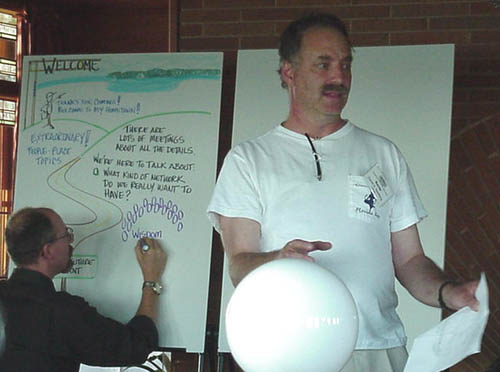
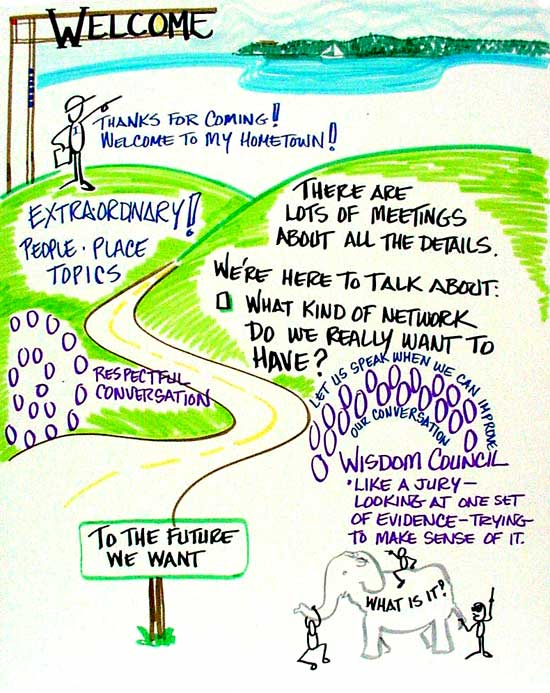
David Isenberg: Thank you for coming to this extraordinary place on this extraordinary day. I grew up in Woods Hole (I wish it was in this house). The house I grew up in was not as big but you could see the bay out one window and the harbor out the other.
These are my home waters. I've hit all of those rocks out there.
On this extraordinary day in this extraordinary place, we've assembled to talk about what most conferences don't deal with. We've come to talk about the network we really want to have. We could talk about how to make our network more profitable, faster, cheaper, simpler, more expeditious, etc. We could talk about what to invest in, regulation public policy, new technology, new protocol but there's lots of other meetings that do that.
 Bob
Lucky: What else is there?
Bob
Lucky: What else is there?
David: What else there is is a sense of where it is we want to go. Some people call it the normative scenario. The point is, if you don't know where you want to go then you don't know what will get you closer to it and what gets you farther away from it.
This year there's CALEA and Carnivore and Echelon…does that get you closer or further away? Or maybe the issue is quality of service -- does QoS get you closer?
Maybe it’s a total ‘pissing into the wind thing’ but my idea is we ought to at least give it a shot. If we can't do it then no one can do it.What kind of network do we really want to have? That's the question I'd like us to address.
In the process we will certainly address nifty new architectures, the decoupling of the network ownership, the role of big dumb companies, and small fast smart companies. My hope is that by Sunday we will have a better idea about the network we want and better metrics to judge what will get us there and/or what will move us away from there.
I'd like to suggest that there's an optimal attitude to bring to a discussion like this. I don't want just the topic to be different, I'd like the venue to be different and the people to be different. Some of us see each other all of the time but there's a lot of diversity here.
I don't want just the topic to be different, the people are different too. Some of us see each other all of the time but there's a lot of diversity here. Take Bob Suitor for example, Bob's the official fishing guide for the conference. Bob's a real smart fellow and he's turned his attention to the pursuit of wiley finned creatures. He also has an interest in things that are older than we are.
I'd like to suggest that there's an optimal attitude to bring to a discussion like this. I'd like to suggest that we could function a little bit like a wisdom council -people who come to think on the same side of the issue. The only thing we have like that is the jury system where you get 12 people all looking at one set of evidence and trying to understand it together. I'd like for us to think of ourselves like a jury looking at one set of evidence. We will be a little bit like the blind men and the elephant and some will insist that it is a snake or a rope or a tree trunk. Rather than sticking to your evidence that it is a tree trunk, if we can also listen to others who know from their experience that it is a rope then maybe we'll all learn something about the larger organism here.
I'd also like to say we don't have good tools for thinking about big, hairy, multidimensional issues. While there's a clear need for precise language, there's also an equally clear need for intuition, openness, multiple viewpoints and scenarios. We will be meeting in plenary as one group all weekend long. (Now it may not be that we do that. It may be that certain people have a real bug about network infrastructure or some other issue, then we might have breakout groups to keep people engaged. )
I'd like to suggest we bring an attitude of respectful conversation to our proceedings over the weekend. Jerry Michalski is fond of saying at the beginning of his meetings that the Quakers meet in a silent circle and only speak when they feel they can improve on the Lord's silence. I won't go that far but I'd like to suggest we only speak when we can improve on the conversation.
That may not always work, so if we have an ax to grind, an issue we want to address, or a new business that we might want to explain, I'd like to give everyone one chance to bring one issue and hit it hard for a very brief time. You'll see along with your badge, a token for 3 minutes of floor time. Here's the timer. You can play that token by giving it to Bob the facilitator who will give you your time and you will have to abide by the 3 minutes rule. For enforcement if you go over the 3 mins. you will have to wear one of these hats.
Comment: Can we trade these? Sell these? (coupons)
David: no
Comment: David you are over-managing.
2. Using the Color Card Signals
|
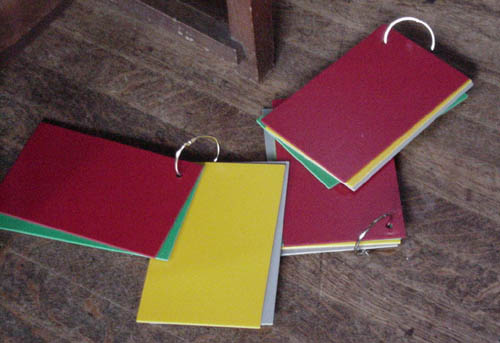
David: Yes I am. We have one other over-management tool Jerry is going to talk about these as I hand them around. We co-developed these. (Jerry & David handed out colored decks of plastic rectangles to be used to give feedback without having to talk.) Jerry: I went to AT&T research when Dr. Isenberg was in the ODD department (Opportunity Discovery Department). He had invited me to give a talk. He had given people a sheet of paper with the numbers 1-10 and had people vote on some things. After that I was inspired to come up with these things. If you disagree with someone, then you hold up the red card, if you agree, then hold up the green card, if you are indifferent or kind of bored, not that into what is going on, hold up the yellow card. If you have a question, hold up the question mark. The idea is that this way you don't interrupt, you just hold up your card. You can get a sense of what is going on around the room. It is a simple mechanism. Use them in good health and take them with you after the meeting if you so desire. |
 |
David: I want to make a few more introductions. The recorded music is by Joe Weed. If you like his stuff, look at the registration table for some of his cd's. I love his music.
3. About the Airplane House
I'd like to introduce Gardner Miller who is the major domo of the house. Can you take a minute and talk about where we are.
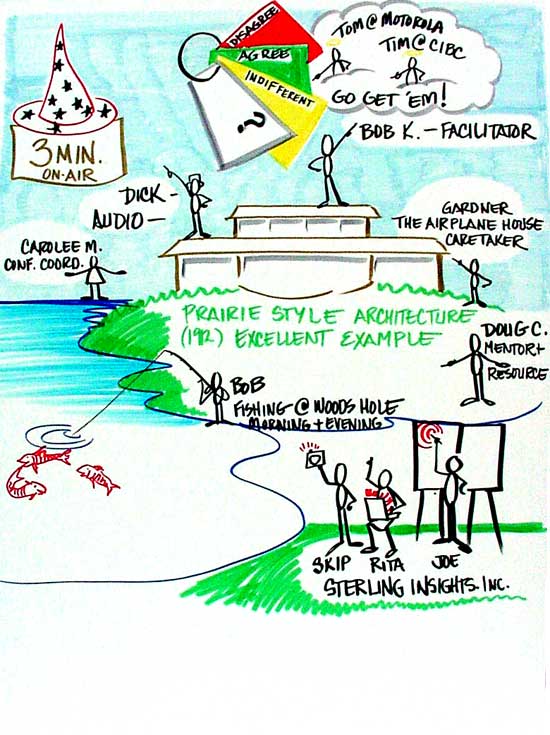 Gardner:
Unaccustomed as I am to public speaking without any wine in me, let me
tell you about the house. It is a special place. It is considered the
finest prairie styled house in the world. Why do you have a prarie-styled
house on Cape Cod? I want you to think it is 10,000 years ago. Just take
a minute to look out that window (pointing East). If you walked for 3
days in that direction you would come to the ocean. All of this used to
be the prairie. The architects who designed this are Elmsly (a genius)
& Purcell. Elmsly joined the firm the same day Frank Lloyd Wright
did. You can see a lot of Elmsly's in Wright's early work and vice versa.
Gardner:
Unaccustomed as I am to public speaking without any wine in me, let me
tell you about the house. It is a special place. It is considered the
finest prairie styled house in the world. Why do you have a prarie-styled
house on Cape Cod? I want you to think it is 10,000 years ago. Just take
a minute to look out that window (pointing East). If you walked for 3
days in that direction you would come to the ocean. All of this used to
be the prairie. The architects who designed this are Elmsly (a genius)
& Purcell. Elmsly joined the firm the same day Frank Lloyd Wright
did. You can see a lot of Elmsly's in Wright's early work and vice versa.
It was made in 1912 for family who lives up the hill for their daughters. They were going to get a house out of a Sears catalog. The architects asked "how about a kitchen and a porch and where are the servants going to live?" So gradually it came to be a pretty big project. They started it in April 1st 1912 and they walked into the house Sept. 30th 1912. It was made with 140-150 people working on it. There was a program going on in Boston where there were 14 Japanese Craftsmen building a teahouse at the Museum of Fine Arts. They did most of the finish work.
The only other thing that might be interesting is that that year, the year the house was done, all the townspeople signed a petition to have that abomination torn down because it was so ugly and unfitting. Isn't it interesting that kind of architectural genius could cause such qualms and yet we now see as a wondrous piece of work on the planet.
Comment: Who owns the house now and how is it used?
Gardner: Max Berger, a Swiss microbiologist. He is VP of Research for Ceiba-Geigy, which is now part of Novartis.
Comment: Is it used for this kind of thing all of the time?
Gardner: We have 5 meetings per year generally.
Comment: Does anyone live here?
Gardner: He does in the summertime for 10 weeks. He brings his daughters. He asked me which one of his daughter I thought was prettiest. I said the last one I saw. He said, "You are a lot smarter than you look."
4. Fishing Opportunities During the Weekend
David: Bob, do you want to come up and talk about fishing?
Bob: Is anyone here interested in fishing? Oh good. People that haven't fished or that haven't been fly-casting before can try it now. It can be a lot of fun. We will be fishing from the shore. I brought rods. I'll be here every morning and every evening. Sunrise and sunset.
We have a nice rod for whoever catches the biggest fish. If you haven't fished before, it could be anyone who catches the biggest fish.
David: You don't have to be a genius here or know how to fly-cast.
Bob: If you haven't spincast and would like to try, please do. I like to teach people, and getting out of the way…I can duck.
There are all kinds of fish: blue fish, stripers, bonita, etc. Do it by all means. Let's meet about 6am or we'll chat with the people who want to. I'm ready to go tonight even. I'll sit off in a corner and you can come chat with me.
David: You'll be the ultimate judge of which one is the biggest. If you catch and release, measure first and get a witness
Bob: Get two.
David: Make sure one of them is a notary.
5. Introducing the Facilitation Team
Bob Kostelak will be our moderator and traffic cop and official timekeeper as facilitator. Old buddy from the AT&T ODD (Opportunity Discovery Department).
Dick Campbell in the corner is our acoustical genius and sound man. He has mic'ed the room. He will be recording the music. We will be having fantastic music during the 3 main meals today, tomorrow and Sunday.
This is Joe Sterling drawing next to me. He is with Sterling Insights. Joe, can you please introduce your team.
Joe Sterling: Some of you know me. I'd like introduce my wife Rita Sterling who will be capturing as much as we can grab of the key ideas into the computer. For your benefit and hers, please speak up so she can capture your thoughts completely. If we can't hear, we'll ask you to speak up.
Skip Andrews is on our team. You may have seen him already with a camera. We are capturing in text and pictures what is happening here. He will be taking pictures and helping with the documentation after the event. What you will see me doing is capturing what we are doing in words and pictures. Interact with me as you desire. If I miss something, let's interact. These pens don't come with spell check. Do you want to say something about what we are producing after the event?
David: Well, I don't know what all we will be producing after the event but we think a web site and paper booklet based on how things go. Let's see how it goes.
I'd like to introduce Doug Carmichael. I have a lot of respect for him. He is a generalist who has been around and seen and done a lot. He got through the undergraduate program at Cal Tech so he's not dumb.
Doug: It's been downhill since then.
David: He is a resource in many, many things. Finally, I'd like to introduce the conference coordinator, Carolee Marano. I'd like to thank her for her hard work. The Big Hook web site was Carolee's first web site.
Carolee: View it in Netscape please. And don't look at the underlying HTML.
6. Thanks to Our Sponsors
I'd also like to thank our two sponsors. Tom Freeburg who is the Chief Futurist of Motorola Labs. Tom and I walked around NY City last February. We talked about how to move Motorola out of the box. We develop the basic ideas. It was due to his support that I put this together.
I needed someone else to pony up some money and Tim of CIBC (Canadian International Bank of Commerce) was the other sponsor who graciously donated money.
I'm delighted to have some Canadians here. I believe Canada is leading the way in regulatory policy and certainly in optics around Ottawa.
Anders Comstedt built the fiber network under the city of Stockholm. Anders gets the prize for coming the furthest distance this time.
We are missing one other kind of sponsor. The missing sponsor is a service provider. I will say no more. That is a big observation.
7. Getting the Discussion Underway
I want to start the discussion going. George Gilder talks about the speed of light, and the span of life. The speed of light is too fast, but I do know about the span of life and I'm starting to think about what I want to leave behind. I think we can say that we have made the money we need and we have established our careers. Let's think about our own span of life and what kind of network we want to leave to our children and the 3 billion people who have not yet made a phone call or experienced any kind of electronic communication. How much longer will our batteries last? My 3 issues, and I just I want to quickly get them up.
There's the end-to-end architecture principle first by articulated by David Reed in the 70's? 80's?
David Reed: I'm not
sure I articulated it. I stole it . 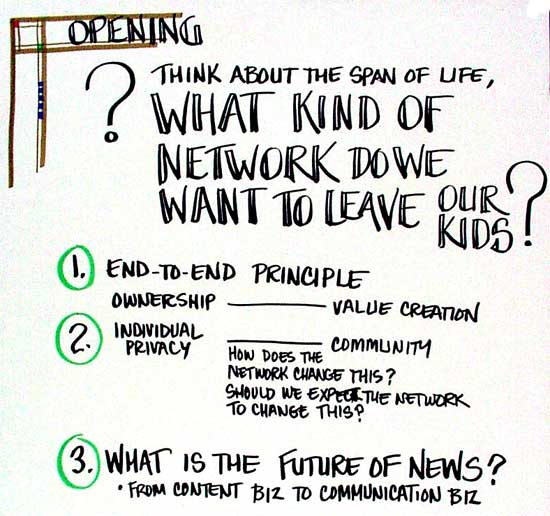
Isenberg: That works for me.
This principle sets up a tension between the ownership of the wires and the switches and the value creation at the edges of the network.
A second tension is the tension between an individual's privacy and the community in which one exists and how communications networks change that tension.
Tom: Can we expand that slightly? Maybe we should ask the question "why should we expect communications networks to change that? It's a people to people problem not a technology problem.
David: That's a good one.
Those are red cards going up there.
Third, I want to say that I 'd like to explore the future of news and that's actually a derivative observation. Ex post facto, I noticed that a lot of the people who I invited here have on-line newsletters. That is why I know them so well. John Jordan, Duane Hendricks, I have one, Petzinger had one, Bill St. Arnaud, Doug Carmichael had a great Y2k one, Tim Horan has one.
One other thing I want to say about CBIC, they wrote a nice investor's white paper on GigE. This one is not your typical investor white paper. It is really good work.
The future of news -- because there are news people and potential news people. David Weinberger is coming. He has a very good one. I don't even read the NY times anymore, I go to these people's newsletters and lists and go to those sources they recommend. The fact that I have relationships with these people changes the way I get my news.
By the end of the weekend I hope we will have a better idea of the network we really want. We will then be able to read about, write about, invent technology for, finance, develop services and applications for networks that look more and more like the network we really want to have.
Let the discussion begin And thank you all for coming.
8. Beginning to Map the Issues
Bob: As David said I will be the traffic cop. I will not be a content person. We need to map out of some of the issues and topics you want to cover so we can use this as a reference guide. You can work off the ones David raised plus your issues.
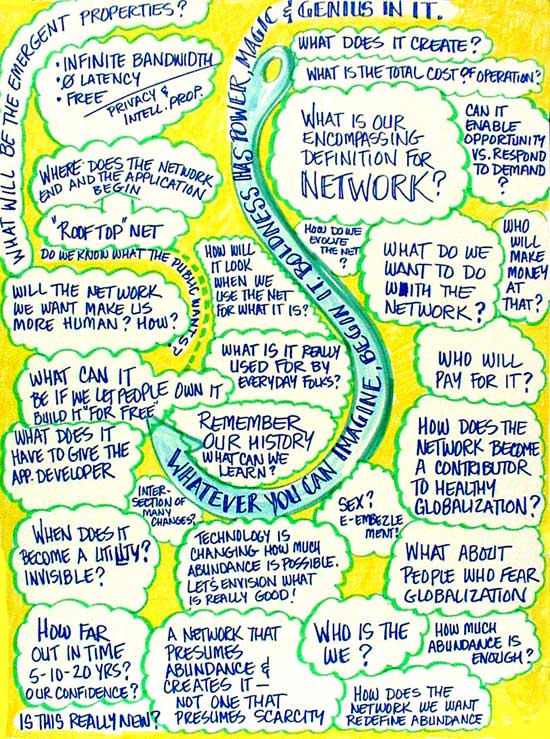
Comment: What do you mean by network? I'm a telephone infrastructure guy. Whenever we try to imagine what we want, we find we are wrong. Do you mean something more than the infrastructure. What does it encompass?
David: I think we mean more than the infrastructure but we can start there. My question is, How far out do we go? I'm with you. I don't know how far out will be productive? How far out does this crew want to go? Do we want to talk about global mind? Applications? Social impact of the applications? Where do we stop?
 I
thought we were wanting to talk about what we are going to do with the
network and who will pay for it and then we can determine the network
definition.
I
thought we were wanting to talk about what we are going to do with the
network and who will pay for it and then we can determine the network
definition.
Doug: I just got back from the UN meetings in New York. What was different this year was the conflict between global as an economic and a social process. People recognize that. The network empowers both of those movements. The thing is, how is the network going to work into what's the future of the economy in relation to the society? What do you do with the people who think their life will be destroyed as they become part of the network, i.e. their economic position requires that they be in isolation from globalization.
David uses the term The Network.
That gets back to what "we" did you have in mind?
Let's start with the "we" in this room. Then do we want to include the "we" in the US? Or the we that is the wired digitencia? Did we want to include everyone in the world, the galaxy.
Bob: We are getting greens for more inclusive of those in the world.
Comment: I came in with one burning question which is the network of abundance rather than scarcity. I'd like to leave our kids a legacy that the network that we continue to build is a network that presumes abundance and achieves it vs. scarcity and controls it.
Recently at a conference, that goal made a VC say that we are in the 5th year of a 20 year build. 20 years is way beyond what I can see. I'd be interested in what everyone else thinks we will be 5 years out in terms of capabilities re: technology that is currently being developed and what we will be doing in terms of the wireless world and the tethered world.
I have a dirty pragmatic view. The network I'd be interested in is one we would call the new essential. If you look at the history of commerce, communication, development, these are all driven by logarithmic scales of change. Trying to make this network as the new essential.
What does the network have to give the end user and application developer so they don't have to worry about the network?
What you can do for free? If I buy 4 PC's and hook them up with Ethernet and build a network at home…I own all of the gear. I always wondered why Metricom didn't allow people to put repeaters on their roof.. What is the extreme of letting people to own this and do it themselves?
Tom: That's the way I'd like to see this go. The answer is Metricom is finding it is hard to charge them.
Jerry: I know people using apple air-ports. I 'don't know how far they've gotten.
Tom: RE: privacy. I'm interested in knowing whether the network we want will make us more human or enlarge our ability to be inherently human. In the end technology makes us a whole lot more human.
There was a company called Rooftop communications. They actually sold a modem, which was an access device plus a packet-relay router. It's a great idea. It scales. You don't need a common carrier. However, how do you get it started?
Comment: Arbitrary networks work.
I'm trying to build a company to do that right now. I have a strong agreement. It ties into abundance. The technology that we are building is giving us the level of abundance that we have never had before. Really focusing on what we want to make happen with the network because we can make the network work the way we want. Wishing what you want to accomplish is a powerful thing. I hope that is what we will focus on. Envisioning what we want to accomplish with this network. We will be able to manifest what we want to have happen. Let's imagine something really good.
Comment: I'm looking forward to Sunday morning, the side of the switches. Once it scales, some weird unpredictable stuff will happen. Along with the purposeful discussions, what will we be able to make happen when everyone plugs in their toaster and we shut the whole thing down.
Comment: All the mechanisms for providing good privacy requires notions of identity to be solved. That flies in the face of anonymity. It is not at all clear what's going to break.
Comment: I'd be interest to see if over the eve. everyone came up with 2-3 words that were descriptive of the network they want. If you ended up with 50 descriptors on a piece of paper I'd be interested in seeing that before we elaborate.
Comment: Can I make a process suggestion? Mike made his statement about the privacy issue and there were a lot of red cards.
Comment: Someone explain the difference between the application and the network - where does one end and the other one start?
Comment: Can people say their name before speaking and where they are from?
Doug Carmichael: Building on the comment re; abundance I'd like to see the network be able to redefine what money is that eliminates scarcity and come up with a system that touches on real wealth.
Comment: This network and the enabling applications that we don't know about today that will be enabled because this new network is there.
Tom: I wonder if it makes any more sense to do that than it did for instance in the early days of the automobile. What would Ford have done in light of the auto and pizza delivery.
9. Describe the Network You Want in Three Words or Less
Bob: Let's now capture the 2-3 words re: the network you want.
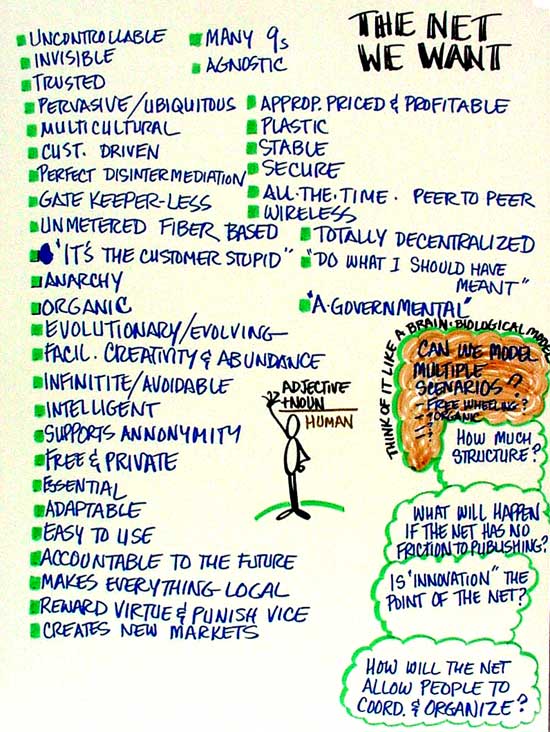
Captured Words
1. Uncontrollable
2. Invisible, trusted and pervasive
3. Multicultural
4. Customer driven
5. Perfect disintermediation (any model based on controlling distribution
is doomed by the Internet)
6. Gatekeeperless
7. Unmetered, fiber based
8. It's the customer stupid
9. Organic, evolutionary
10. Facilitates creativity and abundance
11. Anarchy
12. Infinite, available, but avoidable
13. Intelligent & evolving
14. Supports anonymity
15. Free & private
16. Many nines
17. Ubiquitous
18. Essential
19. Adaptable
20. Easy to use
21. Accountable to the future
22. Makes everything local
23. Reward virtue, punish vice (whose definition?; be careful what you
wish for)
24. Agnostic
25. Appropriately priced and profitable (otherwise it will never get built)
26. Plastic
27. Stable & secure
28. Peer to peer everywhere all the time
29. Wireless and totally decentralized (why would someone from Motorola
say that?; worse yet I really believe it)
30. Do what I should have meant (you mean smart?; omniscient)
31. A-governmental (exists outside government)
32. Creates new markets.
Bob: we could still have more on our map Given a perfect network, what does it create when it exists?
Comment: Nothing.
Comment: Then we will be free to do anything we want for the first time in our lives.
David: If you take a Marxist determinist view, you will end up in worst shape than anyone's choice. I'd like people's opinion on what technology gets cheaper quicker - not to turn it into a techie discussion but does storage and compression get cheaper - what is the end product?
There are a lot of paths to get to that end product too. What do people think might be the right path to get there?
We need to look at the total cost that includes operations. A lot of "bullets" assume this thing runs itself. That's not generally the way the world works.
Comment: Does "the end product" mean that it will stop evolving at some point? Technology evolves on curves. There is no such thing as the end system.
Comment: People are talking about the future but I'd like to talk about the history. What legacy do we want to leave our children? 10 years ago, we couldn't have predicted the cell phone. I was involved in the Japanese cell phone. We made a change of the business plan every quarter. How far out in time - 5 -10- 20 years. We stopped making a forecast for after 5 years. We make a 1 & w year plan just for reference. When we discuss the future issues, to what extent do we cover and how much accuracy we can have confidence in. I'd like to review history as to why we made mistakes for example telephones.
David: I'm not a network engineer like most people here. If we designed a network that was scalable, what would it look like? what would switching fabric look like. Should we have intelligence at the center or at the edge?
What will life be like and then figure out how to network to make that happen.
Bill: There's a great book on the social history of the telephone. It covers the early debates how to sell and promote the telephone. They talked about doing your shopping, with the telephone or talking with your doctor or tele-church services. Just talking and chatting was inconceivable.
Tom: I'd like to follow up on that. What is the network actually being used for now? For every dollar spent on Amazon, there are 10 people saying I love you, or how about those Red Sox.
Mike: The biggest shift I'd like to see is a pervasive mentality of enabling opportunity instead of responding to demand. That extends into the business models. Infrastructure folks respond to demand, not to enable opportunity.
The most conservative things are not the business plans that respond to perceived demand but it's the security models we build. The notion of how we restrict what users can do with each other that responds to perceived need rather than opportunity for users to interact. That's why we have the browsers we have - where we receive only.
How much abundance is enough and when do we know when we've gotten there?
Every time there's been a new medium, we try to pound a square peg into a round hole (Comment: through the attorneys). It takes a long time to figure out how the new medium is expressive in ways that the other ones aren't. I'd like people to start looking at what useful things to use the network for vs. bad cable TV or a bad version of a magazine.
David: I'm hearing something interesting going on here. This will be the first conference where we will talk about the social aspects of the network.
Comment: Could we maybe agree not to mention things like distance learning and tele-medicine. Let's make a space for like sex which drives the Internet more than anything. The reality of e-embezzlement. Include these in the discussions.
Doug: in classical economics, where you have the free flow of info, there is no profit in the system. If we see that it is not able to make a profit unless in a monopoly.
Who's going to make money at that? (Discussed the Radio Shack situation.)
Comment: How do we avoid defacto roll-ups that end up controlling the network? Time Warner and AOL develop choke holds.
Comment: Allows people to coordinate and organize themselves cheaper, people are empowered. I want to see lawful behavior, rule abiding in the sense of maintaining democracy and proceed to do this by its natural operation. I want to see good things emerge from it. What it allows people to do. How it allows people to organize themselves. How we live with this technology.
Question: A few times now there has been a value judgment about the network. I don't know if our inherent assumptions can say that this is perceived as the best structure by the average user. TV has evolved to meeting many more needs… Is the independent node the best strategy?
There's a Harvard research article that drives to that which says that innovation emerges better without the monopoly mode.
Mike: One of the things I worry about is when people talk about frictionless technologies they will often relax into the state of chaos economically and otherwise. When the 1st Amendment was written, being a publisher was hard. If everyone could publish freely with zero friction, what would you get?
Doug: Why do we think the network is so empowering of individuals vs. the global financial services?
I think it is a good observation that it is a good thing that the network is a freewheeling one. But I think we should model several types of networks. A freewheeling one, a monopolistic one, a profitable one. Talk about the characteristics and benefits.
When you have kids you suddenly move to somewhere safer. It's easy to talk about a freewheeling network when you live in a safe environment. I think TV is ghastly but are we representing the population or are we imposing something on people and not thinking about reality?
Jerry: I don't think we can model the idealized, the real network. These things will be all mixed.
Does technology drive the design or do we drive the design or what happens when one bright person designs it. I suggest we approach this from not only understanding what has been and is, but then let that go and explore what can be created with a fresh mind. There are a few fundamental dimensions of the problem that can be viewed. We can get to some very interesting new tools - better and integrated. I'm shocked at how few people try to rethink what we are doing because we are tied down with our old models.
David Reed: There have been a lot of questions re: anarchy vs. structure. Anarchy isn't wonderful but structure isn't wonderful either. Enough structure so a community can manage effectively what it's goals are, but not too much structure. Make adjustments based on the size of the community and complexity of the goals.
David Isenberg: With regard to the thread in the discussion regarding where do the new applications from, monopoly vs. small companies, I want to add 3 more words to the list; 'create new markets'.
10. Exploring Metaphors - Ways to Talk about The Network
|
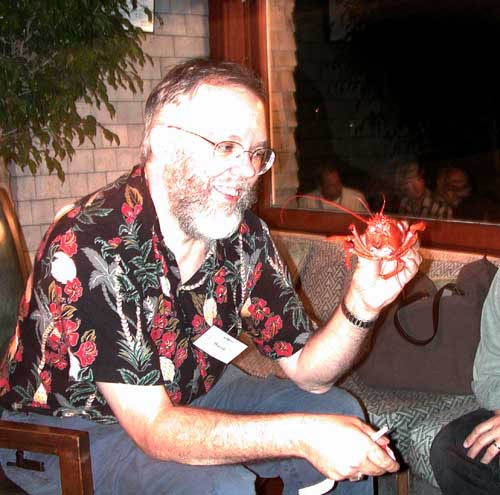
The 'net is like a lobster . . . |
Mike: I think the problem is actually much worse. Not only are people not doing the thinking to realize there are some clear generalizations about the history. Most of them are unaware of the history. If you cross anarchy and structure in a productive way, you get something that is organic. I think that is the perfect network. Steve: I come as an investor and with a neuroscience background so I look at this from an organic perspective and the brain as the model. There are two hemispheres, one that see things as an integrated whole and the other sees the details. A brain is the natural model. The organic nature of the brain is how we will evolve our networks irrespective of whatever direction we set in…based on how we are. Anarchy etc are already addressed or contained in the neural brain model. |
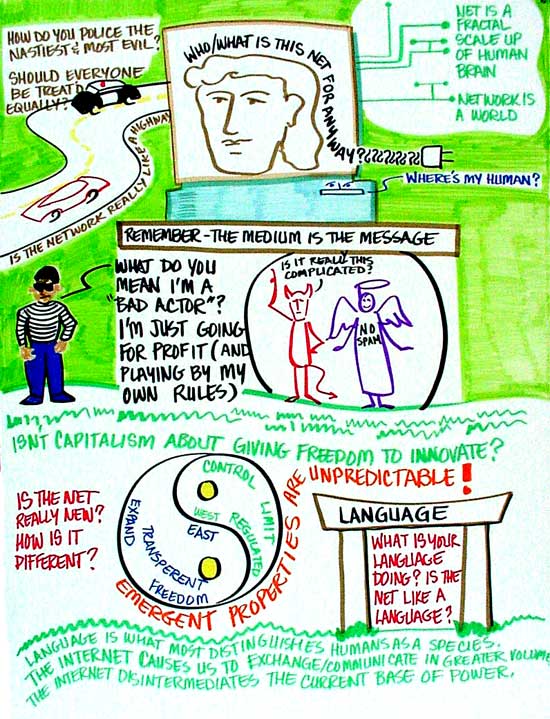
Jeffrey Feldman: Think of the network serving human beings as a noun, human beings as an entity--to do human being things--and given the network, people can do a lot of things on the net. The human part is the adjective…
Bob: I'll let the reds react.
Comment: Could you restate your point in 3 simple sentences?
Jeffrey: Human beings is an adjective - human is the interpretation part, beings is the happening part. is in the individual. The network supports infinite human qualities.
One negative reaction is networks are groups of humans and groups have purposes that go beyond the individual. More interestingly, we've gotten to the point where networks are beginning to service their own purposes. Networks serving themselves and devices not people. Or is the network to serve itself?
Mike: The organisms that work the network work generally on behalf of humans. The things that use the network are not human. If the computers could write the checks, then we'd be an endangered species.
Comment: Someone has to reboot. [lots of laughter]
Jerry: What happens when the intelligence gets so good that humans wind up playing second class citizens?
Technology is trying in its own slow way to emulate the way our brains and our societies work. First you have handwriting, then telegraph, whatever order you want to put these in. You could dominate these technologies until recently. I'd like them to be less and less controllable so these networks are more like our brains and our societies.
Even to think we can imagine the network is hubris. I never knew that plastic balls and blocks were so fascinating until I saw our children creating structures out of them. Let's just build something that our children can get creative with and then get out of the way.
There was a famous guy named George Mealy presented a paper re: the operating systems built by companies. Operating systems built by companies at that time tended to reflect the structure of the organization that built them.
Comment: Is that an advantage?
Tom: I don't understand why we keep saying the network has to be transparent. Look at our highway system. It is anything but transparent. It has drastically changed the way our society is organized.
Comment: Are you saying that the highway system does not look like the brain or the society at large?
Tom: I don't care.
Just for the record, less we come to view this as an organism itself, the network is a technology system, not an organism. The network is a digital device.
The opposite hypothesis that the network is a fractal scale-up of the brain. 30 years ago Marshall McLuhan said the medium is the message. Our behavior is a fractal scale up of the network and other experiences we have.
David Weinberger: The network isn't like the brain even a little bit. It's not even like a computer a little bit. Societies are not like the brain. The network is a world. The network is not a medium. The network is what we experience that we move through. I'm surprised people are thinking it is.
I am hung up on the analogy of highways. The idea that you can advance yourself by screwing others. This is an important property of networks. TCP has rules build in. There are many instances of highways where you can get ahead by screwing other people. How much you enforce the behaviors that advance others too.
Comment: I'm amazed at how we can drive so fast and not have collisions. There's something going on in this collective process that really works.
11. What about Bad Actors? What about Unintended Consequences?
 Comment:
You want to have cooperative behavior.
Comment:
You want to have cooperative behavior.
Comment: You need to address the problems of the bad actors.
Comment: We do have anarchy in the sense that practically Mike O'Dell can't personally punish poor behavior.
Comment: I think he could.
Comment: Okay, he's one of the few who can.
Comment: The bad actors interfere with a few and we live with it.
Comment: That gets to an architectural design feature.
Comment: Can't you get ahead by spending more money at the problem vs. driving the car at 500 mph to get ahead.
We are operating under the assumption that everything should be equal for everyone but that isn't how society is currently structured. Move toward you get what you pay for I propose get what you par for be added to the list.
Comment: You will have a network that will enable certain capabilities for some and not others.
Comment: I meant the guy who deliberately violates the rules of TCP or is looking to break the network.
Comment: Capitalism is based on the utilization of scarce resources. We don't know what networks should look like going forward. We don't know what the applications will be. From a financial perspective there's probably tens of millions going down the toilet.
Comment: This whole good-bad thing bothers me. What's bad, who defines it, who's the cop? Example: forest fires were bad and yet they can be good. We don't know what's good or bad sometimes. We might ill define what we want to create.
Bob: Here, here (lots of greens).
Comment: We have attempted to do that with ATM.
Comment: You don't want to have high level good and bad, but you do want some type of mechanism for cooperation at the lower levels.
So therefore it is capitalistic in the sense that the network isn't trying to tell you what to do.
I want to disagree on that point of wireless networks. It is possible to configure wireless so you don't have to have anything of the barest modicum like that shall not carry guns.
Comment: There has to be something built into the architecture that creates a way to resolve tension. I'm suggesting that just the battery capacity will prevent you from causing trouble.
Comment: Bad actors: I think society has defined the bad actor.
Comment: Unless you are at war and you are a hero.
David: But that is still a societal decision. It is necessary for us to live together w/o destroying ourselves. This is obviously deep philosophy.
Comment: If you are going to have a best effort service, you need to share resources somehow.
Comment: I was struck by the broad band of green agreeing with the statement where we don't want to ascribe good and bad. We can't get away from values being implicit in the system. How do we get away from that. No values is a value system. It is inherent.
Can we actually create a coherent, useful product without a system of creating good and bad? Like these cards are our system of governance, we have agreed on this system and are following it.
12. Balance between Agency and Communion
I hear the tension here that always exists to balance between agency and communion. You want everyone on the network to be in communion but you don't want to hamper an individual agency and that's the way a functional society works.
We all will be the social contract by participating in the network. I disagree with this at the extreme. Somewhere there is an authority and somewhere there is a definition of good and bad, but I don't think you use the network for that. Let's us human beings decide this and let the network be transparent.
Comment: We don't know what the network will be in the future and if you impose structure we will hinder innovation. That's what capitalism is all about.
Comment: There are a lot of aspects of capitalism that limit possibility. For example intellectual property and patents. A pure capitalist approach is not going to solve all of our problems here. The ultimate network will be able to hold the paradox of the various perspectives/approaches. The best you can do is create reasonable feedback mechanisms into the system for people to participate consensually.
5:50pm
13. What Network are we Talking About?
David: What network are we talking about? The global Internet cloud? The network we would recommend to an enterprise? Why is there only one? Or networks? In a capitalist environment where people don't like something, they create their own version.
I just want to make the point that the people who suggest the network should be transparent and stay out of policy and ethics, I think it's impossible. The network architecture unavoidably creates these kinds of structures that influences these things. The problem is you don't know what influence it is going to have.
From a capital efficiency and functional perspective, you want a single global network that you can carve into different virtual networks. This may be the gateway model. Same infrastructure but groups can create their own approach.
I'd like us to look at what the network enables than what the network does. It enables a variety of things. That's what the stupid network is.
Comment: Sometimes when I try to use an analogy I use the metaphor as language. Useful metaphor for this question of control. For example there are people who use French to control thought. Similarly, science has a language that they use as a mechanism for controlling thought. If we translate ourselves in terms of languages. There are lots of forces that are trying to partition the networks. I'd like to think that we will have one network but languages are giving me pause. We don't have one language.
Comment: Science doesn't control thought but it certainly constrains it.
Comment: The problem may be, I'm very confused about whether we are talking about network protocols or what we are talking about what people are doing with the network. I'm more interested in the social level. Is it just me confused about what we mean by network?
Comment: I'm moving back and forth. It's moving all over.
Bob: We are moving back and forth
Comment: The protocols were human designed. We are not able to have a discussion about what we can do with networks in a way that was not possible before we had the Internet.
Comment: Where did the word protocol come from? Comment: Diplomacy. Comment: In a real way, we aren't talking about anything different.
14. Language, Printing Presses, and the Disintermediation of Power Structures
Comment: Language is a thing that most distinguishes the human race and what is new is the amount and variety of communication that is occurring through the Internet. We are refocused on the fundamentals of what makes us human.
Victor Hugo in the Hunchback of Notre Dame has a discussion between the King of France and the Archbishop of Paris about what the printing press is going to do to the Church. Everything you said is what Hugo said the printing press did. That's what you just said. There is no difference.
Comment: And that was the last major advance.
Comment: No the train.
Comment: Every time there's a new form of communication, we have the exact conversation.
Comment: There were forged copies of his book after 24 hours of his publishing the book.
Comment: What the printing press gives is the ability to communicate with anyone else cheaply, fast, reliably. If you look back at the history of the printing press, he was talking about the fact that the other people could make use of that information.
Comment: The web is fundamentally different in that it is not a communication device, it creates a shared persistent world. We haven't had anything until now that creates a new persistent space. Shared persistent space makes it fundamentally different. It is a new public space.
Comment: TV creates a shared space.
Comment: But TV is only one way. TV is not a space. I can't move through it.
Comment: We are giving technology way too much credit. People have had different languages, and different kinds of discourse, different cultures, sub-cultures. One kind of conversation you have in a business meeting, etc. Every kind of language and communication has it's own rules. We are just saying that this is a powerful metaphor and creating something new. But giving the Internet the credit for creating types of discourse is giving it much too much credit.
Comment: Is the Internet really new? There's two answers: it is new or it isn't new. If it's the same as all the other media changes we've seen, then what do we have to do to learn from history so we aren't condemned to repeat it. I think a vote would be a great idea.
15. Is the Dynamic Created by the Internet Really Different?
Comment: You've just collapsed the space into Boolean (logic i.e. yes/no). You said new or not. How is it the same and how is it different. These are subtleties.
Comment: The population is very different from the time of the printing press. It enables spontaneous creation of communities from unacquainted people. It's the first time that communities can naturally form.
Comment: What about
the savannas and prairies. 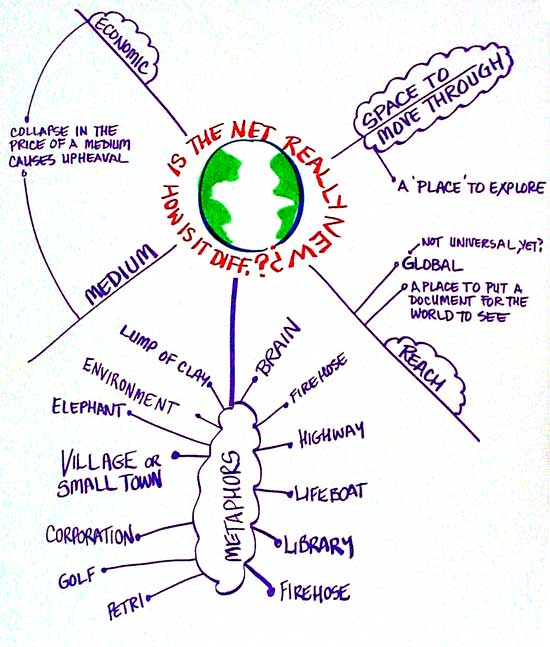
Comment: What about cities?
Comment: Those were all based on a location.
Comment: Where it is different is it is new real estate. I have a vast new savanna that is essentially limitless.
Tom: I have been studying communications for a good long time. I agree the Internet is not new except in one dimension. The Internet makes people's potential sphere of awareness global. Time is another barrier that is has broken.
We have several orders of magnitude change associated with the network.
It's not that it's just bigger and reaches everyone at the same time. Until the Internet, you and other people in the world, could not leave a document out into the world that other people could bump into. This is revolutionary.
Comment: If it's new or not new, or revolutionary, does it change the answer?
Yes.
It's a cost of production issue. The closest analogy is in 1485 with manuscript writing by many, many people. Books were $8,000-50,000 dollars. Dropping books down to $100 changes the readership by orders of magnitude. Major change occurred due to the collapse of a price of a medium. If we are faced with the drop of price of something, some people will be hurt professionally as they are disestablished.
Comment: Did anyone disagree with me when I said it was disintermediation?
Comment: The Internet has changed the scale of things, but global is still not universal. Web pages are not universal and they aren't necessarily permanent.
Comment: The English language has the concept of a pun. I haven't found a European country that has the concept of the pun. There's a play on words. Even though there isn't the word pun in Russian, the concept isn't foreign to them. So, just because you don't have the explicit control built into the network, doesn't mean the network won't affect that control or affect that tool.
Bob: We are running out of time. I'd like to get burning issues from people who are new.
Comment: Having meetings in a virtual basis.
Comment: The rest of the world is changing also, for example increasing population. The intersections between these will be important.
Comment: It is possible that the network can change. Children have differently neurology from earlier generations do to environmental differences. This is co-evolution.
Comment: We aren't here to invent the network. The network has already been invented. The cat's out of the bag. We are talking about its evolution.
Comment: We don't know that.
Comment: I think it is clear why we are here, not just about tomorrow's stuff but what the platonic ideal is of the network so we can tell if the future is a step backwards or forwards.
Comment: I think it would be interesting to compare our discussion with what David's original intent was for this discussion. There's something interesting that we mostly went into the social aspect of the net vs. the technology and that's interesting for where we will go tomorrow.
David: It is now time to eat, drink and be merry. It is time for fishing also.
 |
BigHook Main
BigHook2000 Recap Home | Context | Summary Fri Eve | Sat Morn | Sat Midday | Sat Eve | Sun Morn Photogallery | Scribegallery | Music isen.com, inc. | Sterling Insights Copyright 2000 isen.com, inc. |