 |
|

Session 4 -- Saturday Evening, 9/23
- Welcome
Back
- Ernie
Robson Speaks
- Peter
Kaminski Speaks
- Anders
Comstedt Speaks
- Bill
St. Arnaud Speaks
- Bob
Lucky Speaks
- Matt
Oristano Speaks
- Question
& Answer
- Ethernet Enters the Story
1. Welcome Back
Bob: We'd like to get started with our evening session. Who needs feedback cards?
We will start by using the format of experts. Ernie has asked for his 3 minute talk and then 4 experts and then Matt who wants a 3 min. Then we'll end with questions and answers. Let's try to keep it at about an hour.
David Isenberg: I'd like to announce that Rob Tannor so far has the longest fish. Tomorrow will be very competitive for fishing.
2. Ernie Robson Speaks
Ernie: First of all
I appreciate being here. My expertise is very different from yours. My
expertise was for 15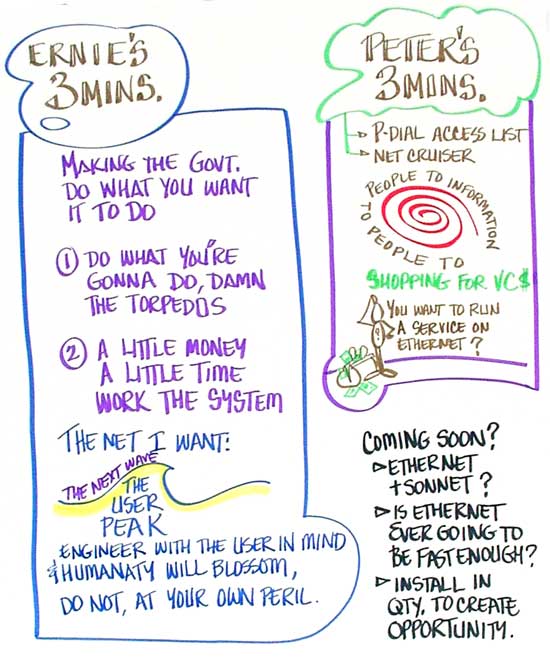 years making the government do what you wanted it to do or not do what
you didn't want it to do. This discussion we have had today, I want to
say stop whining and ringing your hands. This is not a tough system to
work. There's 2 ways to do it: is just go do it and have people catch
up with you or you just work the system. It just takes a little money
and a little time. It's the way the process is set up.
years making the government do what you wanted it to do or not do what
you didn't want it to do. This discussion we have had today, I want to
say stop whining and ringing your hands. This is not a tough system to
work. There's 2 ways to do it: is just go do it and have people catch
up with you or you just work the system. It just takes a little money
and a little time. It's the way the process is set up.
David Isenberg: I have to say when I went to the FCC and I was just some guy with an idea, I was really welcomed.
Tim Denton: Yes, when you have no interest to defend, they are all ears.
Ernie: the 2nd thing is, I what to go back to when were talking about the network we want. In the information age, there's been a hardware peak. There's been a software peak and I think the next wave is a user peak. There are engineering principles around human engineering. There's a way to design a web site that makes it easier to read and understand. There's a way to design a system that makes using the net easier to use. We will be successful if we don't ignore this.
Christian: I happen to agree what you said. When you write a book you write it to your audience and you can learn this if you go to school. Same with presentations. The problem is we find there's actually a shortage of professionals who can execute something like that when it comes to websites or user interfaces.
That's clear from example. [laughter]
Dell for designing their web sites got some people who could train people how to do that better, they set the minimum standards
And that's what they got.
Yes they got the minimum but it's a lot better than others.
3. Peter Kaminski Speaks
Peter: David asked me to talk about Yipes and what we are doing. I started doing internet as a software guy. Went to Netcom to write netcruiser for them. Which got many more people on the net. My focus has been connecting people to info and people to people. I'm an application guy. I've ended up helping found Yipes which does LAN to LAN and LAN to Internet connectivity using GigE over fiber. We started in Palo Alto. We had a regional ISP. Palo Alto expected commercialization to happen on their fiber structure. The residents and we developed a way to use it. It seemed like we could take the new commodity Ethernet switches and stick them on the web. That was the genesis of the idea. That was about the time I found David's web site.
We ended up drawing out the network diagram. We ended up with many boxes. We have the Ethernet switch with fiber in the middle. This was interesting enough to shop around to the VC community. It took us about 6 months to break through. We aligned ourselves with an executive group that was strong. The first VC's would listen to us but it didn't quite make sense to them. The technical due diligence people said we couldn't do that. Finally they would go oh, you could do that. This epiphany happened over and over. You guys are going to kill an RBOC. He was used to spending a 100 million per year and we were talking about a couple of million.
The network we started out to build, we thought it would be a municipal network like the one David described. We are using dark fiber.
4. Anders Comstedt Speaks
 Anders:
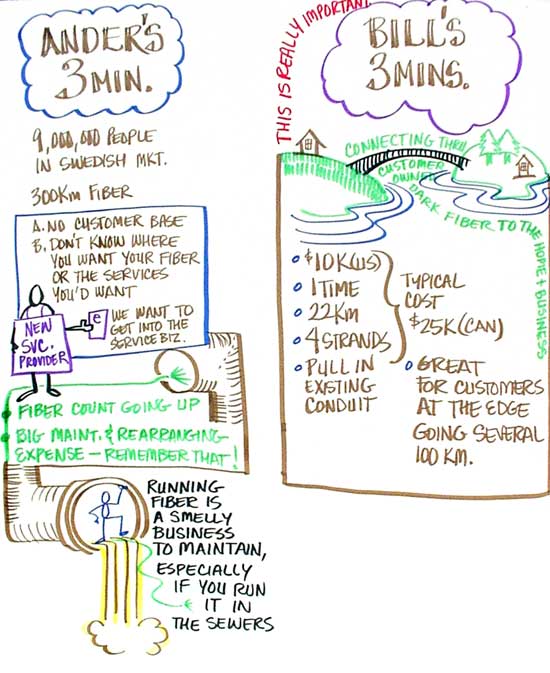
What did you do in the war? I kind of started the war. I know you don't
know much about the Swedish market. We are 9 million people. I operate
a small operation in Stockholm area. We have 300,000 miles of fiber out
there. We try to do what guys like you want us to do. We take care of
a lot of insecurity that any new fiber business would do. They don't have
a customer base. They don't know the services you would like to have with
fiber. With that in mind, we started our operations saying, now that we
get these service operators in town, an opening of the market in Europe
wasn't heard of, how long time you could land a fiber cable.
Anders:
What did you do in the war? I kind of started the war. I know you don't
know much about the Swedish market. We are 9 million people. I operate
a small operation in Stockholm area. We have 300,000 miles of fiber out
there. We try to do what guys like you want us to do. We take care of
a lot of insecurity that any new fiber business would do. They don't have
a customer base. They don't know the services you would like to have with
fiber. With that in mind, we started our operations saying, now that we
get these service operators in town, an opening of the market in Europe
wasn't heard of, how long time you could land a fiber cable.
The Swedish market became interesting for a lot of others. Just by getting yourself a VAP number, you could be a telecom operator. It didn't give you any big rights. You had to negotiated. We've been doing this since 1994. We have significant business with some 30 operators. You will find a number of end customers saying I don't need this telecoms operator.
People were surprised to hear the bank who rents cable from me going through the city. Why do they want to have this many fiber? It is convenient. That is why this is so incomprehensible. We didn't plan for this. We soon found ourselves asking the cable manufacturers to provide us with 192 fibers. Today we are deploying cables with 400 fibers. The fiber counts are going up dramatically. They are a commodity if you sell them high and cheap. There will be a great demand for it.
With 300 kilometers of fiber in the ground we have a maintenance problem. It's not just a matter of getting the fiber down there, you have to maintain it. Ask yourself who wants to go down into the sewers to maintain it.
A number of power utility people would like to dive into this. Maybe use their high voltage lines. The biggest problem is really maintaining this in the wintertime. You can't shut the power down. Number of problems with all of these alternatives. In the end, it will be there for awhile so consider the maintenance aspect.
Bill: I was just thinking watching the ferries going by. This is what the internet is like. You have 3 or 4 ferries doing this. As there are more and more packets, ferries don’t scale. Maybe we should build a bridge. Who builds bridges? You would lay off a lot of ferry operators.
David Isenberg: When you build a bridge to an island, it's not an island anymore.
5. Bill St. Arnaud Speaks
Bill: What we are seeing is in Stockholm and Palo Alto, doing the fiber to lower the barriers for many competitive service carriers. They are strictly doing the fiber. We are now doing some massive fiber builds which allows customers to buy their own fiber. That's where we see the next stage is occurring. In Ottawa we see fiber build through the city like a condominium. Many diverse folks. It is surprising how low the costs are. Many institutions are cheap so I'll buy 50 strands. All of a sudden, if you can buy dark fiber, it opens your mind re: possibilities. I don't have to deal with a carrier again. Now we are trying new technology with a switch where the customers own the ports and the switch components. The customers will own switch ports and fiber so they cross connect with others across the country. This is still very experimental. It is a whole model of change. It is customer-owned. And then peer connect to service providers where they want. We'll see how it works. When governments work with us to deploy this fiber, it allows all sorts of new kinds of relationships.
Question: How cheap is it?
Bill: $10,000 US for fiber connection, 22 kilometers, to a central site, one time, for the next 20 years for 4 strands. Wireless has a great future and has potential. We are laying this with poles. The city has built conduits around the city. If it's not there, they'll dig it for you. Safety regulations involved. We get private companies to install, build, and maintain.
Question: How are you going to do long hauls?
Bill: We are doing something with CWDM up to 500 kilometers. 18-16 channels
But it is not scaleable. Great for customers at the edge. We are looking at what our options are. How to optimize channels. How do you trunk them to prevent channel by channel switching?
Ernie: Does everyone realize how important what he is doing? He has been building a knowledge base. Yeah.
David Isenberg: This is really important shit.
Bill: Sweden has been leading the way. This is a grass root thing that is happening all over the place.
6. Bob Lucky Speaks
Bob: That was really
important stuff and in contrast to that, I'm not going to talk about anything
important at all. 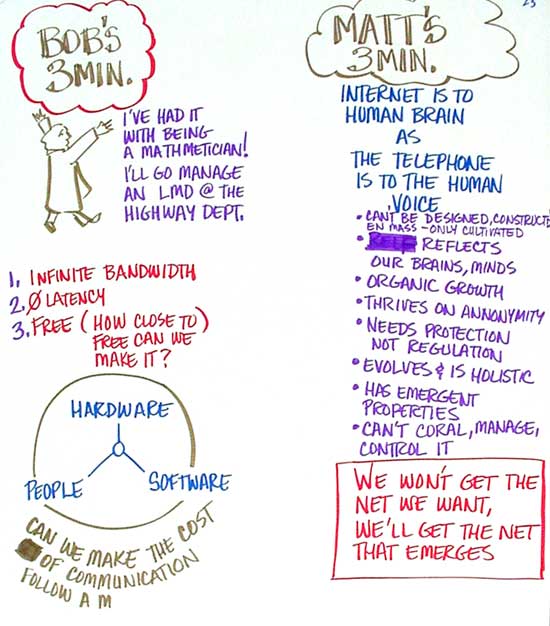 I
just have one small story…what did you do in the war daddy? At Bell Labs
I had a good friend who was a great mathematician named Dave. One day
he quite Bell Labs. He said he had become so disenchanted with doing just
math. He quit and went to the Dept. of Transportation where he could make
a difference in the world. A shock wave went through the lab. Two weeks
later he shows back up at Bell Labs. For years people would ask him what
happened. And he would only refer them to a story that a friend of his
when asked by his kids what did you do in the war daddy, he would say:
"It was an experience too horrible to recount." It turns out this guy
during the war involved in and LMD.
I
just have one small story…what did you do in the war daddy? At Bell Labs
I had a good friend who was a great mathematician named Dave. One day
he quite Bell Labs. He said he had become so disenchanted with doing just
math. He quit and went to the Dept. of Transportation where he could make
a difference in the world. A shock wave went through the lab. Two weeks
later he shows back up at Bell Labs. For years people would ask him what
happened. And he would only refer them to a story that a friend of his
when asked by his kids what did you do in the war daddy, he would say:
"It was an experience too horrible to recount." It turns out this guy
during the war involved in and LMD.
Question: What's that?
Bob: A large mahogany desk (LMD). [laugher] But the moral of the story is that when Dave came back, he was okay with being a mathematician. Society is rich enough that it can afford people like me at the fringe working on intellectual endeavors. The internet world can afford for us to get together to talk about good stuff for humanity. [clapping]
Bob: 3 characteristics we could agree on: infinite bandwidth, free, and zero latency. How cheap can it be made? Can the end to end cost of communication obey something like Moore's Law? I don't know the answer to that. Telecommunications looks different depending on who's looking at it. The vast people see the network as the back offices that run the company. There's a huge cost and that's not going down like Moore's Law either. We are doing a good job with hardware. Can we get the software and the people out to make the cost go down to follow Moore's Law? They will tell you these other models won't scale. I put it to you, that is the real question.
7. Matt Oristano Speaks
Matt Oristano: We did a lot of touch and go so I'm going up to 50,000 feet. I will not be saying that the internet is like a brain. I will be saying though that the internet is to the human brain as to what the telephone was to the human voice. The network is not necessarily like a brain, but -
The network is to the brain as the telephone is to the voice.
The network is like human consciousness; it's like us.
The protocols are it's DNA. Its communications backbones are its nervous structure;
and we are its cells.
It is being built by us, and reflects, embraces, and extends
Who we are.
The network is organic and evolving - So are we.
The network cannot be "planned" or "controlled", except in the most temporary and trivial ways - Just like our lives.
The network thrives on anonymity.
The network thrives on publicity.
So do we.
No one owns it. But everyone has a piece of it. Just like our society.
The network is about freedom, but within socially accepted structures - so are we.
The network needs no governmental meddling, but it also needs governmental protection - So do we.
The network facilitates multiple personalities on multiple levels. So do we.
The network builds on structures and processes that have gone before, and so are we built. Cell structure, or the triune brain would be examples. In that sense, the network represents nothing new.
But the evolving and holistic nature of the net will exhibit emergent properties not seen before nor expected (Napster). So do we. In that sense, both we and the network represent something very new.
The net is an emergent form of new human consciousness, in its infancy.
It cannot be managed, corralled, owned, designed, predicted, or killed.
You will not get the network you want.
You will get the network that evolves to be.
8. Question & Answer
 Bob:
We will now open the floor for questions.
Bob:
We will now open the floor for questions.
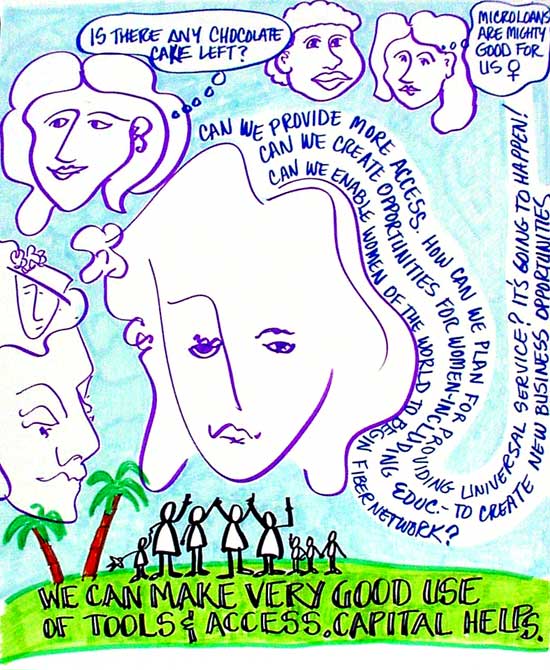
Comment: There's a group called Calmetto foundation. It goes out and to the poor population which are generally women, and it takes 6 of them and gives them $100 each to start their own business. Each of them guarantees payment on the interest of the loan from everyone else. They have the lowest loss rate of any bank in the world. We have this digital divide think and if we look in North America, the poor is mainly single women. Have you thought of taking that super cheap dark fiber and giving some to the poor women and setting up a bank lending them money so they can launch their own business. I think society will change very dramatically at the grass roots level up.
Bill: Fiber is only a small part of the equation. We want to reduce barriers. In Alaska we brought fiber up the pipeline up to remote villages. Now women have set up coops selling whale meat over the internet. It's a great little story of enabling remote people offer their wares to the world.
Question: Why let them do that, let's reduce it down to the core units of society?
Tom P: There are a group in West Virginia who self organize and fulfill orders over the web, they don't need brochureware. They are doing it on AOL accounts. It self organized.
Comment: When you empower someone who already has a skill for something is one thing, not everyone has the ability to use this as a business mechanism. Providing access to folks who might not be able to afford access. Maybe a great use would be to run it to low cost housing. Make sure they have access (a segment of society that can't participate in the whole life of society.)
Comment: We are going to get to universal service. Someone will make it a political issue. The model of the state provides the fiber and someone else will provide the connectivity is more appealing than the last model we had. I think some people here are objecting to providing bandwidth to everyone.
Bill: What we are seeing is a separation of the ownership of infrastructure from the service provider like the power model (gas).
David Reed: I've heard another thing: a common error in assumption. I serve on the Greenstart foundation which is about providing access in 3rd world countries. We've been working on getting access to kids in 3rd world countries. A zero year old person in US and a zero year old person outside of US have the same skill and learning rate to use the internet. The biggest value creator is deploying availability to children.
David Reed: From most able to least able but there's a tremendous thing that humans start out in the same place. If you can break the barrier of the head man thinking it will be used by the leader vs. the children. My children can apply it to their lives much more. For example, considering a career that you wouldn't normally have considered.
Anders: A lot of people think you put the cable down and then forget it. That is true to a certain extent. You need to rearrange the network. You need to design the network with that in mind. When you are dealing with the kinds of things people are doing, you can't control the amount of flexibility needed.
Dan: Is the maintenance an overwhelming problem?
Anders: No. It's just something you have to keep in mind.
Comment: This is not unique to dark fiber. There's cable maintenance as an issue across the board.
Comment: If you want to dig up your road, that is part of the cost.
Jerry: Has the hardware gotten cheaper?
Comment: We still need it.
Mike: There has been a huge distortion in the marketplace. You basically can implement a lot of this stuff and the ability to throw 3 million transistors at something is getting reasonably cheap. It is dangerous to confuse the fact that the market has been historically distorted and that it will always be. There is certainly hardware that changes the economics. You don’t' have to be held hostage to the traditional suppliers and the price points. The economics of that has changed dramatically. People are figuring out that if they don't eat their lunch it will be eaten for them.
9. Ethernet Enters the Story
Comment: Our bet is that the Ethernet is more of a commodity here so it will always be cheaper. The sonic folks have gotten clever. You see a hybridization toward the center.
Comment: Gigabit interfaces aren't fast enough to warrant deploying at this point.
Mike: When we have 10 gigabit Ethernets, I'd be happy to use them. It will become a tactical issue but not a strategic issue. The complexion of that tradeoff will change quickly in a useful way. You will pick the tool that fits vs. what you can afford.
Comments: Sonic over RTP over IP allows a carrier to provide Sonic. Using RTP clocking - real time protocol. Sonic is being used in a point to point fashion. It runs over IP so you have the same recovery as IP.
Roxanne: I have a general question re: Bob's comments. Southwest you can go point to point for $100 and still make more money than their competition. Re: software cost, as we move to Ethernet how much do we gut? How big is that change?
The operating services are wholly different.
Is it a flat rate?
It's the flow of the work and people that have to be coordinated. The difference is so profound with Ethernet. You just plug stuff into the Ethernet.
9:21pm
I think the other thing going on is there's a big piece of the provisioning market that is being replaced by bandwidth options. It's not the metropolitan area.
We provision T-1's. That way you have the facilities nailed up. You roll the body once then downstream you exchange CFA. It' like power of attorney for a switch panel. It all happens in seconds instead of days. You factor it out. SW airlines succeeds because it is a packet switch. What a great service.
We will stop here. We will convene at 9am tomorrow. Some of you are fishing at 6am.
9:24 p.m.
 |
BigHook Main
BigHook2000 Recap Home | Context | Summary Fri Eve | Sat Morn | Sat Midday | Sat Eve | Sun Morn Photogallery | Scribegallery | Music isen.com, inc. | Sterling Insights Copyright 2000 isen.com, inc. |