 |
|

Session 2 -- Saturday Morning 9/23
1. Saturday
Morning – Welcome Back
2. Summing up Session 1
3. Morning Insights
4. Funding the Infrastructure
5. Paying for Best Efforts
6. Increase in Demand 2x Creates a 10x Increase in
Cost of Infrastructure
7. Isenberg’s 3 Minutes: Municipally Owned
Networks
8. Will there ever be Traffic Stasis?
9. Skip Andrews’ 3 Minutes: Will the network
make us more human?
10. Societies collapse because they overspend
on their infrastructure.
11. What are the Minimum Common Services Required
12. Metaphors, Internet, Sense of Self
13. Privacy and Identity
14. Anonymity or Pseudonimity
15. The Net is a Melting Pot
16. What Makes us More Human?
1. Saturday Morning – Welcome Back
Bob: What we are going
to try to do today…we want to encourage you to talk among yourselves and
less to me. I feel like some of the 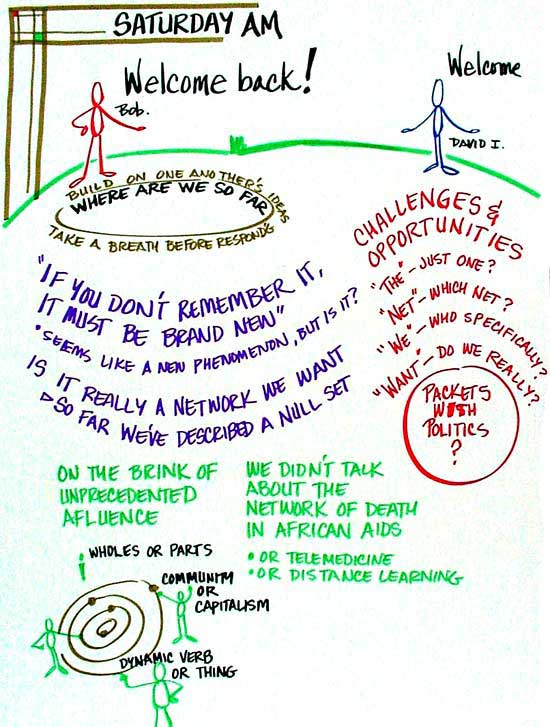 conversations
were stilted by addressing your comments to me. If you see a red card
while you are talking, you have the ability to call on that person and
give your rebuttal to what you say. I don't think you need to go through
all 5 people who raise their card. This will stimulate conversation amongst
each other.
conversations
were stilted by addressing your comments to me. If you see a red card
while you are talking, you have the ability to call on that person and
give your rebuttal to what you say. I don't think you need to go through
all 5 people who raise their card. This will stimulate conversation amongst
each other.
Say your name before you speak. Then take a minute to take a few deep breaths before you speak vs. a rapid fire. More thinking this morning to get into deeper issues. We want you to build on what the person just said. Don't try to bring up another topic. That's pretty much how we want to work together.
We have more of a circle today. We do have someone who has submitted their three minute card. so we'll try to get that in.
2. Summing up Session 1
David has asked three people to summarize what we learned yesterday. I don't know who those three people are so David will you please introduce them. We will have three hours so we will do an hour and 15 mins. and then break for 15 mins.
David: I'd like to welcome the 2 new people today, Christian Huitima of Microsoft - architect for Windows networking, Steve G. Steinberg who wrote the definitive nethead v bellhead article in 1996.
I've asked 3 people to tell everyone what they saw and heard yesterday so you'll get the 3 different views of the elephant.
Comment: Every conference needs an SOB.
Scott Bradner: Somebody had to say it. There are a couple of things I heard. If you don't remember it, it must be brand new. The Internet is either not new or new. There was a lot of spirited conversation about that topic. And we have great pictures showing what we discussed. I don't generally get a physical picture of what I'm saying.
It is certainly having more impact than other phenomena. That may only be our point of view. Lots of talk about the network we might want. I'm not sure that everyone wanted what they said they wanted, for example anarchy. A lot of those things turn out to be null sets. We were having a lot of ‘null sets discussion’ yesterday. History says it is not new. Yesterday was important, a bit irrelevant but needed to be said so we could get on with talking about the net we want.
John Jordan: There was an incredible diversity which reflects the challenge and opportunity here. When groups try to solve a problem they first knock down the concepts. So if we are here to define the network we want, we knocked down the word "THE" and we said "how many" What do you mean by "network", who's "WE", "want". WE talked about either ‘null sets’ or ‘scary sets’. Privacy and anonymity are major leverage points. If you say anything about either of those things you light things up. Capitalism is another one. Do packets have politics? There is a very strong cleavage line in the group. How that shakes out will be interesting to watch.
Tom: To part company with John, I sense a lot less cleavage in the group. I sense a near unanimity of the consequences of all of this. We are on the edge of a lot of incredible affluence where scarcity evaporates from civilized society. The net enables us to be and do our best, eliminate inefficiency and therefore we are on the verge of this utopia. There have been a lot of utopias promised in the past but it is my opinion that this time we will have this affluence.
On a 10 scale of libertarianism I think we are a 91/2. We adhere to the rule that we wouldn't key in on telemedicine and distance learning. Over the clambake where there was a lot of cool stuff being discussed, thing like Telemedicine and distance learning shouldn't be thrown out completely. There are advances happening due to the net which is actually changing medicine. This isn't telemedicine.
We are at different levels trying to get at the same level. Some of us are talking about whole, some about parts, the net as a medium, some talking about the applications. Some about what it is, what it should be, where it came from. Is it a cause or a consequence of what is going on culturally and economically. Lots of interesting dynamics and directions we could go.
3. Morning Insights
David: One of the most articulate skeptics, Steve Talbot, but who had to cancel coming but I highly recommend his newsletter, NetFuture. How many subscribe to his newsletter (3). It is really good. Go to NetFuture.org. If you are a real optimist, these will inoculate you.
 Bob:
We'd like you to discuss something that you wanted to bring out to the
rest of the group from your walks and talks, your shower this morning,
discussed over dinner, while you were fishing.
Bob:
We'd like you to discuss something that you wanted to bring out to the
rest of the group from your walks and talks, your shower this morning,
discussed over dinner, while you were fishing.
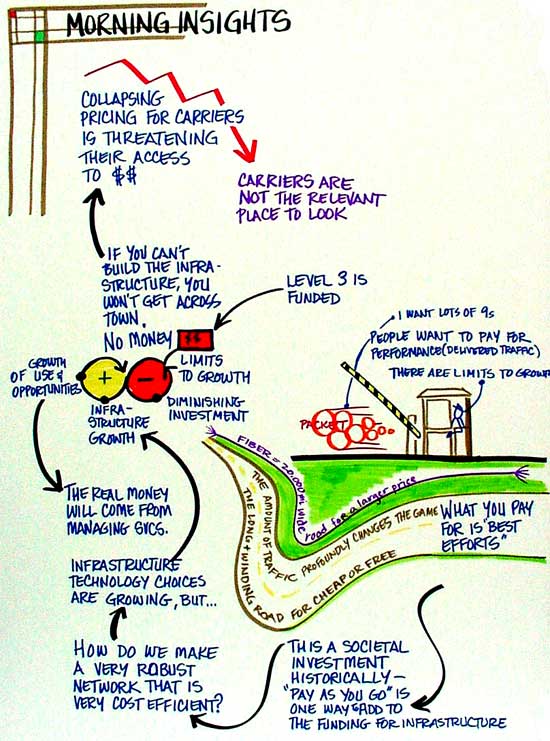
Roxane Googin: Talking about the utopian nature re: what we are potentially facing I'd like to put out a contrarian view. A short term view of how we get from here to there. I look at the impact of technology on value creation that is manifested in the stock market. If you look at what's happening in the stock market, if you think we are leaving the PC paradigm we are moving to the network paradigm, it looks like we are getting into some potholes in the way. If you see the stock market as a discounting mechanism, some service providers are starting to go bankrupt. How do we get from here to there. The first move to this paradigm was very optimistic but reality is prices of the carrier are getting higher. The capital markets are in danger of freezing which means they aren't going to grow and we aren't going to get what we want. Long term, how does it look like from now where people are going under and the providers of the service are being denied access to capital to what we want to get to?
Bob: Pick a red card or a green card.
Comment: I think it is a classic mistake to focus on the carrier as a metric of a phenomena. They had their day, but what's interesting is those navigating around it. The bottleneck in the system is what the market has to deal with. The carriers aren't the ones creating value. The value is at the edges.
Mike: I agree with your general statement that a lot of the excitement is going on at the edge. She is right. If you can't build the infrastructure that connects it all together, then all you'll be able to do is get across town. You've seen an interesting phenomena, where toll charges are charged based on how far you go. I didn't do it.
The interesting question is if the money dries up for building it, then there are real limits to growth. I put 3-4 million dollars a day into my network, capital expenditures. You don't do that selling pencils on the street corner.
My point isn't that spending capital doesn't have the high return to fix the bottleneck.
People imagine the edge is a place that exists. It exists because people have put that infrastructure in. People assume a lot of stuff exists that doesn't at this point.
Christian: This is a lot like what happens in any industry driven by individual initiatives. You get cycles of investment and then you get cycles of drought. What you have to see is the trend. The basic resource, the transmission of bits, is getting cheaper and that isn't going to change any time soon.
The problem is the transporting of bits isn't the largest part of the cost.
Bob: What is?
It's people and infrastructure.
4. Funding the Infrastructure
The fundamental problem with the industry is it has been structured around vertically integrated lines like the mainframe. We moved main frames to PC horizontal segmentation. There's a lot of capital that is being wasted.
David: Hypothetically.
Steve K.: Level 3 is funded. Some people are going to lose and they aren't going to get funded. It's a mistake to believe that if you look at yesterday's leaders, they will continue to be the leaders. There's a ton of capacity. It will get lit by someone. It fundamentally lowers cost. We all know what the RBOCs cost. You get a cheaper, less scalable RBOC - of course they aren't making any money.
Steve: How do we come up with these supposed services that people have talked about for years and years.
Scott: You said people are getting funding. Mike said no one is making money. Because people get money from VC's, doesn’t mean those commodity bids wind up being something that can support the network per se. It will be interesting to see if the people who are good at moving bits are good at providing services to pay for those bits. Commodity bits are going to be tough. Everyone buys the same equipment.
Comment: There's a lot of different ways to go after network architecture.
Comment: The statement is factually wrong.
Comment: The underlying infrastructure is identical.
Comment: How many empty conduits do you have.
Comment: The issue of the conduits, there's a huge number of things happening. The current technology that's out there is actually very unscalable.
9:25 am
Comment: The technology that is being used for building the infrastructure, there are a few thing to pick from. There are better things to do and worse things to do based on your network design.
Comment: In retrospect there will be one low cost network design.
Comment: No. Unless you have an identical typology, that won't be true.
Comment: What are you debating and why does it matter?
Comment: It matters as to whether the infrastructure will support itself.
Comment: What we are debating is the economic ramifications of what's going on with this commoditizing network and the importance is, if this is the next disc drive business, our growth will be based on a half-assed designed architecture with potholes. How can we develop a low cost architecture and how will it be financed. How can we make it as good as it is.
Comment: Isn't it possible that this is just a societal investment?
Comment: A natural monopoly?
Comment: Not a natural monopoly. We've been talking about the highway system. The difference is the investment community is choosing to finance something that will probably not be able to provide direct return.
Comment: We had a model like that 20 years ago in most of the world but not the US. It was a societal investment where the government was involved in the telecom business overseas. You saw where it got Europe. Do you want to go back to that?
Comment: I'm not saying the government gets involved, I'm saying that society as a whole, is putting all of this capital into building out these networks. They may never make money. The airplane is a good business if you are a customer but not if you are an airline.
I hope that as we shift into wireless where historically the access hasn't been free and people are used to paying as they go and that will drive some of the funding over. The view people of how I use Internet is it is completely free. But if I pay for it through use of the cell phone then maybe I'll be more ready to pay for this.
Comment: The Internet has never been free. People have been naive but that doesn't make it free.
Comment: The consumer pays by the hour.
Comment: Does anyone here really think the Internet is free?
5. Paying for Best Effort
Let's talk about what this means in a networking sense. What you pay for is a best effort connection. I will tolerate low quality of service. When I wanted to drive to Acapulco, there was a super fast expense toll road and a super slow free public road. What is required to provide both of those choices. Can we remember that everybody does pay. They are asking for best efforts, that's what they get, that's how the network is designed. And that's okay. For that you get one price, all you can eat model when something's available. Do we create a second alternative highway is another question.
Comment: When did best effort become a pejorative?
Comment: You did equate best effort with a slow winding road in Mexico. [lots of laughter]
Comment: It's a very scenic road.
Comment: One of the things we figured out is that if you build more roads, more people drive more places. If you add roads you don't decrease congestion.
The analogy of the inability of highway builders to build out of congestion I do not believe holds water here. If you assume that a DS0 is one lane of traffic then a single fiber is a road that is 10,000 miles wide and it will be 20,000 miles wide tomorrow and what really matters is the toll gate at either end….I'm trying to address your point already Michael…it's not the width of the road that matters, there's still that bottlenecks are rapidly expanding by orders of magnitude. I don't believe the road analogy holds water.
Comment: There's a term that needs clarification: the notion that the network's function is to deliver a certain number of bits somewhere. That's like the notion that the highway system's function is to deliver a certain number of cars somewhere. I think its right but it's really wrong. The notion that the network provides connectivity which means the option to get from here to there. That unifies the question of what's the value of the net that doesn't have bits.
Comment: A half empty network is entirely different .
Comment: Most of our dumb carriers are being operated by people who don't see this
The reason that you can't build your way out is because the demand is infinite. That's the problem. It's not a problem unless you have to come up with the money to keep building.
David R: If I as a user can only buy tickets to go on the road and I can't buy tickets to exclude other people from using the road, then I'm not paying for the service. The service I want is the service of exclusion. Until I can pay independently for the service of exclusion, the incentives in the system are to create the congestion, the infinite backup.
Comment: Nature does abhor a vacuum no matter the system.
Comment: These finance guys are allocating costs to services that they don't understand.
Comment: That may be the case but if the bandwidth is available then the services will emerge to fill up the pipe.
Comment: You're talking about the wrong metaphor.
Comment: There's no incentive to build half-empty.
Comment: Isn't that a marketing problem?
Comment: No.
Comment: We get away for charging more for our service.
Comment: I'm not specifically attacking you, but if you go to global crossing , it doesn't see that.
6. Increase in Demand 2x Creates a 10x Increase in Cost of Infrastructure
Mike: There's a deep problem here folks. The problem is that the capacity of the network to carry the traffic grows polynomial with offered load exactly because you want the alternative for all of the traffic to slosh in one direction in milliseconds. The capacity of our network measured in megabit-route-miles doubles every 4 months. It is 10x per year. That's what we are growing our network at. However, the offered load in terms of total bits per second, that doubles only every year. The finance guys say they have to put in 10x as much resource and the revenue grows 2x, then you have a fundamental problem here.
Comment: The only way to solve it is to charge for something other than delivered traffic because the costs do go up non-linearly.
Comment: But the difference of exponents that big, you get no takers. Luckily you don't have to. We are getting a reduction in cost per bit so it's not so bad. There may be economic limits on the size of the network you can grow. The functions cross over at some point. The generalization isn't true. It's the interaction of a bunch of different curves and figuring out where they all intersect.
Comment: This is why wireless will fill more of the vacuum than we think.
Comment: We are already reaching a market where smarter consumers, higher end adopters are already not buying pipes of a certain width, they are buying guarantees of certain services being delivered.
Comment: This would be a fine theory if it were true.
I contract with Bridge for 4 9's of delivery and they put in as many pipes as is required to deliver that on a daily basis. Right now that's 3 T1s. They just come in and say we'll put in as many servers in your facility that we want and as many pipes as is required for this level of data for this level of service… and I don't care what the overhead is.
Bob: When David set this up to discuss what we will build as a brand new network…I’m not hearing any of that. What if we scratched the current industry structure and looked 20 years out, what would that look like?
Mike: The best model is a benign monopoly.
Comment: I know Michael has all of the answers but how about others.
Mike: There's no viable implementation of that model.
9:41
Bob: If we could say that we had already arrived at the network we wanted, that it's already been built, and what are some of the obstacles we had to address, that would move us to the network we want?
Comment: I just want to disagree with the idea that we have already built a network. The whole option exists in front of us. Everything is changing. I think it's all up for grabs. You can start with an empty slate.
Mike: Essentially it is too late to change it.
Comment: I'd like to hear the argument for that.
Mike: It's tough to change what is happening 2 years from now but you can work on 4 years from now.
Comment: I agree with that.
David: I'd like to play my 3 mins. card.
7. Isenberg’s 3 Minutes: Municipally Owned Networks
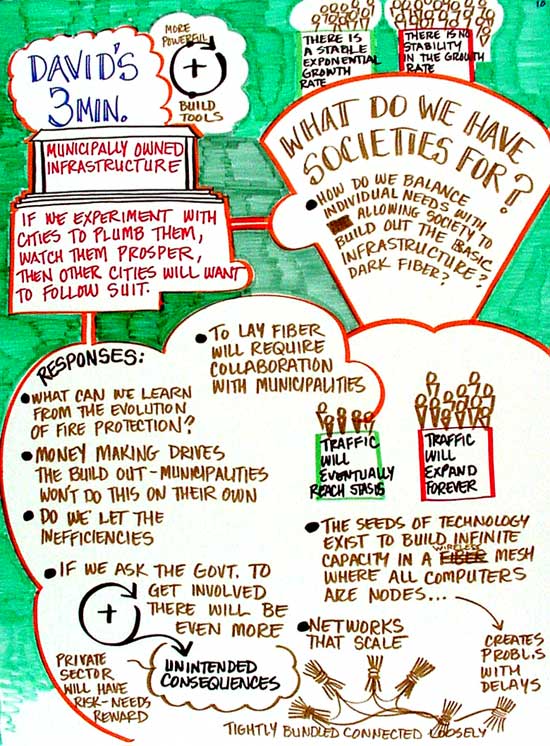 David:
I want to talk about this issue over here: a-governmental. I think the
current federal regulatory system is about the old paradigm. I think there
are new functions governments can play. I’d like to introduce the concept
of municipally owned networks for example: Stockholm. It is a good paradigm.
It works. It works the same way that roads and sewers work. Sewers were
built not because of profitability but because we needed them or we would
die. Even though people might not want a sewer built in their land, we
still did it. If we do it as an experiment here and there and find that
those cities that have this prosper and thrive, then more cities might
do it. We might then get to the network we want.
David:
I want to talk about this issue over here: a-governmental. I think the
current federal regulatory system is about the old paradigm. I think there
are new functions governments can play. I’d like to introduce the concept
of municipally owned networks for example: Stockholm. It is a good paradigm.
It works. It works the same way that roads and sewers work. Sewers were
built not because of profitability but because we needed them or we would
die. Even though people might not want a sewer built in their land, we
still did it. If we do it as an experiment here and there and find that
those cities that have this prosper and thrive, then more cities might
do it. We might then get to the network we want.
I'm going to make a comment that I cannot see that happening because no one went into making sewers for a profit. It was a natural thing municipalities did when they were young and small. But now there are a ton of people wanting to make money delivering that service and we have a mindset around the world to let the economic system do that and not the governmental system.
Fire protection: originally if you look at the history of insurance and fire protection was a private business. You would buy fire insurance and if there was a fire in your house, fire trucks would put out your fire but if you couldn't afford that insurance, your house burned down and you were out of luck. What happened was society people said it is too dangerous to have people who can't afford fire insurance. So that changed.
Comment: That's a changed model and it failed.
David: Let me go from my analogy to my point. The analogy is you use the word natural as to what society chooses to fund. There are certain investments in road, in education and there are other things we choose to have. We think about a system as being anarchistic and a-governmental and we don't see which parts are heavily regulated and which pieces are based on federal allocation of bandwidth. There are a lot of embedded choices here. We have choices to make that should be made consciously.
This is probably not the place for this whole discussion, but I think you need to look over time at the models of government directed investment vs. societies that have less government investment. My friend from Canada and I, we discussed that over time do you want a government with its politics deciding how money will be invested and the inefficiencies that creates or over time have the market decide?
I would argue that the problem we are all addressing, has to do with the government forcing too many constraints on us. Not much of it is implicit and laid out in one policy arena. It is done in a bunch of different agencies on many dimensions. If you look over time at cities where a huge amount of gov't intervention in the investment process, over time the investment capital dries up and the productivity goes down.
David: Anders say something. Don’t' just sit there.
Anders: I'm sort of feeling some hostility in the room. I think you have to ask yourself what do we have societies for? How come we aren't out there on our own. How come we have these complex societies, where we have the decision making processes that are on one hand very private and then we have decision making that takes place in a political context and a corporate context. How do we get the most out of this? What do we really want government to do? No one can tell me that a lot of the technology marvels you have here in the US comes purely out of pure private enterprise. That is a lot of rubbish. There is some kind of collective mechanism to coordinate big projects. How do we get some kind of situation where on the one hand we do all of these big things together while providing for innovation. It's a tradeoff. How do we balance this? I agree with the notion that we aren't talking about just one network. We will have a lot of networks. When asked what do your customers want, I just remove barriers to them getting what they want.
Comment: In putting in fiber, are your providing ISP connectivity or a facility where ISP's can deliver services to their customers.
Anders: The only thing I provide is dark fiber.
Comment: You are putting in the capacity to build the network.
Anders: It is a piece of the problem. It's not building the Internet.
Comment: It's like putting in the airport. It's paving the runways. He's not operating an airline or staffing the control tower.
David: Who wants the Gov. to be the ISP? Who wants the government to put fiber under the streets so competition can thrive?
Comment: These are terribly flawed analogies. The city puts up an airport…the government covertly manages that. Competition is the law of the jungle there.
Comment: Very limited analogy.
Comment: I think we have to go back to basics. Who has the right to set the neighbor's house on fire. If you get rid of your sewer, then you basically poison your neighbor. There's an incentive to do something on a collective basis. What I do on the net, how does that impact my neighbor? What you observe is stupid cycles. For 20 years the gov't does nothing and then overnight they invest in which they overspend. Then they freeze investment.
Comment: The only reason why it makes some sense is public works notion (public utilities), there is some sense to that. However what will happen there will be some kind of contract and you will get frozen there.
Comment: I don't know much about the gov't of Sweden but I have watched the gov't of US. They get caught up time and time again in the Law of Unintended Consequences. If you think about welfare, etc. where a nice idea gets taken but best intentions run awry because the system is not organic to respond in time. I once had a conversation with Casper Weinberger when I asked him does anyone in the gov't have any idea what the Internet was going to be - he said no. The whole Internet, the network we love, is a wholly unintended consequence. Therefore, asking the gov't to do this better scares me.
Comment: It's very simple, how many times a day do you flush? Those kind of things where the curve is stable. We are talking about ideal networks where the asymptotes are moving also. Expectations are changing every day. The last decade, PC capability has gone up a million x, is anyone really satisfied with the PC user experience?
Comment: Good question.
Comment: Software has compensated. [laughter]
Comment: We run around with all of these technologies, our complexities are increasing and our needs are adding on top of it.
7. Isenberg’s 3 Minutes: Municipally Owned Networks
David:
I want to talk about this issue over here: a-governmental. I think the
current federal regulatory system is about the old paradigm. I think there
are new functions governments can play. I’d like to introduce the concept
of municipally owned networks for example: Stockholm. It is a good paradigm.
It works. It works the same way that roads and sewers work. Sewers were
built not because of profitability but because we needed them or we would
die. Even though people might not want a sewer built in their land, we
still did it. If we do it as an experiment here and there and find that
those cities that have this prosper and thrive, then more cities might
do it. We might then get to the network we want.
I'm going to make a comment that I cannot see that happening because no one went into making sewers for a profit. It was a natural thing municipalities did when they were young and small. But now there are a ton of people wanting to make money delivering that service and we have a mindset around the world to let the economic system do that and not the governmental system.
Fire protection: originally if you look at the history of insurance and fire protection was a private business. You would buy fire insurance and if there was a fire in your house, fire trucks would put out your fire but if you couldn't afford that insurance, your house burned down and you were out of luck. What happened was society people said it is too dangerous to have people who can't afford fire insurance. So that changed.
Comment: That's a changed model and it failed.
David: Let me go from my analogy to my point. The analogy is you use the word natural as to what society chooses to fund. There are certain investments in road, in education and there are other things we choose to have. We think about a system as being anarchistic and a-governmental and we don't see which parts are heavily regulated and which pieces are based on federal allocation of bandwidth. There are a lot of embedded choices here. We have choices to make that should be made consciously.
This is probably not the place for this whole discussion, but I think you need to look over time at the models of government directed investment vs. societies that have less government investment. My friend from Canada and I, we discussed that over time do you want a government with its politics deciding how money will be invested and the inefficiencies that creates or over time have the market decide?
I would argue that the problem we are all addressing, has to do with the government forcing too many constraints on us. Not much of it is implicit and laid out in one policy arena. It is done in a bunch of different agencies on many dimensions. If you look over time at cities where a huge amount of gov't intervention in the investment process, over time the investment capital dries up and the productivity goes down.
David: Anders say something. Don’t' just sit there.
Anders: I'm sort of feeling some hostility in the room. I think you have to ask yourself what do we have societies for? How come we aren't out there on our own. How come we have these complex societies, where we have the decision making processes that are on one hand very private and then we have decision making that takes place in a political context and a corporate context. How do we get the most out of this? What do we really want government to do? No one can tell me that a lot of the technology marvels you have here in the US comes purely out of pure private enterprise. That is a lot of rubbish. There is some kind of collective mechanism to coordinate big projects. How do we get some kind of situation where on the one hand we do all of these big things together while providing for innovation. It's a tradeoff. How do we balance this? I agree with the notion that we aren't talking about just one network. We will have a lot of networks. When asked what do your customers want, I just remove barriers to them getting what they want.
Comment: In putting in fiber, are your providing ISP connectivity or a facility where ISP's can deliver services to their customers.
Anders: The only thing I provide is dark fiber.
Comment: You are putting in the capacity to build the network.
Anders: It is a piece of the problem. It's not building the Internet.
Comment: It's like putting in the airport. It's paving the runways. He's not operating an airline or staffing the control tower.
David: Who wants the Gov. to be the ISP? Who wants the government to put fiber under the streets so competition can thrive?
Comment: These are terribly flawed analogies. The city puts up an airport…the government covertly manages that. Competition is the law of the jungle there.
Comment: Very limited analogy.
Comment: I think we have to go back to basics. Who has the right to set the neighbor's house on fire. If you get rid of your sewer, then you basically poison your neighbor. There's an incentive to do something on a collective basis. What I do on the net, how does that impact my neighbor? What you observe is stupid cycles. For 20 years the gov't does nothing and then overnight they invest in which they overspend. Then they freeze investment.
Comment: The only reason why it makes some sense is public works notion (public utilities), there is some sense to that. However what will happen there will be some kind of contract and you will get frozen there.
Comment: I don't know much about the gov't of Sweden but I have watched the gov't of US. They get caught up time and time again in the Law of Unintended Consequences. If you think about welfare, etc. where a nice idea gets taken but best intentions run awry because the system is not organic to respond in time. I once had a conversation with Casper Weinberger when I asked him does anyone in the gov't have any idea what the Internet was going to be - he said no. The whole Internet, the network we love, is a wholly unintended consequence. Therefore, asking the gov't to do this better scares me.
Comment: It's very simple, how many times a day do you flush? Those kind of things where the curve is stable. We are talking about ideal networks where the asymptotes are moving also. Expectations are changing every day. The last decade, PC capability has gone up a million x, is anyone really satisfied with the PC user experience?
Comment: Good question.
Comment: Software has compensated. [laughter]
Comment: We run around with all of these technologies, our complexities are increasing and our needs are adding on top of it.
8. Will there ever be Traffic Stasis?
David Reed: I'd like to run a poll. The question is do you think there is ever a point where we achieve some kind of traffic stasis. If you say green, the traffic patterns would reach stasis. Red is it will go the other way - infinite…red = increasing demand.
Bob: Lots of reds.
Comment: The first law of economics is human needs are infinite and resources are finite.
Comment: But economics is wrong. Economics is screwed up. It is a dark science.
Mike: In Vail, they put up a wireless system which gives you a megabyte on a continuing bases. Once you have a megabyte on a continual basis, the perceived experience is not different from 10 megabits to the average guy.
Comment: There is a very specific counter-example to this, Mike. It is what French Telecom is doing with its cable modem services - they are charging use by the byte. The traffic pattern exploded in a way they didn't anticipate.
Mike: That's an example of poor design.
Comment: Someone will design something that uses all megabytes, then we will be maxed. You will always be chasing your tail. People will find a place to spend the money.
10:03
Tom: There is a situation in networking that we can build where what you do affects your neighbor a lot. And that's where we have a mesh connected wireless. Everybody's node becomes part of the greater network. We know how to build those today with increasing capacity. We've got to believe in it and work a bit harder. Think about what that will do to the whole way the network is organized and thought about. All of a sudden this idea of a central carrier is gone.
Comment: No. Not if you want the bits to get through.
Mike: Used to be organized like that. Routing those things is really hard and the delay gets to be very hard.
Scott: We tried and used that. It took a lot of work and we didn't get very far.
David: That doesn't mean that it will always be that way, Scott.
There were democratic societies tired for years and they all lost to one form or another.
Comment: You have to induce hierarchy in order to do the computations to route it.
Comment: Actually I think that would be really interesting. I think there is a serious debate whether hierarchy and structure are needed or if there is a path that doesn't get bottlenecked on some central resource.
Mike: If you believe in the infinitely increasing demand, then the architecture would break down.
Comment: I think in your architecture it would.
Comment: I thought that one got all too many red ones. Everyone accepts Moore's Law that there's a stable growth curve that matches demand to supply that has worked remarkably well. (not everyone agrees) I'd like to take a different thing, not if we reached stability but if there is a stable exponential, pick the constant on it. How many people believe with green cards that there is a stable exponential that the Internet will find or that it will oscillate indefinitely (red card).
Comment: What does stable mean?
Comment: Moore's Law has been stable to the point investors can bet on it.
Comment: They are making bets based on keeping a Ponzi model going.
Comment: What's interesting, the biggest difference between the bellhead mindset and the nethead mindset, is the bellhead mindset is that there's a saturated demand.
Comment: Is there an exponential growth.
Jerry: The exponential is different. By building tools we become more powerful and get more tools where we become more powerful.
Comment: Jerry says it flattens. Some say it is unbounded.
Comment: Do you think we could reach an agreement on a characterization like Moore's Law. Green if you think there is a stabilization.
Comment: It's going to grow a multiple of x every year because of investment. It will double every 6 months or every 10 or something like that for 20 years.
Bob: Lot more reds.
Comment: I think that function will be determined by the application, the Napster application that comes next, that will be the avalanche and create the demand. It's my belief that government can participate as an incentive to grow the pipe.
Comment: They can turn off Napster.
Comment: I'd like to propose a model of technological abundance which we have achieved which is the technology of distributing food. We have gotten to a point in society where we have enough food. At some point we didn't have enough food. You can go farther with this, and say there's unequal distribution of food due to political concerns. I offer this as a model.
Comment: On the hierarchy point, I don't think anyone answered this. What makes up a small world network. You can describe networks as loosely connected, tightly connected, bundles of network. I don't understand why there's this either/or.
Dan: I attended a seminar at MIT, it was proposed that the limit would be the limit of the human brain. They estimated the channel at 600 megabits is the human limit
Comment: I don’t' understand how you can quantify that number in any way. The representation of the thing you are focusing on. You can increase the fluid in the medium in which you can produce and suddenly you take a lot more bandwidth. Having a finite number of bits per second that a person can process is a fallacy.
Comment: The number I heard was 5 gigabytes.
Bob: One more person who will close out this session?
Ernie: I did want to say, David, that there are ways the Gov't can help the private sector by taxes, incentives such as the railroads and highways which were subsidized. Those are once in a generation type of high priority items and there are serious unintended consequences. Need to have risk and reward.
10:15 Break
9. Skip Andrews’ 3 Minutes: Will the network make us more human?
10:45
Bob: Okay. Welcome back. We want to continue where we left off but we want to do it at less frenzy pace. A little more time between people talking. Think more about what we want to say.
Is there a way to
frame a deliverable for this session?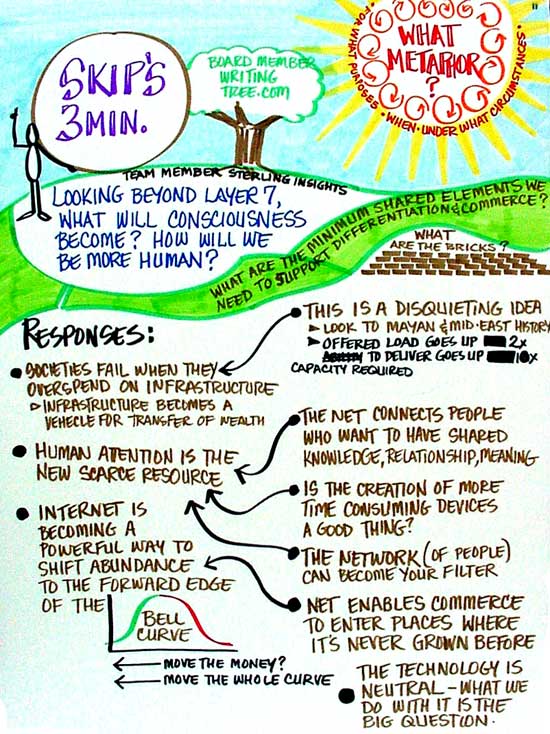
We've been thinking about that. We've been wanting a topic to emerge from the group. I know I struggle with not having a topic. But with this session we will have a much more free session without imposing a topic but if there are topics you'd like to suggest for the afternoon please feel free.
Skip has cashed in his 3 minute coupon.
Skip: My name is Skip like Skippy peanut butter. I would like to explore a concept, will the network make us more human? While the discussion was interesting about the bandwidth, etc. what if we looked out to a layer 10, I m more interested in the composite intelligence in this room to address what is consciousness, what will the shared experience of the network do to really help the global society at large? What might we start that will give us a pattern of success that will lead to that shared experience in the future? I think the key point I'm looking for is how can we get really big in our thinking process that expands human thinking into a global mindset.
Comment: Give us an example.
In addition to being COO for Sterling Insights, Inc., I'm on the advisory board for WritingTree.com which is site for first time authors and publishers. What we are getting is a whole lot of stories from geographical areas that have been totally underrepresented Women who are from Muslim countries telling heartfelt stories that are really great. Mothers from Fiji who are writing about the horrors when they are watching Baywatch and wondering why there's such a huge difference. I corresponded with someone in Africa. How do we share in thinking and trading roles from an individual perspective, how can we look from feminine perspective of a global issue and masculine or a money issue vs. a poverty issue and pull together a greater sense of community and shared connectedness?
Doug: I'd like to build on that. I get to be in a lot of groups like this in different industries. What's strikes me is how similar the dynamics are. What has happened this morning is the internal dynamics of a tsunami of the Internet. When you go to education groups they are talking about similar dynamics.
Everyone has an agenda about how to make everything better. But society can't afford to do all of these things at the same time.
Societies collapse because they overspend on their infrastructure. They work everything they can to maintain the infrastructure in a way that societies go broke. The network will have a huge impact on governance, national security issues, education. The 20th century was built on those kind of wars. The 21st century is likely to have some of those same patterns. We need to have some way of melding the social impact vs. liberatiarian cowboys.
Bob: My reaction is the story about the stories being written but I don't have the time to read them. We have all the bandwidth but I still only have so many hours in the day.
The real problem, the real limitation is the attention of human beings. The world isn't going to see it they don’t' have time.
Adina: I'm going to build on that in 2 different directions. Even though you don't have time, there are certain communities who are interested in that and will find each other. It used to be when you were traveling from point to point, you had some time of stillness, you couldn't do anything but reflect where you could have some time. But now we fill that with cell phones and e-mail on portable e-mail devices. I'm an addict. I think there is an overload and I'm not sure I want to stop it. But I'm also not sure we are making the world better by reducing the time to reflect.
Tom: I hope we don't stray from the opening topic. Collaborative filtering mechanism - here's one person on the network where there are a certain number of people who want certain information. If I take all of the books, etc. and eliminate all of the ones that are not useful to me I still have many more than I can ever read. The answer to that is your network. It helps us develop strategies for triaging.
8. Will there ever be Traffic Stasis?
David Reed: I'd like to run a poll. The question is do you think there is ever a point where we achieve some kind of traffic stasis. If you say green, the traffic patterns would reach stasis. Red is it will go the other way - infinite…red = increasing demand.
Bob: Lots of reds.
Comment: The first law of economics is human needs are infinite and resources are finite.
Comment: But economics is wrong. Economics is screwed up. It is a dark science.
Mike: In Vail, they put up a wireless system which gives you a megabyte on a continuing bases. Once you have a megabyte on a continual basis, the perceived experience is not different from 10 megabits to the average guy.
Comment: There is a very specific counter-example to this, Mike. It is what French Telecom is doing with its cable modem services - they are charging use by the byte. The traffic pattern exploded in a way they didn't anticipate.
Mike: That's an example of poor design.
Comment: Someone will design something that uses all megabytes, then we will be maxed. You will always be chasing your tail. People will find a place to spend the money.
10:03
Tom: There is a situation in networking that we can build where what you do affects your neighbor a lot. And that's where we have a mesh connected wireless. Everybody's node becomes part of the greater network. We know how to build those today with increasing capacity. We've got to believe in it and work a bit harder. Think about what that will do to the whole way the network is organized and thought about. All of a sudden this idea of a central carrier is gone.
Comment: No. Not if you want the bits to get through.
Mike: Used to be organized like that. Routing those things is really hard and the delay gets to be very hard.
Scott: We tried and used that. It took a lot of work and we didn't get very far.
David: That doesn't mean that it will always be that way, Scott.
There were democratic societies tired for years and they all lost to one form or another.
Comment: You have to induce hierarchy in order to do the computations to route it.
Comment: Actually I think that would be really interesting. I think there is a serious debate whether hierarchy and structure are needed or if there is a path that doesn't get bottlenecked on some central resource.
Mike: If you believe in the infinitely increasing demand, then the architecture would break down.
Comment: I think in your architecture it would.
Comment: I thought that one got all too many red ones. Everyone accepts Moore's Law that there's a stable growth curve that matches demand to supply that has worked remarkably well. (not everyone agrees) I'd like to take a different thing, not if we reached stability but if there is a stable exponential, pick the constant on it. How many people believe with green cards that there is a stable exponential that the Internet will find or that it will oscillate indefinitely (red card).
Comment: What does stable mean?
Comment: Moore's Law has been stable to the point investors can bet on it.
Comment: They are making bets based on keeping a Ponzi model going.
Comment: What's interesting, the biggest difference between the bellhead mindset and the nethead mindset, is the bellhead mindset is that there's a saturated demand.
Comment: Is there an exponential growth.
Jerry: The exponential is different. By building tools we become more powerful and get more tools where we become more powerful.
Comment: Jerry says it flattens. Some say it is unbounded.
Comment: Do you think we could reach an agreement on a characterization like Moore's Law. Green if you think there is a stabilization.
Comment: It's going to grow a multiple of x every year because of investment. It will double every 6 months or every 10 or something like that for 20 years.
Bob: Lot more reds.
Comment: I think that function will be determined by the application, the Napster application that comes next, that will be the avalanche and create the demand. It's my belief that government can participate as an incentive to grow the pipe.
Comment: They can turn off Napster.
Comment: I'd like to propose a model of technological abundance which we have achieved which is the technology of distributing food. We have gotten to a point in society where we have enough food. At some point we didn't have enough food. You can go farther with this, and say there's unequal distribution of food due to political concerns. I offer this as a model.
Comment: On the hierarchy point, I don't think anyone answered this. What makes up a small world network. You can describe networks as loosely connected, tightly connected, bundles of network. I don't understand why there's this either/or.
Dan: I attended a seminar at MIT, it was proposed that the limit would be the limit of the human brain. They estimated the channel at 600 megabits is the human limit
Comment: I don’t' understand how you can quantify that number in any way. The representation of the thing you are focusing on. You can increase the fluid in the medium in which you can produce and suddenly you take a lot more bandwidth. Having a finite number of bits per second that a person can process is a fallacy.
Comment: The number I heard was 5 gigabytes.
Bob: One more person who will close out this session?
Ernie: I did want to say, David, that there are ways the Gov't can help the private sector by taxes, incentives such as the railroads and highways which were subsidized. Those are once in a generation type of high priority items and there are serious unintended consequences. Need to have risk and reward.
10:15 Break
9. Skip Andrews’ 3 Minutes: Will the network make us more human?
10:45
Bob: Okay. Welcome back. We want to continue where we left off but we want to do it at less frenzy pace. A little more time between people talking. Think more about what we want to say.
Is there a way to
frame a deliverable for this session?
We've been thinking about that. We've been wanting a topic to emerge from the group. I know I struggle with not having a topic. But with this session we will have a much more free session without imposing a topic but if there are topics you'd like to suggest for the afternoon please feel free.
Skip has cashed in his 3 minute coupon.
Skip: My name is Skip like Skippy peanut butter. I would like to explore a concept, will the network make us more human? While the discussion was interesting about the bandwidth, etc. what if we looked out to a layer 10, I m more interested in the composite intelligence in this room to address what is consciousness, what will the shared experience of the network do to really help the global society at large? What might we start that will give us a pattern of success that will lead to that shared experience in the future? I think the key point I'm looking for is how can we get really big in our thinking process that expands human thinking into a global mindset.
Comment: Give us an example.
In addition to being COO for Sterling Insights, Inc., I'm on the advisory board for WritingTree.com which is site for first time authors and publishers. What we are getting is a whole lot of stories from geographical areas that have been totally underrepresented Women who are from Muslim countries telling heartfelt stories that are really great. Mothers from Fiji who are writing about the horrors when they are watching Baywatch and wondering why there's such a huge difference. I corresponded with someone in Africa. How do we share in thinking and trading roles from an individual perspective, how can we look from feminine perspective of a global issue and masculine or a money issue vs. a poverty issue and pull together a greater sense of community and shared connectedness?
Doug: I'd like to build on that. I get to be in a lot of groups like this in different industries. What's strikes me is how similar the dynamics are. What has happened this morning is the internal dynamics of a tsunami of the Internet. When you go to education groups they are talking about similar dynamics.
Everyone has an agenda about how to make everything better. But society can't afford to do all of these things at the same time.
Societies collapse because they overspend on their infrastructure. They work everything they can to maintain the infrastructure in a way that societies go broke. The network will have a huge impact on governance, national security issues, education. The 20th century was built on those kind of wars. The 21st century is likely to have some of those same patterns. We need to have some way of melding the social impact vs. liberatiarian cowboys.
Bob: My reaction is the story about the stories being written but I don't have the time to read them. We have all the bandwidth but I still only have so many hours in the day.
The real problem, the real limitation is the attention of human beings. The world isn't going to see it they don’t have time.
Adina: I'm going to build on that in 2 different directions. Even though you don't have time, there are certain communities who are interested in that and will find each other. It used to be when you were traveling from point to point, you had some time of stillness, you couldn't do anything but reflect where you could have some time. But now we fill that with cell phones and e-mail on portable e-mail devices. I'm an addict. I think there is an overload and I'm not sure I want to stop it. But I'm also not sure we are making the world better by reducing the time to reflect.
Tom: I hope we don't stray from the opening topic. Collaborative filtering mechanism - here's one person on the network where there are a certain number of people who want certain information. If I take all of the books, etc. and eliminate all of the ones that are not useful to me I still have many more than I can ever read. The answer to that is your network. It helps us develop strategies for triaging.
10. Societies collapse because they overspend on their infrastructure.
Mike: I think Doug made a point that if I heard him right I find troubling, i.e. overinvesting in infrastructure basically corrodes it from the inside out. The interesting question is do we have the most efficient means of doing that ever created? I think it bears thinking about very, very carefully. It is certainly a fire hose. Fire hoses are good at knocking things down. I found that comment very disquieting.
Bob: Doug, do you want to say anything more about this?
The book (The Collapse of Complex Societies) is published by the Oxford University Press in 1998. He looks at historical events example: where you get an irrigation system, some of the workers diverted to do the silt cleaning and then more agricultural workers supporting the silt workers. You get into logarithmic curves where the productivity goes up and you get a crossover point. (10x and 2x example) That's the key point. In the kind of synergy when we get between capital, we can easily get into cycles like that are quite destructive and not notice. The key ones are population, environmental draw down, and marginalization of the poor.
Connecting that and the original question and the info load, I agree the net may act as our filter. I see that as not as a solution but an exacerbation of the problem. What that does is it makes it easier for me to only focus my life around like-minded people. I will only be involved in people who are like me. I will lose the serendipity in my life. I don't even know my next door neighbor's name. I am so used to using like minded filters just to survive the info overload.
Tim Denton: I'd like to take up your point. The Bell Curve book was disturbing whether you think it is right or wrong. Think of your 5 closest friends. How many college degrees among them? We can tell you what degrees they have because we pretty much know who is reading this book The Internet is probably the cleverest ways to transfer revenue to the forward edge of the bell curve. Maybe this ought to happen. Maybe we have gone through a period when relatively speaking more income and revenue went to the industrialized working classes than was good for society. Their power has declined and the power of the people to write code has increased. The code writers example had a lot of resonance. Pretty much everyone here is on the forward edge of the bell curve. As a way of getting money away from the stupid and to the intelligent, the Internet may be an effective method. I'm not saying this is true. It hit some resonance for me.
Adina: If the technology innovation is steering the money toward the smart, I am not sure that is a bad thing. The printing press is an agent of change. When people talk about the printing press they talk about the broad impact on society. That didn't happen for many hundred years later. There was now an ability to copy scientific drawings, persistent transfer of knowledge for example recopying plant information. This set of scientists could now build knowledge. The first impact was the available info to the elite. Much later the impact was mass literacy. The initial impact is on the intellectual elite is not so bad. If given the impact is rewarding a high level of education. To share the wealth is to have more education and thoughtfulness. If that is true, it is a value to society.
Tim: A couple of points to Doug and Skip. I think the Internet helps spread capitalism and democracy around the globe. We have the tade of services in a way we didn't have before. We now can have software programmers around the world. History of warfare by John Keegan. Modern warfare is not a normal human attribute. We humans have done away with dueling, slavery, etc. If we bring it back to why the Internet is helpful to society.
Jerry: No two countries who have had MacDonalds have gone to war with each other.
Comment: Serbia had MacDonalds.
Jerry: Oh, darn it.
Comment: My big question is what do we do about this? Fundamentally we are talking about control. If we can predict it we can control it. If the Mayans had known what the cause of their demise would be, would they have changed their ways?
Christian: I think this discussion misses the point. The technology is kind of neutral to whether it drives us to the elite and whether it drives to another model of society.
Comment: The question remains the same. We started out with this potential detrimental impact.
It is difficult to say if we impact it negatively or positively. People will build networks and they will add features and capabilities and services to differentiate them from different networks in order to make money. They will build them. You can't make this investment and not use that infrastructure to get some sort of return.
11. What are the Minimum Common Services Required
Comment: What are the minimum common services that allow all of these Internetworks to operate and what services will people put on private networks that will allow them to compete?
Comment: I think for capital efficiency reasons, its good to have one network because everyone shares the same infrastructure - there's good returns to scale. On the other side, people are going to want to build separate networks. You need to have more than one later. It's the bricks. Can we or will we get to a network where it's all a shared common packet.
Comment: Like you have two different kinds of electricity?
Comment: You've got very high voltage and very low voltage. You don't run a data center off the same plug. We must at least have a two-layer protocol.
Mike: Extending on your brick model, I think it's important that whether you rent space in an office tower or elsewhere, the business should work in either case. That's one of my feelings about people who rely on duct tape. There's levels about that you need to get right. You actually need something about TCP.
Jerry: There's some pieces here that are technical and interesting but we are wandering from the initial topic that was proposed such as how we can affect global thinking topic.
12. Metaphors, Internet, Sense of Self
David Weinberger: If we go back to 5 mins. before the conversation, I think we need to be careful about metaphors. It's at least about connection (vs. information). I'm using this in the ordinary sense of information. I feel unworthy because I can't read everything that I should read. The web seems to be as much a conversation or a party. That is built into the nature of the web as a hyperlinked medium. Voluntarily built space and people are there because they have something to say or sell.
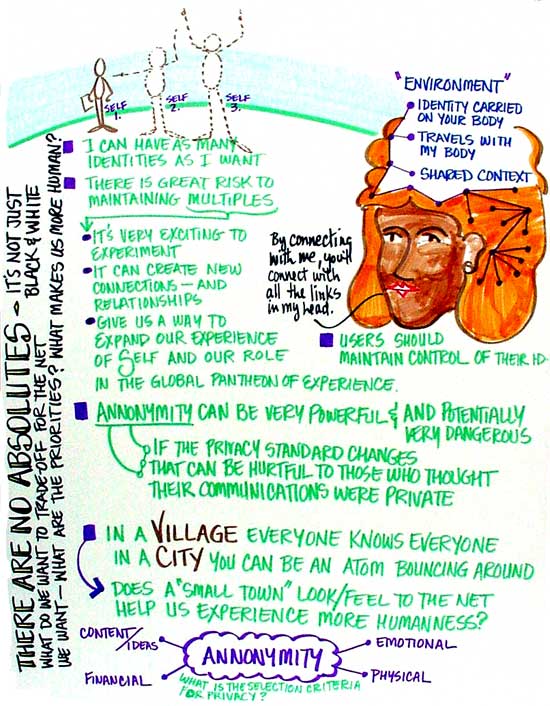 David
Reed: I actually think you hit on something that the metaphor re: infrastructure
might be wrong. There's another possible metaphor that the net is an environment
that encloses us rather than supports us. If you think about it that way,
then we are in a shared lifeboat. We have managed to construct a situation
where we have to live in a lifeboat. That is a trend that is something
we have to struggle with. Even though we have abundance, we have to live
in this abundance as if we aren't going to bang our elbows too hard. We
can benefit form the tightly connected loop that closes the loop faster.
The struggle I have is even that metaphor isn't quite right, because we
have mobility coming in where identity can move around. This is where
even environment is too static. Where your environment is changing, that
is a different society than one that is static. I'm playing with metaphors.
David
Reed: I actually think you hit on something that the metaphor re: infrastructure
might be wrong. There's another possible metaphor that the net is an environment
that encloses us rather than supports us. If you think about it that way,
then we are in a shared lifeboat. We have managed to construct a situation
where we have to live in a lifeboat. That is a trend that is something
we have to struggle with. Even though we have abundance, we have to live
in this abundance as if we aren't going to bang our elbows too hard. We
can benefit form the tightly connected loop that closes the loop faster.
The struggle I have is even that metaphor isn't quite right, because we
have mobility coming in where identity can move around. This is where
even environment is too static. Where your environment is changing, that
is a different society than one that is static. I'm playing with metaphors.
Tim: But your point would be..
David Reed: We at least have to get to the environment metaphor to have a useful conversation here. I want to throw away the infrastructure metaphor. I'd like to at least talk about the further out metaphor. The further out one is your identity is carried on your body. Doesn't matter if you are in your house, i.e. not owned by geography. I'm now connected.
Adena: Could you describe ways that would make a difference.
I was driven this way by Mike's comment. The network looks to me like I’m in the place wherever I am and so when I'm in this room, the net's at a higher level than the infrastructure. The links I see are the links you have that you would surface if you had the time to say it but they surface instead into my network. It's better than hyperlink.
What is the name?
It's the web.
It's a shared context.
David Reed: The web is an edifice that we build collectively and link together but we don't live in there. I'd rather have the metaphor be in your head. By having the conversation with you, I acquire all of the links you have.
David Weinberger. The reason why your metaphor seems so wacky is that the web is impacting our sense of self. We have a sense of self tied with physical geography. We always have to be consistent in our selves which is constraining. This requires a huge amount of psychic energy. We get to type in who we are. We can be anyone we want. People love this. We get to rewrite ourselves without the same amount of consistency. I think this is why people are so excited. It's a fundamental change in what it means to be a person. We are trying to make sense of it in a spatial sense of self but that is being erased by the web.
Jerry: 3 things real fast. What you are saying sounds a lot like Sherry Terkel's view is we will have all these fragmented personalities. I disagree. I think we will have a unified integrated personality which is a healthy human being. The web will help us work out some of these things. This allows us to work out some of these things and then we'll circle back to being a whole person.
Two other things: addiction and fear. I'd like to address the topic of being on the train and suddenly not being able to read. And the topic of this thing being completely new and suddenly we can leave things out there. Addictive behaviors are arising everywhere. They are natural and to be expected. We've never been able to publish works and bump into each other without having someone watch over our shoulders. We have to design a few more do not disturbs into the software. People need to learn more self control as to how they use the technologies. More temptation on the airplane but you can still read.
Regarding fear, my belief fundamentally is that fear is the thing that separates us. The ability to acquaint ourselves in a relatively safe way with people we would normally not want to interact with and discover something positive about them will reduce our fear about them. When children playing games over the Internet get acquainted with people who are from different cultures, their view changes. The ability to walk into places and not be fully disclosed, this increases serendipity and increases overall health of the planet. My only fear is this may take 3 or 4 generations. My larger fear in the middle there the next world war is going to be triggered by trans-border data incursions. Every day every min. there are hundreds of data incursion are occurring and some power will want to attack. It might be geographically difficult however.
Skip: If I heard correctly, to tie in the metamorphosis of the self, and the different selves we contain, fundamentally as humans we carry a great deal of bandwidth within our selves to be different selves at work, at home for example. I want to have the experience maybe at the most base level, a global orgy. Having the experience of being someone in a foreign experience, or being a woman or being a man. To add to the global sense in the way that books have done this. This is an expansion of the little self that is me.
Tom - I'm not completely convinced that you aren't violently agreeing. It is true that an integrated self is maybe essential but in order to have one we have to rule out, or rather explore, and experiment.
Christian: I'd like to come back to Skip's point regarding the people publishing on the net form around the world. What is the constraint there? There are actually 2 constraints. The very reason this is possible is because the Internet is open. Publishing your best idea on the Internet may look cool but it's going to strike you. Remember the flash when vision news went public? People were shocked. Things have consequences. I don't think it would be a good idea to force a single identity for everyone on the Internet.
Comment: Here, here.
13. Privacy and Identity
Christian: We have to influence privacy.
11:35 am.
Dan: There have to be some limits. This is a balance I don't know how to achieve, under some circumstances where that anonymity threatens someone's security, The thing a few weeks ago, anonymously publishing a news release. Clearly there needs to be a way to recover the true identity to prosecute. Anonymous threats. The extremes of child pornography, that sort of thing. You need some kind of mechanism. Anonymity for benign persons is great but we need to be able to revoke it for abuses.
We are confusing 2 things. We are confusing the implementation with the desired effect. You want the ability to ensure the responsibility for acts. You want to be able to hold people responsible for acts they commit. Anonymity is the red herring. You do what you need to do to hold people accountable.
I think anonymity is a slippery concept because it changes. Think back about before caller ID. A phone call was anonymous. All shopping was done with cash and you weren't able to track purchases. Now with plastic it is mundane and accepted. What is troubling right now may be accepted in the future. Or it may swing back the other way. The network can't be governed by the capricious mood swings of the population.
Tim: I think most of us agree that complete anonymity can be a scary thing. There's a company that is supposedly creating a network that is guaranteeing anonymity. Whether we agree with it or not, it is a dangerous tool.
Jerry: we are saying anonymity, I'd prefer using pseudonymity. Zero knowledge is interesting but there are a hundred different reasons why they need the info.
Comment: If you want to inform the gov't of your company's cheating.
Jerry: Yes but that's only a very small percentage of my interactions.
Christian: People get hurt by network communication. What we are seeing also is the net is new for society. In this history of society it takes about a generation to be assimilated. My point is that saying, well forget about it (re: privacy) is actually very dangerous. You should be proactively addressing this issue. We should be capable of the tools for this.
Doug: It's really striking to me how the conversation has gone from how to be human to the individual and anonymity. An issue that goes along with anonymity is the anonymity of corporations. The dependency of the technology on the corporate form. It is interesting how States charter corporations which then are immune from a lot of public knowledge about what they do. The net has become so co-dependent on other institutions like the corporation or global finance. Globalization of the markets will go on for the next whole century. It is pretty easy to look at scenarios where it could collapse quite quickly into Balkanization. The function of the market tends to eliminate those differences. Local situations become economically preferable. We find ourselves having come to Balkanization and local and regional economies at the very point we have lost governance in a broader way. We are defaulting to these privatized individual technology discussions avoiding some of the larger context that we are in.
14. Anonymity or Pseudonimity
David: I'd like to build on that and observe that anonymity and privacy are recent constructs. In small villages people knew everything about everyone. Growing up in this town we knew who were the desirable people to hang out with and who weren't. We all know was using drugs, who was an integral person, what church they went to.
Christian: That's why you moved to New York.
David: And things are very different in New York. You can exist as an atom and never think about being a molecule You choose your associates very carefully based on these community of interests. These are at most bidimensional. You lose the serendipity if you have a perfect search engine. You loose that serendipity that you never thought you would have.
Growing up in this town, has led me to know lots of different kinds of people and different ideas than if I had grown up in a city. I'm concerned that our discussion of the net is conditioned by our view of urban life where privacy is not only good but it's possible. I'm kind of free associating here. One more thing, bad actors…there was this kid in town who was into drugs way before us, sort of a lead indicator. One night he robbed the post office. It happened to be a really snowy night. The police followed his footsteps. I'd like the network I want to look and feel more like a small town vs. an interest group, a corporation, a city.
David Reed: I'm troubled by the ease with which we fantasize that anonymity or pseudonimity is achievable in the future. It's obviously not true for the kinds of reasons Jerry talked about. The only way to be anonymous is to disentangle yourself from what is going on. You depend on the city to feed you, to provide you jobs, and you are actually more interconnected. At the same time that you are creating this self sense of anonymity (psychological state), you are actually more connected. I feel this is like a psychological splitting from reality.
11:50 am.
David: I think there are two different kinds of anonymity and they are not equivalent. One is the kind where other people know you or don't know you and the other kind is where you leave a record in a database. If no one accesses that database are you really anonymous or not?
Adena: What is social and emotional anonymity vs. financial, political, governmental anonymity? Does someone know if I was dishonest with my friends?
15. The Net is a Melting Pot
Tom: The network is ultimately humanizing and localizing. I'm in this room because of the network. I know this community because of the net. I used to write an article and put my e-mail on it and I knew my readers. It was a local environment. It's pretty intimate. As for privacy, if privacy is so human, what was it that selected for it? If it is really that fundamental, what was the selection advantage? What's so fundamental about privacy?
Comment: David, I think you are in a dream world. There were drug dealers dealing through those post offices so you didn't really know what was going on. It's the same kind of thing with the post offices.
The culture on the net is a mixture of things. On the net you have a melting pot. In Canada you have multiculturism. All of those will exist on the net. Some are local, some are national and they all coexist on a very fragmented international culture.
Bob: This discussion is an example of the lack of absolutes. We made this list of what we wanted and none of them are absolutes. They are all traded off. You want a little privacy, you don't want no privacy. I go into Radio Shack and I just want to buy a battery. I don't want to give you all my info. There are troublesome things here too like the Church of Scientology. How important anonymity might be in different governments. Bad actors in one country may be someone you approve of. There are no easy answers here.
Adena: I want them to pay me to get my information.
Comment: I want to go back to what David was saying about small town vs. big town. One thing that struck me was your preference for small type groups. I see the romance and beauty of that. But the groups that move us forward are the one-dimensional groups such as science. A bunch of physicists create physics.
Ernie: Galileo, my favorite great scientist, found a way to create a better telescope by the ability to observe functions of celestial body he was able to prove Copernicus' idea that the sun was the center of the solar system, not the earth. He was excommunicated and house arrested for the remainder of his life. So, if you have a one dimensional group, their mindset can be completely a-scientific, or a-growth.
Comment: I think you are violently agreeing with him.
Okay great.
16. What Makes us More Human?
Christian: I think we are missing a part of the question. What makes us more human? The net makes us more human in a very interesting way. It increases our ability create knowledge. We've seen that already to advance research. At least we are getting there in terms of better communication.
Bob: The whole question of anonymity is for the network to provide people with the control to relinquish information at their control. My location for a cab is a good deal. The network has to give the end user the guarantee of that control over their information. I've given up my control of information. Who's in control of their information and then to relinquish that. I think it really is that the network should allow the user to control the use of their info.
Jerry: This is a heavily intellectual scientific group. Saying that more science is progress and is always good is a pretty big presumption. Adena was saying earlier that maybe it's good that smarter people who have more degrees will get more benefit from the network. I have so much trouble with that statement. If you look at doctoral training and then you look at cult induction, they have a lot in common. [laughter] You are basically being taught to use someone else's vocabulary to pick a fractal piece of the discipline to be your expertise which you then defend against all comers which sets up an environment where it's hard to make new inventions and the new inventors are the people who are laughed out and thrown out in the beginning. I don't know that more science necessarily creates more progress. I think this new thing allows us to undo these things and allows us to be more human.
John: Is the network that we want going to make us more human or less human? Will it make the world better for spammers or Muslim women who can write stories about their experiences? Life is too messy for this. It will be both/and. Science has inflicted napalm on us and penicillin. Technology can give us privacy. What does that mean? My desire for the conversation after lunch would be to see more of this. People could get more privacy or more globalization. At the same time we want small towns we want large city. At the same time we want privacy, we want more publicity.
David: I like the slowing down. I think it's more relaxing to be in a discussion where people take their time and think more careful about what they want to say. I'm happy with the change in atmosphere here.
How many people are going to leave before the lunch buffet tomorrow? (10)
We have a 2 hour break now. It may be the last time to get your t-shirts and to wander around this town I love. You'll fit right in because there are intelligent people here. The lunch tables are on the west lawn. The buffet is over there. Drinks are behind the chimney. See you at 2pm.
 |
BigHook Main
BigHook2000 Recap Home | Context | Summary Fri Eve | Sat Morn | Sat Midday | Sat Eve | Sun Morn Photogallery | Scribegallery | Music isen.com, inc. | Sterling Insights Copyright 2000 isen.com, inc. |