 |
|

- Four Speakers and Three Questions
- Greg Amadon Speaks
- Bob Berger Speaks
- Dewayne Hendricks Speaks
- Tom Freeburg Speaks
- Questions & Answers
- Spectrum Issues
- Regulatory Issues & Educational Problems
- What is the Network we Really Want?
- Raj Sandhu Speaks
- Government or Free Market Activity to Get the Right Balance?
- What is the traffic engineering protocol that you really want?
- Resetting the Direction – from problem solving to envisioning the future
- Reconvene and Process Check
- Mike O’Dell Speaks
- Christian Huitema Speaks
- Scott Bradner Speaks
- David Reed Speaks
- Dan Grossman Speaks
- Jerry Michalski Speaks
- Larry Lessig Speaks
- Tim Denton Speaks
- What about Middle Boxes?
- The Hour Glass Model
1. Four Speakers and Three Questions
Bob: Would everyone take a seat. We will start this session off with 4 people giving a talk on a specific topic. We will give them 5 minutes each. We will go sequentially through them. No questions until all 4 people are done. We will divide this with 1.5 hours, then a break, then 1.5 hours. The 2nd section people will do their 3 minutes coupon talk.
David Isenberg: Here are the questions we want the speakers to answer:
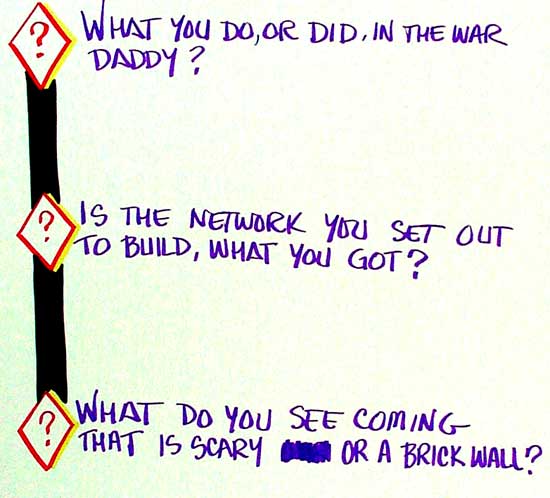
- What you do, or did, in the war daddy to get those battle scars?
- Is the network that you originally set out to build the one you ended up with?
- What do you see coming that is scary or looks like a brick wall?
 I'd
like to introduce Professor Lawrence Lessig who was the special master
in the Microsoft antitrust trial. He is running for at large board seat
on ICANN, Internet Committee for Assigned Names and Numbers. Professor
at Stanford. What else would you add?
I'd
like to introduce Professor Lawrence Lessig who was the special master
in the Microsoft antitrust trial. He is running for at large board seat
on ICANN, Internet Committee for Assigned Names and Numbers. Professor
at Stanford. What else would you add?
Larry: First of all, it's Larry and second, I'm a dumb lawyer trying to understand values implicit in the architecture you guys build. I'm honored to be here. I'm wanting to stop more dumb lawyers from doing dumb things to the network.
David Isenberg: We also have Greg Amadon who founded TeraBeam which is fiberless optics services and allied equipment company. Not yet public so don't send money. Greg recently did a management transition and turned the helm of Terabeam over to an ex-AT&T management team. He's now in search of the next insanely great thing. We hare honored to have both of these folks here even thought they are late and missed some really great things.
David Isenberg: Raj beat me up at lunch time. He said "we're sitting here and no one has the foggiest about what they are talking about." I decided that Raj has a point. We do have awesome technical expertise in the room. We want to tap some of that expertise. The forum we've chosen is 5 minute talks. We'd like to start with the 4 wireless experts who are in the room today: Greg Amadon, Bob Berger, Tom Freeburg, and Dewayne Hendricks.
2. Greg Amadon Speaks
Greg: What a crowd. You really put together a great group, David. Over the last 3.5 years I have been building a free space optical gigabit on a local loop network. We looked at all the free space optical technology out there to effectively take fiber out of fiber optics. It takes about 2 years to get fiber to penetrate concrete. With fiberless optics, free space optical, you can install a whole system in about 10 weeks. A system that has the same capacity as true fiber optics but it looks more like wireless. The key thing we developed was a point to multipoint wireless optical system that could have a single point of presence in a building that could address 500 users simultaneously up to gigabit speeds. We would be selling a fraction of that gigabit downstream so that might mean a 10 gigabit or a 100 gigabit piece. The way we designed the system is it's scaleable so you could add another gigabit in the downstream. So, it's a lot like fiber only it deploys much more quickly. This is a new technology so it has created a fair amount of controversy. Our one limitation is fog. We have to build our cell sites small enough to take into consideration the worst fog in an area. Anything you can do in a fiber system, we can do exactly the same stuff. We recently did a transaction with Lucent. They invested $400 million dollars into our company. They contributed a product they already had into our company plus 10 people from Bell Labs.
These guys have done a lot of work for the intelligence community. They put together the first 10 gigabit free space optical link. They're even out in front of what you can do with fiber.
We aren't exactly in production yet but we could be in production pretty quickly. Once the cell sites were installed you could provision it under a week. Could get it down to a day. As long as you have a window that can see a cell site we can get you the kind of connectivity that is anywhere from 10 megabits up to a gigabit.
I think the big limitation
is core routers. The need to convert from optical to electrical to optical
is a hard and fast limit. It needs to be terabit. That's the scary part.
How do you scale up the core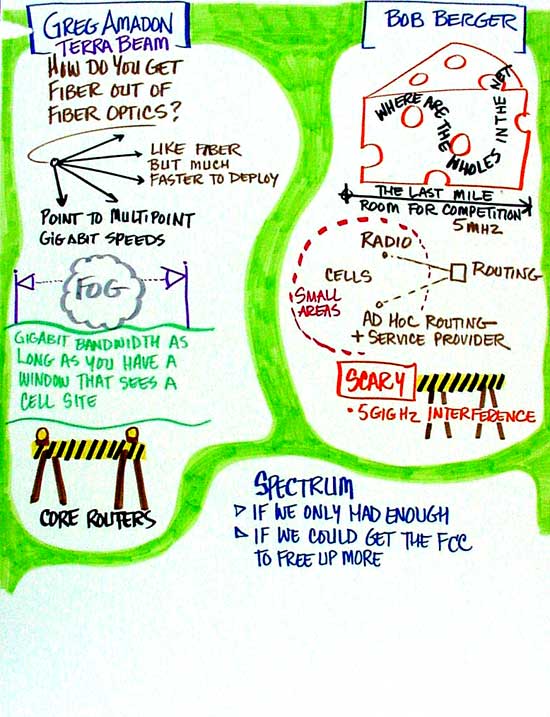 without huge expense and acres of farms of gigabit routers.
Most of the war wounds were coming up with a technology that was unanticipated. Taking on some of the bigger companies that aren't happy about disruptive technology.
3. Bob Berger Speaks
Bob Berger: I'm going to talk about a company that is just getting started so we don't have a lot of experience directly with this. My backgrounds was: I started an ISP in 1993 so I have war wounds from that. I pioneered a lot of international hosting as well.
Comment: I was a customer who appreciated what you did.
Bob Berger: Always scary to meet a customer. [laughter]
Over the last few years I have been a consultant advisor to different Internet infrastructure companies and equipment makers. I have had a good perspective of where are the holes in the network. What we identified was that the access portion is being monopolized. What we are developing is equipment that allows service providers to offer fixed wireless broad band using the 5 gigahertz unlicensed spectrum. The service provider would build out C base stations kind of like the cellular approach and the CBE would do dynamic routing. You could create a kind of mesh with the end user devices. What we are looking at is allowing a service provider to put out a network and with the router to get around some of the traditional problem of using 5 gigahertz for transmission where you aren't allowed to have much power. By combining some of the techniques in the radio with the ability to do the routing, we think service providers could economically build out a network that avoids some of the line of site problems and other deployment problems. We talked about having some of the devices on the homes actually auto configuring. We are hoping this will allow us to get more of the network we want by allowing competition into the last mile. The big problem we see is a duopoly in the cable industry. We are hoping the unlicensed spectrum will allow a lot of service providers the ability to have competition for the last mile. There's issues of interference and congestion in the 5 gigahertz. We hope that can be solved by the fact we are talking about relatively small areas that have either injectors or repeaters. Having a little more bandwidth than the existing 2.4 gigahertz.
4. Dewayne Hendricks Speaks
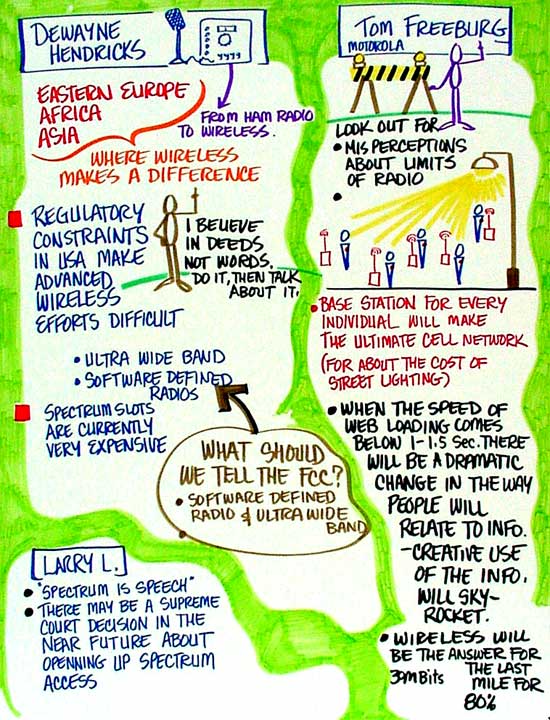
Dewayne: I want to talk about what I've been doing with broad band wireless. I've been a ham radio operator since I was 12. I've been involved in Packard radio systems. I've been doing wireless in Africa, Eastern Europe, Asia, Pacific and US. Places where wireless really makes a difference, where there aren't alternatives. I've been involved in a lot of issues getting unlicensed spectrum. I was part of a group that was lead by Apple that got the universal national information infrastructure into 5 gigahertz. In 1996, I wasn't satisfied with the outcome, I wanted more spectrum. All told the licensed spectrum is about 230 odd megahertz. My advisor told me that if you really want to do what you want to do you won't be able to do it here because of the barriers that the incumbents put out. Go elsewhere where there aren't constraints and make it work and come back with the argument of what can work outside of the regulatory environment.
I wanted to build a test bed to show what you can do with both licensed and unlicensed technology. I got a mountaintop site. I set up a system where I delivered from ISDN speeds to 30 MHz. I don't charge for the service, I'm the Internet service provider. I have people from Sun who are users of that network. I run it unlicensed. You can cover a metropolitan area of like 30 miles using off the shelf stuff. On the licensed stuff I was able to take an MMDS cable system and put some secret stuff on it and do the same thing but at much higher speeds.
It shows what you can do if you have access to do use the spectrum they way you want to. I got Cisco and Sun to come in on this where no one owns it but everyone shares the benefits from it. I believe in deeds not words, i.e. showing what you can do and going from there.
Regulations are a big barrier. The FCC is working on this model where they treat spectrum as property. Bob Lucky and I are part of the group called the technological advisory council. There are 25 of us who are asked to help with technical question. They gave us several questions to deal with talking a look at ultra wide band technology, software defined radios, and noise. You've heard a lot about software defined radios, there are rule make proceedings going on about this. We have been told that we have a spectrum drought and this is very serious. The commission felt it really had to change the spectrum model. They hope the technologies will overlay the existing services. If you look at the incumbents, that's where everyone wants to be. The only way we will be able to use that is to use new technologies that essentially do no harm but still make use of that spectrum. Whatever is going to happen to remains to be seen.
5. Tom Freeburg Speaks
Tom Freeburg: My viewpoint is a lot different than some of the previous speakers because I have spent all of my career inside a major corporation. It definitely tends to color one's thinking. At least it color one's actions a lot. I have experienced a lot of people being fired or quit most of the time for being right.
What I am most afraid of first is people. Yeah, the regulatory environment is one of them. But I have this overriding fear that the misconceptions people have about the limitations of radio are going to prevent us from reaching the future we really can build. A lot of people think that spectrum is limited, that we are running out spectrum, that radio is limited to very slow speeds. There is a huge community of people who don't know enough about using the Internet at all trying to push that. I'm sure there's some good there but I don't know where it is.
I think it is really important to focus on developing modulation methods and a few very simple rules to be applied in the regulatory environment that will enable us to build systems that are very robust against interference. Think for a minute, what is the ultimate system: one base station for each active user. We can get there. We have had the technology available to build a radio network that will provide 10 megabits a day to the pocket of everyone for really a moderate cost. The cost has gone down some. The cost is about equivalent we pay for street lighting. If you are willing spend the same amount on a data network as we currently spend lighting the roads and streets, we've been able to provide a very high speed wireless portable network. The people who make funding decisions place streetlights a lot higher in priority than the data networks.
You can see all of the scars I've gotten from Motorola but never from our customers.
6. Questions & Answers
David Isenberg: Do people have questions for these folks?
Matt: I have a question for Tom. Motorola bought General Instruments, General Instruments makes set top box for the cable industry, cable industry is trying to promote a set top box to be all things to all people, everything we ever wanted from the web will come from this set top box, they will own it, how do you think that bodes for Internet as a whole?
Tom: I manage the group that built Motorola's first cable data modem. I believe in data coming over the same cable as your TV set. However, I don't think anyone sees the day when we all have coax cable for a pocket. There's a lot of cases where you don't want to run cable. I think I said yesterday that fiber is more effective than wireless for broad band delivery and always will be where you already have fiber.
Question: Do we end up with a wireless world wide web, or does the wireless networking beget a new web that is not HTML based and not browser based?
Tom: WAPis an application on a cell phone to give you access in a very limited form to a very limited set of data on the Internet. The current applications that will be apt to have the most success, do things that are much more limited than you would ever do from a high speed terminal so it is different.
By the way, I was a chief architect on a system that Motorola built for IBM for the service engineers. One of the things we tried to put on that was something that looked like what the world wide web does today. The service folks loved it. It's translation into their every day lives was pretty limited. The speed of the browser really makes a big difference. I do believe that high speed Internet will make a dramatic change in our society. When you can get a web page inside of one and a half second human patience limit, people begin to engage in a creative thought in a dramatically different way vs. relying on our memory. The web today, with the high speeds, is changing the way people think which will have ramifications for the development of society that are so far beyond anything we have seen or are able to conceive.
Question from participant (inaudible)
We have the possibility of that outside of the US. I've been involved in the FCC standard almost 8 years. I was one of the founding chairmen of the committee that was the ancestor of the committee that was pushing that. Both the FCC standard and the I-Tripoly standard are fatally flawed in exactly the direction you are talking about except that the regulation in the US was put together in such as way that there's an overriding consideration of spectrum hygiene that if properly adhered to, if we really retain our strength to stay with it, I think we'll prevent that kind of thing from happening.
Dewayne - The TAC is looking at this right now.
Bob - I was going to ask you since we are both on the TAC . The question is what should we tell the FCC? Fold their tents and go away? What should they do? They are really frustrated.
Dewayne: In the case of unlicensed bands, like with 2-4, no one anticipated the future. When the commission brought these rules out in '85, it was the result of an effort that was started in '81 to try to change the spectrum management. It was more successful than they ever imagined. Now we have the buildings and devices out there but the problem is we have a lot of incompatibles systems sharing the same spectrum. When you put it all together, that's what you see, it can't work. The thing is now, auction or licensed spectrum is so high that everyone is running to unlicensed because it is free.
Christian: Should the FCC mandate IG in a stronger way?
Comment: There's an opportunity for an industry forum to try first.
Christian: There is one such forum going on.
Comment: There are some possibilities to try to avoid it.
7. Spectrum Issues
Tom: The problem is though, that the industry forum that exists tends to drive toward maybe simple answers and always fall back to the spectrum game. I think we need a focus on modulation techniques that are fundamentally more robust against interference, whereas spread spectrum takes power and squishes it into bandwidth and does nothing about the net tradeoff if I interfere with you.
Question: What kind of application are you envisioning? Is this fixed wireless, mobile?
Tom: I think it’s everything. From my view wireless is the only answer for the last mile for about 70-80% of the people.
Question: What do you see as the upper limit for how much bandwidth you can provision to a single user?
Tom: I know how to do 30 megabits today and I'm pretty sure we know how to double that every couple of years conservatively for the foreseeable future. I don't know that there is an upper limit. Do you agree with that Bob?
Bob: Yeah
Tom: Mobile, fixed, portable - they are all the same if you do it the right way.
Tim: Is there other spectrum along that beach front range that you mentioned that can be auctioned off.
Dewayne: The Commission has some proposals on the table now which the best people minds there think are the way to start on the road to solving this problem (refarming the beach front property). It's not going to be easy. We've gone through the initial part of that rule making cycle on both of those topics. But we are at least 3 years away from new rules to do something.
Tim Horan: Were they operating in the cellular range or the pcs?
Dewayne: Everything. 30 megahertz to 3 gigahertz.
Tim Horan: Wouldn't the people who paid a lot for those licenses be quite upset?
Bob: You bet. That's the problem, they own the stuff, keep out of what we own. And yet the technology would permit an overlay that might be invisible to them. The people who make the ultrawide band radios give a powerful argument. They say look, when you hook our modem up to your computer, the computer puts our more radiation than our thing does. You're never going to see us. What's wrong with this?
Tim Horan: Is there any other spectrum they could auction off in that range?
Comment: According to the chairman, we are out.
Mike: Aside from this being unpopular from the budget surplus standpoint, since most of these expensive spectrum slots are largely unused, maybe the answer is give the money back and make all of the spectrum open and just say that it's basically unlicensed and whatever has to run in here has to be robust against whatever else shows up in it.
Larry: This is a question re: the regulatory strategy. When you are talking about the overlay strategy, or the strategy to overlay on the beachfront, is that because this is the right way to do it or do you assume there is no way to undo the owners of the beach front. From a constitutional standpoint, the underappreciated fact here is that the whole framework, established by Congress, with the radio act, is increasing vulnerable that it isn't necessary to be a regulator in the mode they are a regulator. To the extent we continue making advances in getting the courts to see that spectrum is speech and there's a speech issue here, it becomes easier for you not to imagine convincing a Chairman of the FCC who needs to go work for one of these industry people after he's finished [laughter] they might just say to hell, this is regulation of speech and not justified. Which is it?
Dewayne: Both.
2:44 p.m.
8. Regulatory Issues & Educational Problems
Adina: Perhaps the courts are the way. You look at a regulatory environment and a legal environment and people say that's the way it is. One of the reasons why this is sticky is that the government is bought and sold and there's a lot of money working against democracy. So, if the way it is bad and they are entrenched with money to keep it that way, what can be done? Is this campaign finance reform?
David Reed: I've been thinking about this for a long time. We have another level of problem which is not just the regulatory problem which is sadly sort of an education problem, which is the scheme by which we have managed wireless is in fact imbedded in our engineering curriculum in a sad way as if the spectrum is the only way to manage things. It is very odd to explain to people what ultra wideband is. I think it's possible for the regulators to go to thoroughly competent engineers, who really know their stuff and have done wonderful things, and get an answer that it's impossible to do what Dwayne and others are making happen. I'm afraid we will have to wait until those people die off.
Comment: I understand what Adena said. But look at who we have in the room. These are not powerless companies. If the government can be bought and sold, then do some buying and selling. This could be a nice clean election issue for whatever guy wants to run with it. It's like running against the pharmaceutical companies. It can be done. All it requires is some corporate money behind it. Look at what is happening to Japan.
Ernie: With the exception of 1 or 2 people here, I think I speak more knowledgeably about how you manipulate the government because I did that as my career for about 15 years. In the short run, the government can be bought and sold, not in the crass way you are saying, but in terms of getting the right experts, and getting the right story, and if you give me the money and the right amount of time, I can get the government to do what I want it to do in the short term, not in the long term. But the long run is 20 years and we're all dead then. And so I think if the government can be bought and sold, then we need to be creatively buying and selling the government to make this work.
Raj: Isn't there something going on with the low end of the UHF frequency? A bunch of people bought it up?
Comment: Yes. 540 million
Raj: That seems unfair that they can trade that frequency privately but the government can't say you can sell it back to me first.
Comment: I'm unclear if there's really a spectrum drought or is it that the people who have the spectrum aren't using it efficiently? What is the load factor? And how loaded up is the spectrum?
Bob: I think the reality is that if you get a receiver and sit out in the parking lot and tune across the entire band you find almost nothing out there except these little tight cell phone bands that are really busy but people own that stuff in between like the FAA owns that. People have ownership and it is very inefficiently being used.
Comment: Why couldn't we have a system that takes that bandwidth and assigns it real time?
Bob: Ultrabandwidth might do that.
Dewayne: What the Commission proposes is secondary markets
Comment: Why couldn't industry go to the military and rent some spectrum from them?
Comment: Lots of luck.
Comment: It's easier to buy the military.
Roxanne: As a current owner of spectrum, I could maybe highlight some issues. How many people here know the name of Nexband? Nexband quickly went bankrupt. They are sitting on a big piece of spectrum. The government cannot auction it because it is tied up in the bankruptcy court. They are holding up our spectrum so they can get a payoff. They sat on it and did nothing with it in 4 years. They overbid, couldn't make the payments, and are in bankruptcy.
Comment: I was with MCI and we promised a contract we never gave them.
Comment: The FCC wouldn't give it back to them.
Roxane: The bottom line is it is tied up.
9. What is the
Network we Really Want?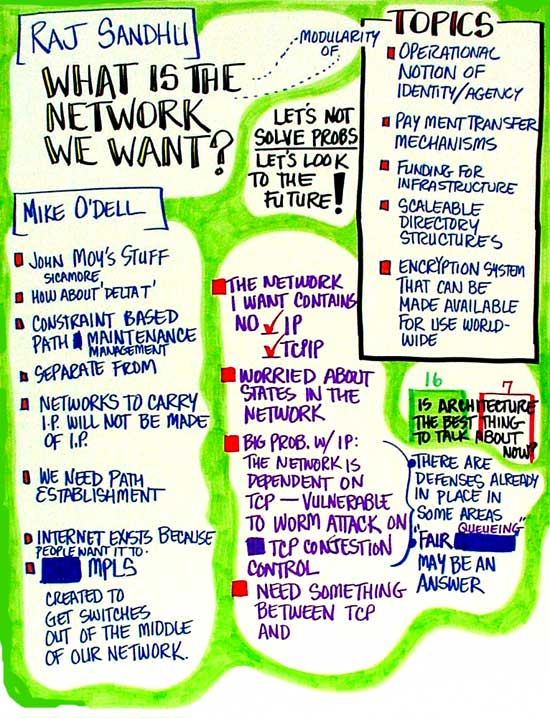
David Isenberg: This is great. There's a lot less tension in the room. We are all relaxed and talking about issues we all know a lot about.
Comment: Let's go back to privacy. [laughter]
David Isenberg: The issue that I organized this thing around is: What is the network we really want? We can talk about the network we have. Raj's argument was that if we talk to some of these experts maybe it will help us get closer to the network that we really want.
Comment: David, the talks we heard were not about networks we have, mostly. They were about things in progress.
David Isenberg: Perhaps I slightly misspoke. What these talks were about were networks that were extrapolations of current thinking. They are based on technology that people believe are doable. They are not based on people sitting back as saying, if I could really design this network the way I'd like to be…." So, Raj is it getting closer to the issue?
10. Raj Sandhu Speaks
David: Raj, take 5 minutes.
Raj: Wow, this is pressure. I guess, this is not a criticism but there 's a whole lot of technologists in the room and I was fascinated with the topics of social science. I don't think it's a bad idea to talk about these things. But I think since we have these experts here, we should tap the expertise in the room re: technology. I invest in one carrier and communications companies. It would be interesting to know what thoughts would change based on this awareness on Monday. We haven't heard the fiber guys yet, and Mike, and the Internet. It's early to ask the question yet what we will get out of this.
Raj: This certainly opened up my eyes as to what is possible. If you could just have a miniscale connection wherever you are in whatever medium you want, that's the ideal network. If we could talk more about this and it helps us solve the problems then I think that would be great.
Tim: So you'd like us to keep tapping the experts.
David Reed: I'd like to express a concern because I have a different type of expertise in terms of software protocol structure expertise and we have a bunch of us in the room also. I think there's a middle ground between the policy (how we would like it to behave like) and what we will build it out, there's sort of a middle ground that we haven't touched on. The operational notion of identity and agency. What is the thing that says who you are or which device it is or who is paying. There's the payment transfer mechanisms at so who pays what to whom and when that creates incentives to build more.
Mike feels there isn't enough of the revenue in the big application space being directed down to the infrastructure to mean that there will be enough funding for the infrastructure to keep up with the growth. The R&D and the capital funding will probably run out. There's a bunch of structural things that need to be in place to get to the network we want. I don't want to talk about business models because that ends up about into discussions of advertising. What is the modularity of the network we want to design, the pieces?
Adina: If the question is what are some of the things that are built into the infrastructure that enable it to do some things like rapid openness, if most will access the Internet through some non-PC devices, is there going to be cable walled gardens and phone walled gardens. And then the revolution we talked about yesterday where you change the economics of publishing, one of the fundamental changes is the Internet changes the economics of information sharing, we go back to the walled garden model, we lose that. That's one kind of choice built into the infrastructure that changes the whole thing. And the second one you mentioned are the identity, security, and privacy that is built into the underpinnings that changes the structure of anonymity. What is getting built in and what isn't and what choices do we have?
Mike: There are some deep protocol implications.
David Reed: As one of the authors of the end-to-end argument, I am not a big fan of building anything in terms of freezing it, but I am a big fan of inventing things to try. I do think that we need to build some fairly simple things into the network soon like cryptographic key infrastructure to make one available for applications.
11. Government or Free Market Activity to Get the Right Balance?
Christian: Wait a minute. When you say you want to build something like that, you have essentially two ways of doing that either through government or you can have it as a result of some free market activity.
David Reed: I actually disagree but it would take some detailed discussion to resolve our differences. The heavy hand of regulators on corporate adoptions of infrastructure, the threat of serious intervention if a company buys it is held up. I'm willing to bet that there is a financial way to build it.
Christian: Passport is an example.
David Reed: I think some of those are interesting experiments.
Question: What's that?
David Reed: I don’t' know.
David Reed: I personally don’t think that assigning code. It is an odd service that doesn't bring value to anyone.
I'll pull a metaphorical example out of a recent event that you could make the same argument you made about cashing not having a supportable business model until Okimi found a way to charge the content sources for cashing of their content. Once that business model was created there was a massive self-sustaining support for this. A lot of people are paying for it and whether it will ever recover it's investment…The real investment was pretty cheap. It isn't cashing it's funding. I'm interested in what other people's thoughts of what modules fit in this middle space of things that would enable a useful network of the future. One other category is scaleable directory structures. What I mean is something that doesn't run into limits of DNS to catalog a zillion of items in storage throughout the world that aren't on a collection of commerce servers. I think that's a sub problem of a lot of things.
Dan: I'd like to build on that. One doesn't run into this tar pit we're in right now with DNS with trademarks and other intellectual property and these incessant battles over the names of things.
Tim Horan: How does a standard like MPLS fit into what you guys are talking about? Can that be implement and is that scaleable?
Mike: MPLS is essentially implementation slight of hand.
Comment: It is a local gravity well.
Mike: It is not very good but useable layer 2 technology.
Christian: It is more useable than ATM.
Mike: They reinvent frame relay without getting it right. [lots of laughter]
Roxane: What should we be doing?
Mike: They are all unique up to isomorphism. It doesn't matter.
Mike: It’s a layer or two of encapsulation and it will never be secret sauce.
Christian: What's interesting in this topic is the fact it attracted a lot of the old telco mentality. We saw that as a way to grasp to a last straw.
Dan: I would argue just the opposite. It fixes a lot of things that are broken about IP.
Mike: It is a layer 2 technology and has nothing to do with IP. It was created because of me personally. It was my network architecture that provoked Cisco. The real reason is how do we get those blasted switches out of the middle of your network?
We explained why we did this. We won't ever get them out until we make the hardware do something different because they use if for things our products can't do.
Comment: Maybe this shows a potential pressure point for our discussion. It sounds like this is something you needed to create the network you wanted so what would be the next iteration?
David Isenberg: It didn't do everything you wanted.
Mike: It doesn't do what we wanted because the signaling is not as useful as it could be. We could have stolen better ideas. Don’t waste time having good ideas when you could steel better ones.
12. What is the traffic engineering protocol that you really want?
David Isenberg: What is the traffic engineering protocol that you really want? What would it look like?
Mike: Basically John Moy's stuff that he did on the cascaded frame switches.
David Isenberg: Okay, I'm lost. How many people know John Moy's stuff?
Mike: The whole point is, once you understand the constraint based path creation and maintenance is what is all about and that it is completely separable from the payload container, it turns out that frame relay, IP carryover frame, and routing TDM OC48's are all isomorphic from a signaling and path management point of view.
The point is that the constraint based path management machinery for traffic engineering is invariant of the payload you are managing.
People don't understand the difference between failing to fail and working. It's a very subtle difference but it is very important. What people don't get it that networks designed to carry IP efficiently are probably not built using IP. That's like the argument: to carry truck loads of straw then bridges should be made of straw.
There's a long list of things to worry about in building really big networks but that's basically what I do. I worry about what we need 4 years from now.
Dan: The network I want definitely does not contain IP or TCP. I voice some heresy. I'm probably going to get burned at the stake.
Comments: Tell us why.
Dan: IP is at the extreme of a spectrum of technologies (x25 is the other end) as far as the amount of state that is contained and the balance of processing between things you do initially to set up a communication and the things you do for each packet in the communication. The real answer has to be a chunk of space in the middle where there's a flexible tradeoff in situations where you want to do a lot of stuff up front in a intensive processing fashion and situations where communication is so short-lived those up front things are going to cost too much in processing and you want something that is more IP like. The big problem with IP is the IP network is entirely depending on TCP dynamics for its stability. We know that there is a risk. Someone can crash the Internet permanently and unrecoverably by a worm that could drive the network to collapse. I don't remember the number of the RFC. It's TCP congestion control.
Comment: There's a new RFC that talks about it.
Comment: We haven't had a solution to the problem that the Internet has to be a cooperative commons on the TCP side. It’s a miracle that it keeps running.
Mike: It goes much deeper than that. There is no department of the Internet in the government. The Internet exists because a bunch of people wanted it to. People agree to cooperate. I think the interesting thing about the Internet is it's the largest collaborative effort in the history of the world.
Dan: When the Internet was a research effort and problems could be addressed, that was great but the minute we admitted the great unwatched, the small number of bad actors...
Christian: That's not true. That's there's no defense besides TCP, is not actually true. Many of them are already there. There's a whole bunch that are there. Ex: ingress pipe.
You look at who is using the network by looking at the addresses.
David Reed: Can I just raise this? I like to have this debate. I think there's a different thing which is that there's a fantasy that this is the issue when any American can bring down the GPS system by using a radio and antennae and overloading the GPS. They are probably quite vulnerable.
3:20 p.m.
Mike: There are a number of tools but are they devoid of problems? No. Sometimes, it would be useful for the network to know a little more than nothing about what's going on. But there's a slippery slope there. There may well be applications where path establishment makes perfect sense and it would be nice if there were a good way to do that. I haven't been able to figure that out. There are applications that could use path setup and would make life easier for those applications. The interesting question is once you do it would those applications like it enough to pay whatever it would cost.
13. Resetting the Direction – from problem solving to envisioning the future
David Isenberg: It's time to break but I'd like to say something. Here we're solving problems and I wanted to create opportunities. Peter Drucker said the biggest mistake you can make is solving problems. You should be creating opportunities. You don't make any money or change the world by solving problems. You change the world by creating opportunities. The opportunity I'd like to create here is to envision the network we really want to have. I don’t' want to solve a problem of path queueing. You can do that over coffee on the lawn. I don’t' have any problem with the discussion but it's not why I rented this house.
We do need some kind of path establishment, I agree.
Comment: He did state what he wanted in the Internet. He doesn't want the TCP.
David Isenberg: What do you have for a substitute?
Dan: Somewhere between ATM and IP.
David Isenberg: Let's work on that.
About the time TCP was born there was another protocol born called Delta T developed by Dick Watson of Livermore. It has a different, radical view of the world in terms of the way it used the universe. Consequently the protocol works very differently. There was a vicious shoot out in the literature and basically Dick disappeared. The difference with Delta T is it admits rate based mechanisms in a way TCP has a lot of trouble doing. Those kinds of control mechanisms are probably more useful to a lot more applications. That should be pursued aggressively. That might change the world a lot.
Question: What do you mean rate based?
Christian: TCP takes an accounting view of how many packets in transit. You could instead count the number of bits.
Mike: TCP actually does both of those. For a TCP to work, you have to do a rate estimator but it is lame estimator because the information it has available isn't very good. Delta T has other information available which is needed. It also has interesting properties in that there's no open and there's no close.
Bob: We are going to bring this session to a close now. We are going to take a poll.
David Isenberg: How many people think this conversation is over my head and useless and or I can't relate to this thing at all. If you think that, put up a red card.
Jerry: Make it less extreme, i.e. is this the thing we should be talking about now?
David: Okay, is this the thing we should be talking about now? The last half hour - architecture. Put up a green card.
(Results: 16 greens & 7 reds)
I think we might look at break out sessions. Should we do a breakout session: No is red. Green is yes.
The breakout groups would cover: social vs. technical aspects.
(Results: 15 reds. 10 greens.)
How many people would attend this technology session?
Bob: How many people would not attend the technology session if there was another session on the social aspects?
Comment: I'd like to propose something different. I think we need someone who can interpret between the technical and the social. I think what we are missing is a discussion about what the technical mean. WE can skate between the two.
Comment: Yes, that makes the technology discussion more worthwhile.
Comment: We need an interpreter.
4:00 PM
14. Reconvene and Process Check
Bob: Let's get started. We will probably go to around 5:15 p.m. We will try to continue with the same technology theme for this final session this afternoon. We will kick this off with 4-5 people .
David Weinberger: Point of order. I know you want to continue with the whole group, if there are some of those of who want to address the social issues in a breakout I'd be interested in going into another room and reporting out.
Adena: Can there be a reverse report out?
Bob: It might be a good idea to stick around for the 4 speakers to hear what they have to say before you break.
15. Mike O’Dell Speaks
 Mike:
I'm going to talk about the war daddy thing. Stuff related to the technology
but not about packets and protocol. Where we see the network we are trying
to build for the next 4 years.
Mike:
I'm going to talk about the war daddy thing. Stuff related to the technology
but not about packets and protocol. Where we see the network we are trying
to build for the next 4 years.
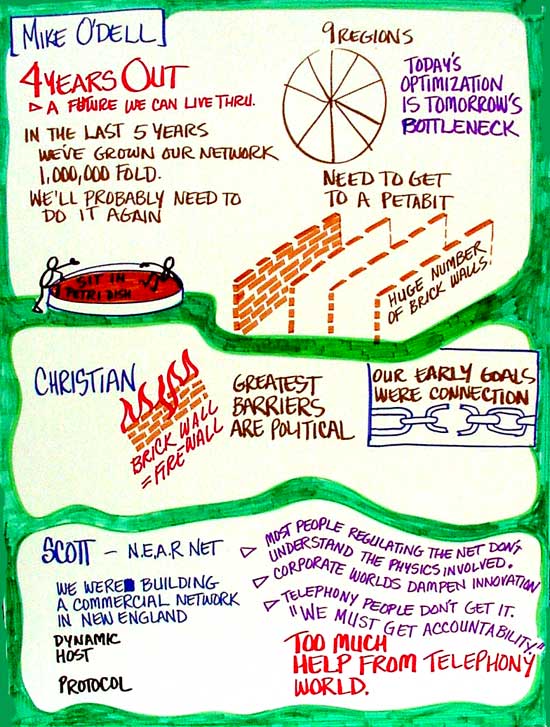
My job is basically trying to make sure the future is one we can live through. My job is if the sales people are successful how do we live through it. It's okay if we need 6 instead of 4 but not 3 instead of 4. Look at what has happened in the last 5 years, we have grown the capacity of the network. One mile of 600 megabit circuit. That number has grown 10x per year, nearly a million fold.
The question is what it is going to do next. I try to duck those hard questions. Am I willing to bet my company that we don't need to do that again? I'm not willing to make that bet. The only reason it would stop growing is people will stop inventing new things. The North American region is trunked to several others. It looks like the inter-retention will convert to 50/50.
The Internet was the first telecommuting tool. People want to know about the weather where they are not elsewhere. There would be 10 trunks. After that we need 100. We are making bets on optics and doing a lot of math and it turns out very big.
The thing that is scariest is that there are a huge numbers of walls. The faster you go, the farther your body parts go. If you aren't scared then you don't understand. We are enabling opportunity not about responding to demand. Historically the telephone networks have responded to demand, not about creating opportunity. The barrier to experimentation has gone to zero.
We operate in a petri dish. Our job is to build a giant petri dish and people pay us to sit in the petri dish to see what happens. I don’t care who wins or loses. Our job is to create an environment where nature can sort that out. My job is to make it possible for us to operate in a mode where we are on a biological footing and not on a centralized planning footing.
16. Christian Huitema Speaks
Christian: I tried to follow the format that was requested. I remember a quote where we were sitting in a panel re: antitrust and we came to testify as to what had been done in the FCC. You have to understand something, economics trumps technology and politics trumps economics.
When we set up the Internet in the 80's what we were doing at the time was barely legal. We have kept bumping for 10 years against basically the… They were trying to enforce a monopoly. The French did not dare to price the international more than the national ones. We kept pounding on many battles like that. The wireless battle is still being fought. The other one was encryption. We used grass roots tactics. Each time you spoke in public we repeated that again and again. What was it we were trying to do? We were trying to get connectivity. What we wanted was a open. We have hit the firewall. It's just like that. Precisely to destroy the open ends of the network. The alleged reason of the enterprise, this is my private property. I want to know what is going on. Its' not about protecting the private property but who gets to deploy what.
17. Scott Bradner Speaks
Scott: Not easy dances to follow. I was one of the cofounders of Nearnet. That was a commercial network run by Harvard MIT and MBU. We had a lot of fun with that by employing BBM, an interesting group to manage. We got sort of what we wanted. We were building connectivity and the ability to innovate. We certainly got that. The Internet started out as a commercial endeavor. No restrictions there. AUP - appropriate use policy.
I was one of the operational requirements area directors in the IETF during the Cider discussions. These were one of the more vigorous discussions over how to compose the addressing structure of the Internet. Did the people who were telling use what to do knew what they were trying to control. They don't understand the physics under it. They don't understand what was mandated by the ability to move data around the network.
I see the Internet being able to work around walls. The net was created because it didn't have to have permission. In companies you need permission to do anything on the net. What I'm seeing and a I'm seeing a lot of it is too much help. Some of that in the last session. There's a community that is very interested in the net, the telephone world. The folks that come from the traditional telephony world. They cannot understand that the Internet works. It has no quality of service. It has no accountability. A chief scientist of a branch of a large equipment vendor said we have to deploy ubiquitous NPLS so we can get accountability for individuals. Justice ministers wanted to be able to track individuals using the net.
The way they try to fix the net. They try to fix it with their circuit rich environment. Circuits at the infrastructure, not at the application level. They see this as the secret sauce that will make the Internet work since it obviously doesn't today.
18. David Reed Speaks
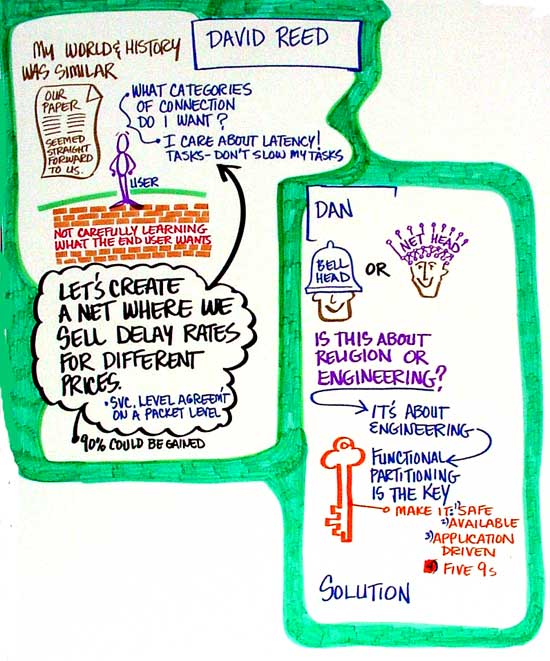
David Reed: Christian covered a lot of what I did trying to create connectivity and set the ground rules. We had to be extremely limited in what we built into the network. We wrote the paper 3 or 4 years after we realized what we were doing was radical. It actually seemed straightforward. Some things that are going on now that maybe fix what we did wrong. The Internet works great but there's some unfinished business that we tried to deal with in the beginning which is what the end user really wants. In a categorical way vs. an application way. They tend to aim at last year's problem. We spend a lot of time debating this in code words. What does the end user really want in terms of categories: diversity of connectivity without limits as an attribute. But the typical engineer wants to know if you can survive with 5? If we had done that we wouldn't have had the WWW.
What I see is that kind of thinking has kind of evaporated. The scary thing in the future the target that is pursued is voice-over IP or interactive TV. More generic things like the hazy definitions of having a personal identity that can be held accountable or having a billing system that doesn't require a person in the loop. So you can trust that it is reliable down to an operational level of the network. I want to summarize this with one thing: I think end users care about delay. The delay they care about is a task related delay from when I asked for something and when I get something. They aren't actually concerned about network delay. The ability to modulate network delay when you need to is something that needs to be built into the network.
If there's a new mechanism that has just he minimum amount of stuff to manage the delay through the network.
The major problem with the network is it is filled with memory and when that builds up, delay accumulates. There's no incentive to minimize that in the protocols. Increasing delay slightly increases utilization. At the very largest level is to create an incentive for networks to sell better delay for a better price. There's no fine grain method that's present in the network.
David Isenberg: Isn't this like QOS?
David Reed: No. If you go to QOS, it is defined as a long list of kinds of service, not a statement about delay. I will deliver all of your packets in a 125 milliseconds. That's a service level statement.
19. Dan Grossman Speaks
 Dan:
Got my wounds split up the middle. My bellhead friends accuse me of being
a nethead. My nethead friends accuse me of being a bellhead. The bellheads
bring an awful lot to the party. They have succeeded in building a network
that has been stable, reliable, has met some basic needs people have had.
It has always seemed to scale. Even before I was born, it was still scaling.
Dan:
Got my wounds split up the middle. My bellhead friends accuse me of being
a nethead. My nethead friends accuse me of being a bellhead. The bellheads
bring an awful lot to the party. They have succeeded in building a network
that has been stable, reliable, has met some basic needs people have had.
It has always seemed to scale. Even before I was born, it was still scaling.
The problem in my mind is that we have too much religion. It is very easy to say the bellheads are dinosaurs, the netheads have all the answers, that IP is the solution to the world's problems and that it's perfect and immutable, we can't possibly want something better than TP. It's not about engineering it's about religion. We will need to develop at the engineering level without bringing in the theology in. The problem I see underlying the issue I've raised about IP is that functional partitioning between IP and TCP was not exactly the right functional partitioning for a network that was going to be open to the masses. We need to think very carefully about how to use functional partitioning to achieve things. We need security against bad actors and trustable by the users. We need to partition it so it is available. That implies some things about functional partitioning as well. It needs to be application driven as well. We have been trying to add to IP. This gets back to the functional partitioning issues. We'll have to rip out IP and start again with someone else.
20. Jerry Michalski Speaks
Jerry: Dynamic load
balancing media server but let's call lit frogger. How I come to want
it. On live, a company that had avatar online chat. As you spoke the head
had some lip sync technology. What they invented underneath was a technology
that uses added compression and an ordinary server to do what you normally
need: a conference bridge. They built it very sweetly. I began to think
what if you had a little bit of server code that treated a multiparty
audio conference as the default. Forget about point to point which is
a special case. What if that were the default - start there. If I call
David and he's down the hall my laptop hosts the conversation. Then if
we conference in a colleague somewhere else, this thing dynamically hunts
for a better server to live on that averages out the latencies between
our conversations hops over there, reinstates the conversation, and then
continues to monitor traffic, where there's more space, better space.
All these servers are hopping around as needed. I call it frogger because
you are trying to find dry land. Napster is the heart of this peer-to-peer
environment. It implies what we all should do is hoarding music. Napster
doesn't do much for people who want to tell stories about music. 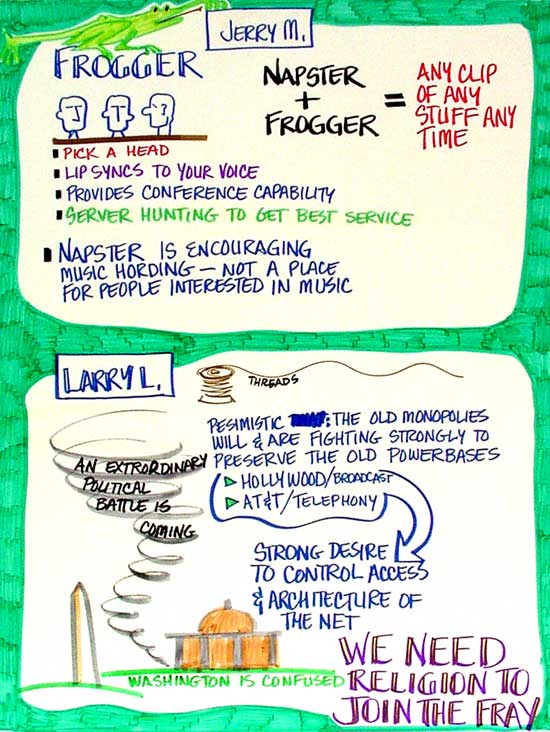
Jerry: What is the implication to the phone system and media streaming of having moveable servers that hunt for their own spot in the network?
Comment: There are a number of solutions that work on this basis in the game industry. The fundamental problem is someone has to provide them and operate them.
Jerry: Some carriers might be interested in providing more stable platforms for a small fee.
Comment: Yes it is doable.
Comment: The issue is can I buy, sell and trade servers?
Comment: You might want to check out Yadda Yadda which just got a patent covering this whole area.
If you look at the cost of a server it is about 20% storage but it will be 80% storage. The bottleneck is the controller.
4:41 p.m.
21. Larry Lessig Speaks
Larry: There's this thread that began with Mike and ended with David which was saying some of the most important things the Internet has taught us regarding architecture enabling innovation. I wanted to sell my 3 min. card because Dan said it's not about religion its about engineering. It's not that there isn't an interesting engineer discussion but because you are missing an important political battle that is being organized around this issue. I have been in the process of arguing about in the context of the many regulatory context where this issue of end to end is getting adjudicated. How a broadband network gets deployed. The network we have right now doesn't enable which applications get deployed and which don't. I think this is a political battle that needs to be fought in the future.
Larry: This debate in Washington is confused because I don’t think we've been clear about the values that come out of a particular technology that really give us leverage against very powerful old monopolies that will do their darndest to guarantee that this new innovation will not be allowed. This is the battle Hollywood is fighting re: distribution. I'm extraordinarily pessimistic. We will lose this battle. They have been very smart in this battle. I don't think you can't underplay the political implications of this battle. The powerful has something much greater at stake than just this.
Dan: I think we are agreeing violently. When I said we didn't need so much religion, I had some specific things in mind about particular technologies. I believe the technology is plastic, it can be responsive, must be responsive.
The suggestion was not that we mustn’t have views but that we mustn’t let strong emotional beliefs dictate the structure of what we want to accomplish.
4:47
Tim Horan: What is the political battle we are talking about here.
Comments: There are people in Washington and Hollywood that want to close the network.
22. Tim Denton Speaks
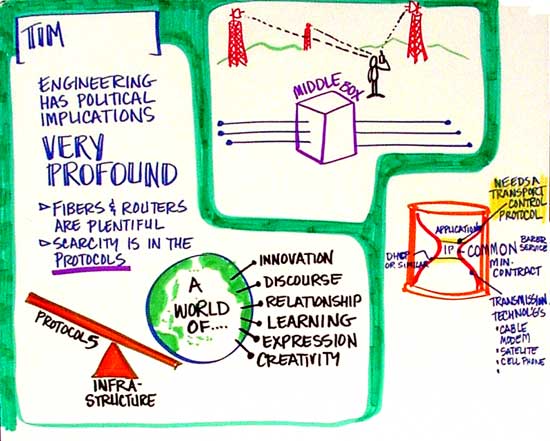 Tim
Denton: I'm a lawyer. I started to learn about Protocols. It is my belief
that we need strong doses of political religion in this issue because
what is at stake is who gets to create wealth and who gets to monopolize
wealth. Politicians need to understand the profound impact of this on
the evolution of wealth. I see these pyramids of sterility called broadcasting
and communications of the past and I see this vast explosion of wealth.
Hollywood they don't understand how vitally important this is for wealth
creation coming from the computer industry. When it comes to explaining
this to the politicians, it is vitally important that they understand
the implications of engineers. The Internet was designed to accomplish
discourse, equality, innovation. This is a good thing and needs to prosper
and grow. This is my message to the politicians and to you. Therefore
this engineering has implications of a profound kind. We need to talk
about it.
Tim
Denton: I'm a lawyer. I started to learn about Protocols. It is my belief
that we need strong doses of political religion in this issue because
what is at stake is who gets to create wealth and who gets to monopolize
wealth. Politicians need to understand the profound impact of this on
the evolution of wealth. I see these pyramids of sterility called broadcasting
and communications of the past and I see this vast explosion of wealth.
Hollywood they don't understand how vitally important this is for wealth
creation coming from the computer industry. When it comes to explaining
this to the politicians, it is vitally important that they understand
the implications of engineers. The Internet was designed to accomplish
discourse, equality, innovation. This is a good thing and needs to prosper
and grow. This is my message to the politicians and to you. Therefore
this engineering has implications of a profound kind. We need to talk
about it.
David Isenberg: I'd like to point out that Tim made a really profound point in his last paper. The point was that technology, fibers and routers are plentiful enough that the new scarcity is at the protocol interfaces.
Tim Denton: The paper was basically saying that protocol is designed by human beings. If you aren't looking at how protocols work, then you aren't looking at what is relevant. You must look at how regulatory advantage derives from the construction of protocols. David saw it better and clearer and deeper than perhaps I did.
23. What about Middle Boxes?
Comment: Protocol could have been designed so you couldn't call around to carriers. We specifically designed so that wouldn't happen.
Roxane: I have a question on this whole thing. We have this lowest common denominator but we keep trying to fancy it up. Is it important to think about to make it nicer you are then making it less open or more expensive to operate.
Comment: The Internet is the common factor that meets the most need. If it is not common it diffuses the whole effort.
Roxane: There is a concern there then.
Mike: One man's ceiling is another man's ceiling collapse.
David Reed: A lot of people who have a sense that the way to make money is to sell boxes. There are middle boxes is to do interesting things. I have this great middle box because you have your servers on your premise and you should buy it. The problem is that box stands in the middle of everything and the secret business plan is the software needs to be revised every time you bring in a new application.
Mike: The list of unnatural acts is very long. [laughter]
David Reed: You can't argue against these things because they do work for what they were designed for but you need to look at what will happen in the future.
Mike: They don't work. They just fail to fail in an interesting number of cases so people are confused. Failing to fail means it doesn't work from first principles, it just works accidentally. It works well enough for you to believe it is working.
Comment: Natbox is a simple example. It turns out to be hard to run Internet telephone. But if you want to bypass your telephone company, you cannot do that. The Natbox blocks you from doing that.
Comment: There is a very real set of issues that people need to solve on a day-to-day basis. While these boxes are not the best solution, they deal with very specific problems.
Comment: They are absolutely required in some situations but that doesn't mean they don't hurt you later.
Larry: The way to think about it is a kind of environmentalism. These are technologies that impact innovation. They shut down the opportunity for innovation later. This is the debate about end-to-end. It's like the environmentalists who got hunters to see their interests where the same, to see the consequence of compromising this principle. Someone else has to be reflective of the consequences of those technologies.
Comment: Many of them are taking them away for the most benign reasons.
David Reed: Some are not benign. E911 is an FCC mandated functionality to be delivered in 2002 by all providers of cell phones. It keeps track of where you are to connect you to the local emergency services. There's another technology solution where you put GPS in the machine so the cell phone can figure out where the service company is.
David Reed: The phone operating companies take the position as a matter of course that location information is something they own. They have a right to do anything they want to. In particular they have chosen to defray the cost by selling that information without - I actually think position- based commerce is a value creating opportunity but who gets that right?
Tom: I'd like to point out that this conversation has just obtained full convergence. Having everyone remain in the room the technological has taken us back to privacy and we are talking the same language with a little "translation". [laughter]
Comment: I think we might have come to a conclusion. Are we saying keep the IP but the next level up is we more diversity in that layer and we need a network that can route without having to care whether there's a TCP and that we need that all the way down to the end user.
5:08 p.m.
Comments: We have other things than the TCP.
Question: Are we concluding here that IP is in some way inviolate?
Comment: No, it's the transport of the information to the end user.
24. The Hour Glass Model
Christian: How many of you are familiar with the hour glass model?
David Isenberg: Help us out.
Christian: Basically in the middle of the hour glass, you have what shall be common. This neck is as narrow as it can be. The reason it is narrow is it is the minimal contract which is enforced to everyone and that neck is essentially IP. You enable innovation there. The only thing you have to do is to be able to carry IP. You get optical fibers or whatever. You get innovation there in the way you transmit. You get innovation here in the way you do applications, like the web or electronic commerce.
In-between the applications and the IP you need some way of transport. One of the most used is TCP.
Someone's going to come up with another point of view and it will be the bellheads laughing at the netheads.
For some sufficient value of time, that better be true. But at the moment this is the best guess as to how to organize.
IP itself is not so much at risk for two reasons - it is incredibly pretty - it is a standardization on the format of the end points and a way to encode the size of the packet. There must be something suboptimal. You can only replace it by adding complexity to it. The value of the hourglass is you will either add stuff above that level or below it. You have to be common to all the transports.
David Isenberg: This session was a really great example that no one knows as much as all of us. Let's give us all a round.
Quote from someone: TODAY'S OPTIMIZATION IS TOMORROW'S BOTTLENECK.
5:15 Dinner
 |
BigHook Main
BigHook2000 Recap Home | Context | Summary Fri Eve | Sat Morn | Sat Midday | Sat Eve | Sun Morn Photogallery | Scribegallery | Music isen.com, inc. | Sterling Insights Copyright 2000 isen.com, inc. |